

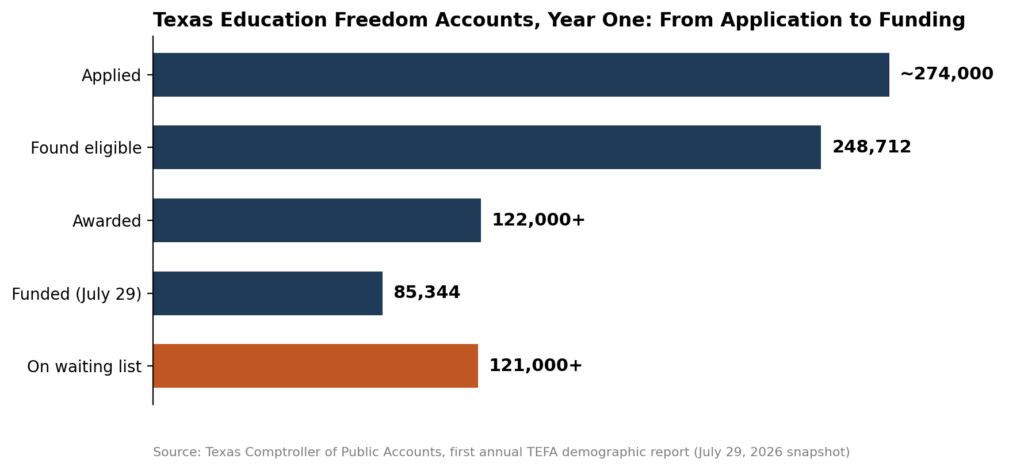
The first annual report on Texas Education Freedom Accounts is full of big numbers — 274,000 applications, 85,344 funded students, a 121,000-name waiting list the comptroller’s office calls the largest in the country. But the phrase that best explains year one appears at the small end of the data, three separate times.
Fewer than 30 students received the full $30,000 disability award that headlined the program’s 2025 sales pitch. Fewer than 30 students from high-income households — those above 500 percent of the federal poverty level, more than 67,000 of whom applied and were eligible — were funded at all, and only because state law required they be awarded together with a lower-income sibling. And in any school district where fewer than 30 resident students received an account, the state is withholding the numbers entirely, leaving hundreds of districts to plan the school year around students they cannot count.
Together, those three edges of the data tell a clearer story than either side’s talking points: the program that launched this month is smaller, more targeted, and more supply-constrained than the one Texans argued about last year. Whether that is a first-year growing pain or the program’s durable shape is now the central question heading into the 2027 session — and the data needed to answer it is only partly public.
What the report settled
The loudest charge against Senate Bill 2 in 2025 was that education savings accounts would subsidize affluent families already paying private tuition. The first-year funding data does not support that — though the reason matters.
Per the comptroller’s report, a July 29 snapshot required by SB 2, 80 percent of funded students live in households at or below 200 percent of the federal poverty level — roughly $66,000 for a family of four — and almost 25 percent have a qualifying disability. Households above 500 percent of poverty, as noted above, were funded only through the sibling rule.
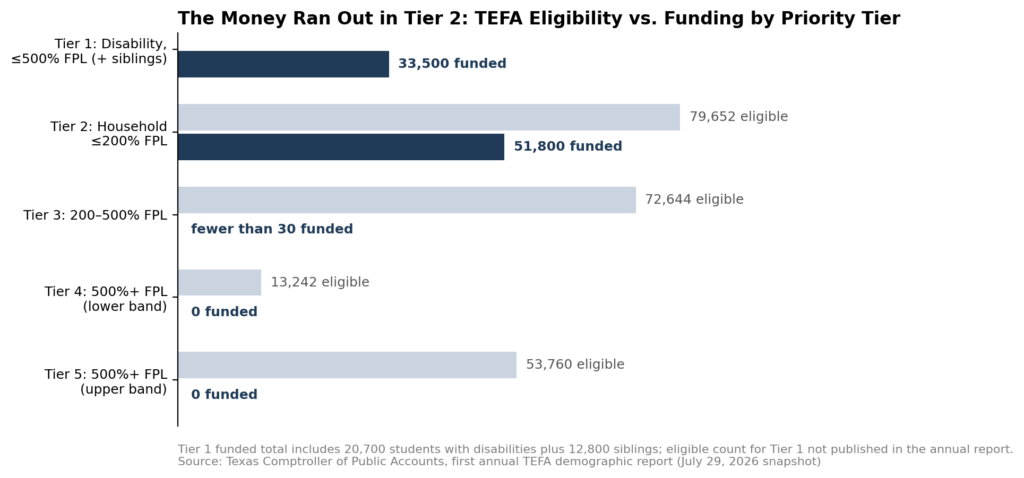
The reason is mechanical. SB 2’s priority tiers put students with disabilities first, low-income households second, and everyone else in line behind them — and the $1 billion appropriation was exhausted inside Tier 2. Tier 1 funded 20,700 students with disabilities plus 12,800 siblings. Tier 2 funded 51,800 of 79,652 eligible low-income applicants. Tier 3, the middle-income tier, funded fewer than 30 of 72,644. The two highest-income tiers, with 67,000 eligible applicants between them, funded none.
That means the “universal” program Texas debated exists so far only on the waiting list. As funded, TEFA in year one is a disability and low-income program — a fact that cuts against the “handout to the wealthy” critique and, at the same time, against any claim that first-year demographics prove what a scaled-up program would look like. If the Legislature funds deeper into the tiers in 2027, the profile of who benefits will shift by design.
What the report complicated
The second promise of 2025 — that accounts would primarily rescue students from public schools that were failing them — looks weaker in the first-year data, on two fronts.
First, the pipeline. Earlier program data reported by the Austin American-Statesman showed that as of June 10, 57 percent of awarded students (excluding pre-K through first grade) had previously been in private school or homeschooling — consistent with application data reported by The Texas Tribune showing students already in private school or homeschool made up the bulk of applicants.
A Dallas Morning News analysis of comptroller data found barely a quarter of the roughly 275,000 applicants statewide were enrolled in public schools. And the single largest funded grade is pre-kindergarten, at 9,449 accounts — families the program is reaching before they ever enroll in a public school, not pulling out of one. The annual report itself does not track prior schooling, a gap that will keep this dispute unsettled.
Second, the math of the award. The standard private-school award is $10,474 — about 85 percent of average state-and-local funding per public school student — while The Texas Tribune reports the average award actually paid runs $7,500 to $8,000. The Dallas Morning News found applications lagged in poorer and rural districts — rural districts produced just 11 percent of applications — with experts pointing to the gap between the award and private tuition, and to the simple absence of nearby private schools. Specialized schools serving students with disabilities can charge $25,000 to $60,000, which is why the near-absence of full $30,000 awards drew frustrated coverage in Houston.
The binding constraint may be supply rather than demand. To participate, a school must have operated for two years, hold accreditation, and administer a nationally recognized test — a reasonable integrity guardrail with a first-year cost. KWTX profiled a Waco-area family awarded $20,000 for a son with autism who found only one school able to serve him; because that school was a year old, the family is paying $8,000 out of pocket and waiting for its eligibility. In Tyler, a new Catholic academy opened this fall with enrolled families who qualified for accounts they cannot yet use.
Where supply exists, the program is visibly moving enrollment. Oak Creek Academy in Killeen, which serves students with special needs, says 76 percent of its 141 students will carry accounts this year. At Allen Academy in College Station, 12 of 24 newly enrolled families told the school they could not have attended without the funds. Legacy Christian Academy in Beaumont reported 20 percent enrollment growth. The pattern across those reports: the accounts work best where a seat already exists at a price near the award.
The blind spot
The comptroller’s office suppresses account data for any district with fewer than 30 recipients, citing family privacy. The Houston Chronicle calculates that leaves roughly 16,000 recipients — 15 percent of the total — untracked across nearly 700 school systems, with the redaction falling hardest on the small and rural districts least able to absorb surprise departures. “We are asking for the information we need to responsibly operate our schools,” Gunter ISD superintendent Brandon Enos, legislative chair of the Texas Rural Education Association, told the Chronicle.
The blind spot cuts both ways, and readers should treat early claims about TEFA’s effect on public schools with caution. Texas public schools lost more than 76,000 students last year — the first non-pandemic enrollment decline in about four decades, per a Texas 2036 report — before a single account was funded. That decline is concentrated in early grades and driven largely by demographics. Districts will be tempted to attribute this fall’s losses to vouchers, and program supporters to attribute private-school growth to demand alone. Neither claim can be tested until fall enrollment data lands.
What the report measures — and what it doesn’t
The first annual report is a participation document, not an outcomes document. It counts who applied, who qualified, and who was funded. It does not track where funded students previously attended school, does not include district-level counts below the 30-student threshold, and — because SB 2 required delivery by Aug. 1, mid-confirmation — freezes a moving process at a single July 29 snapshot. Coverage has already flagged those gaps, and competing characterizations of the same tables are circulating widely. The Dispatch will keep anchoring on the underlying report data as it is updated rather than on any characterization of it.
The outcomes evidence starts arriving later. SB 2 requires participating schools to administer a nationally recognized test, which will generate the first comparable academic data on account holders after this school year. Until then, the honest answer to whether the program is producing better results for Texas students, families, and schools is that no one yet knows. Year one can only show who the program reached, at what cost, and where it could not deliver — the questions this report partially answers and the ones above it leaves open.
What to watch
Early September: The comptroller has said fuller participation data will follow once waitlisted families claim seats declined by others. Watch whether the funded total climbs back toward the ~96,000 the office projected in July, or whether the gap between 122,000 awards and 85,344 confirmations persists — the first hard measure of how many awarded families found a workable school.
This month: TEA’s A-F accountability ratings land, the first issued alongside an operating ESA program. Ratings drive the “escape failing schools” framing on both sides.
October 1: The second 25 percent installment pays out to private-school families. Any measurable drop-off between installments would be the first signal of mid-year attrition.
Late October: Fall public school enrollment snapshots — the first data that can begin to separate TEFA’s effect from the demographic decline already underway.
January 2027: The comptroller must update the waitlist figures for the Legislature. At the current average award of $7,500 to $8,000, funding the 121,000-student waiting list would require roughly another $1 billion (Dispatch calculation). That number — not the philosophical debate of 2025 — is likely to be the actual fight of the 90th session: how far down the tiers to fund, and whether the two-year school rule and the $2,000 homeschool cap survive contact with year-one experience.
Sources
Texas Legislature Online — Senate Bill 2 (89R, 2025)
Texas Comptroller of Public Accounts — First annual TEFA demographic report (July 29, 2026 snapshot); news release, Aug. 3
The Texas Dispatch — Texas Funds 85,344 Education Freedom Accounts and Leaves 121,000 Students on a Waiting List (Aug. 4); TEFA Nears 96,000 Students (July 8); First Payments to Nearly 73,000 Families (July 3); First Round of Funds to 42,000 Families (April 23); Over 274,000 Applications (April 8); Texas Talks — Mandy Drogin on Education Freedom Accounts (Feb. 24)
The Texas Tribune — More than 85,000 students using school vouchers in Texas’ first year (Aug. 3); Texas public schools see first non-pandemic enrollment decline in about 40 years (May 11); applicant demographics via KENS 5
The Dallas Morning News — voucher data analysis, republished by Government Technology and the Longview News-Journal; “Fewer than a third of North Texas students who applied for a school voucher received one” (Aug. 3, subscription)
The Houston Chronicle — “Amid vouchers, districts’ planning uncertain” (Aug. 4, subscription); coverage summarized by 710 KURV
Austin American-Statesman — “About 1,000 students living in Austin ISD will use private school vouchers” (Aug. 3, subscription)
KWTX (Waco) — Texas Education Freedom Accounts: Local families navigate new school choice program (Aug. 3)
KBTX (Bryan) — Vouchers in the Valley: How TEFA funds split private, homeschool families (Aug. 4)
12News (Beaumont) — Texas school voucher program driving private school enrollment ahead of new year (July 31)
KLTV (Tyler) — New west Tyler Catholic school aims to make private education affordable (Aug. 4)
Texas Scorecard — Texas’ School Choice Program Has Nation’s Largest Waiting List (Aug. 3)
CBS Austin — Texas comptroller touts record school voucher rollout, but critics cite missing details (Aug. 3)
Houston Chronicle special education analysis — Data show how far school choice funds will go with private special education programs (via Yahoo News)
Texas 2036 — Report: Texas public schools lost 76K students in one year (May 2026); Waco Tribune-Herald, “Local schools face enrollment dips” (July 31, subscription)