
Every day, Texas oil and gas wells bring roughly 26 million barrels of salt water to the surface — more than a billion gallons. It is not a side effect of drilling. It is the larger part of what comes out of the ground. In much of the Permian Basin, wells yield three to five barrels of water for every barrel of oil.
Run that volume out a year and it comes to about 1.2 million acre-feet — roughly seven percent of all the water Texas uses annually, surfacing in the driest corner of the state, in a year when 57 percent of Texas has been in drought.
Almost all of it goes back underground. And Texas is running out of room to put it.
“The bottom line is we’re running out of places to put this stuff,” House Energy Resources Chair Drew Darby told witnesses at a Sept. 14 hearing. “And if you want to know why this is important, if oil and gas industry cannot figure out a way to treat the produced water problem in the state, we will have no oil and gas industry. Am I clear on that? This is an industry that contributes $27 billion to this state.”
That is the shape of the opportunity. A waste stream large enough to matter, arriving in a place that needs water, at the exact moment disposal stops working. Every piece of the solution now exists in Texas. What does not exist is an answer to a single question: who pays for the treatment.
What produced water is
Produced water is not drilling fluid. It is ancient seawater, trapped in rock formations for hundreds of millions of years, that comes up the wellbore alongside oil and gas. Mixed into it are the fluids operators inject to fracture the rock.
The result, as Inside Climate News catalogued in August, can contain bromide, arsenic, strontium, barium, radioactive isotopes and volatile organic compounds including benzene, toluene, ethylbenzene and xylenes. Its salinity can run several times that of seawater. This is the fact that governs everything downstream: the saltier the water, the more energy it takes to clean, and the more it costs.
Texas has never measured it precisely. Paul Dubois, the Railroad Commission’s assistant director for technical permitting, told the House committee the agency still cannot measure produced water directly and works backward from what operators report injecting. A direct reporting system is expected to go live next spring — after the Legislature convenes.
What the injection numbers show is striking. Operators report putting 29 to 30 million barrels a day back underground, of which 22 to 23 million is pure disposal. About 4 million barrels a day is imported from other states — Texas is absorbing other basins’ wastewater too.
Why disposal stopped working
For decades the answer was simple: drill a hole and inject. Texas has more than 2,000 disposal wells in the Delaware and Midland sub-basins, and roughly 85 percent of Permian produced water goes down them.
Then the ground started moving. Injection raised pressure in the receiving formations enough to trigger earthquakes and, in some cases, blowouts where fluid surfaced on its own. The Railroad Commission responded by curtailing injection in designated seismic response areas — and it worked. Shutting in 20 deep disposal wells in the North Culberson-Reeves Seismic Response Area cut earthquake rates by two-thirds from 2022 levels, the Bureau of Economic Geology told the committee.
But the fix only temporarily relocated the problem. Pressure migrated to shallower formations, and BEG’s seismicity researchers told members the state now needs the same proactive monitoring there. Dubois conceded the commission’s permitting guidelines “were never going to constrain seismicity when production and disposal continued to increase rapidly.”
The result is a hard ceiling arriving on a schedule nobody controls. Jim Newman of Aqua Fortis told the House panel analysts forecast “as much as a 5 million barrel a day deficit in the Delaware” basin. Michael Lozano of the Permian Basin Petroleum Association put it plainly in Austin: “We’re at this precipice.”
Why the volume keeps climbing
The squeeze tightened because production did. West Texas Intermediate started 2026 near $57 a barrel and ran above $100 through the spring as the Iran conflict disrupted global supply. Diamondback, the third-largest Permian operator, raised its guidance and added rigs and frack crews.
Texas production is running near 4 million barrels of oil a day. Every additional barrel of oil brings three to five barrels of water with it, and the ratio worsens as fields age and drilling moves into formations that produce more water per barrel of oil. Industry analysts project Permian produced water reaching 26 million barrels a day by 2030.
This is also why the stakes are framed the way they are in Austin. Oil and gas severance taxes fill the Economic Stabilization Fund, which hit its $26.9 billion cap in late 2025. Royalties from state lands feed the Permanent School Fund, which with the Permanent University Fund took in $3.12 billion in fiscal 2025. Since 2014, production taxes have sent $9 billion to public education and $13.3 billion to the State Highway Fund. When Darby says the industry “contributes $27 billion to this state,” that is the argument: produced water is not an environmental sidebar but a constraint on the revenue base itself.
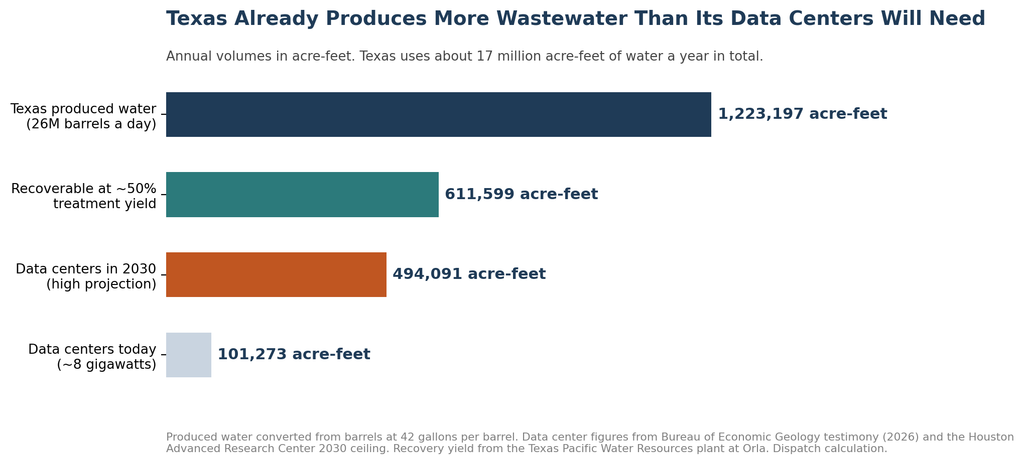
At 26 million barrels a day, Texas produces about 1.2 million acre-feet of this water a year. Even at the roughly 50 percent recovery rate the newest treatment plants achieve, that is more than 600,000 acre-feet of potentially usable water.
Set that against the demand everyone is worried about. Ning Lin, chief economist at the Bureau of Economic Geology, told senators that Texas data centers at roughly eight gigawatts today use about 33 billion gallons a year — just over half of one percent of state water use, or about 101,000 acre-feet. The Houston Advanced Research Center’s high-end projection for 2030 is 161 billion gallons, about 494,000 acre-feet.
Texas already brings more wastewater to the surface than its data centers are projected to need at the outer edge of the forecast. The resource is not the constraint.
Where the water could go
Four end uses are live in Texas right now, and they are not equally hard.
Back into the oilfield. The easiest and already the largest. Roughly half to 60 percent of Permian produced water is recycled for fracking. But frac demand is finite and falls when drilling slows — it cannot absorb a growing stream.
Onto land. Senate Bill 1145 moved land-application permitting to TCEQ, which is evaluating seven applications. Texas Pacific already holds a pilot permit to apply treated water to rangeland and has asked to expand to 2.73 million gallons a day across 102 acres. Texas Tech researchers irrigated alfalfa with treated produced water and published the results in Irrigation Science — though the authors called the findings preliminary, limited to a single growing season, and recommended multi-year study.
Into rivers. The hardest and the most consequential. TCEQ has accepted surface-discharge applications since 2024 and has issued none. Six are pending, five in the Pecos watershed, totaling about 55,000 acre-feet a year at full build-out. Eric Bernard, a Midland land planner and former co-director of the Texas Produced Water Consortium, told senators that “re-watering the Pecos River would be the first major rewatering of a river in the world,” with “potential to restore 8.6 million acres of a degraded landscape.” Pecos County once had 42 named springs; rancher Ryan White testified it now has one, and that his own spring flowed 1,200 gallons a minute until 2014 and has not flowed since.
Into cooling loops. Adrianne Lopez Billings, who leads research at Texas Pacific Water Resources, told Inside Climate News the company already uses treated produced water on-site in condensers and chillers — and that the experience “is informing their plans to use treated produced water at data centers that are flocking to the Permian Basin.” Sen. Adam Hinojosa put the policy version to the Senate water committee: “having that infrastructure cost borne on these data centers is not a bad thing.”
That last pairing is the one worth watching, because the two industries are already neighbors. Data centers are sitting in the Permian for the same reason the water is there — cheap power near the wellhead.
The limitation is a price, and it is specific
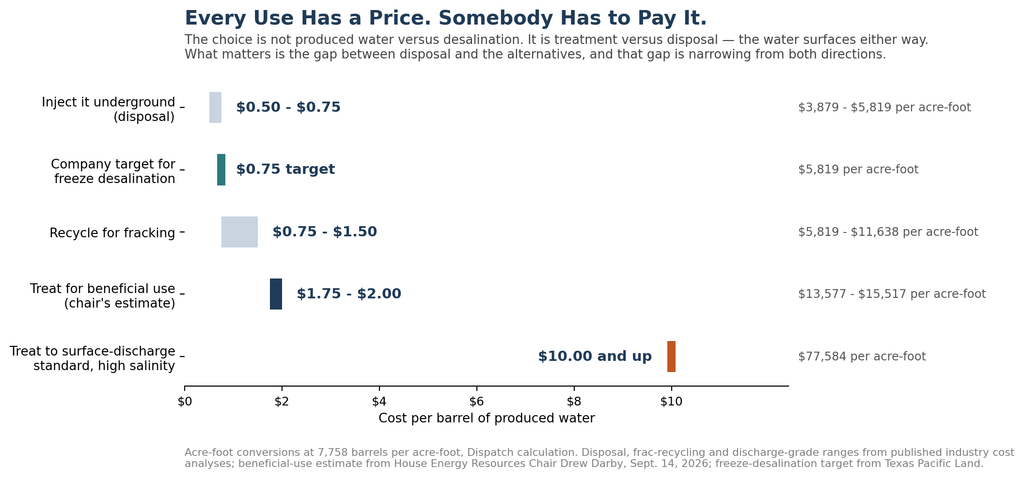
Injecting produced water costs roughly 50 to 75 cents a barrel. Treating it to a standard where it can be used outside the oilfield costs, by Darby’s estimate, “as much as three times that — $1.75 to $2.” Nobody at the witness table disputed the spread. Treating high-salinity water to a standard that permits surface discharge can exceed $10 a barrel.
Translate to the unit Texas water planners use and the problem is unmistakable. At $1.75 a barrel, treated produced water costs about $13,600 an acre-foot. Brackish groundwater desalination in Corpus Christi is being contracted at under $1 per thousand gallons — about $326 an acre-foot. Seawater desalination generally runs a few thousand dollars an acre-foot.
On those numbers, produced water is not a cheap new supply. It is among the most expensive water in the state.
But that comparison is the wrong one, and getting it right is what makes this solvable. Texas is not choosing between produced water and desalination. The water comes up either way, and somebody is already paying to dispose of it. The relevant number is the gap between disposal and treatment — currently about a dollar a barrel — and that gap is narrowing from both ends. Disposal costs are rising as seismic restrictions shrink capacity. Treatment costs are falling as plants scale: Shane Walker of the Texas Produced Water Consortium told the House committee that pilots ran 20 to 800 barrels a day in 2024 and 2025, while “in 2026, companies are demonstrating 2,000 to 20,000 barrels per day,” an increase of one to two orders of magnitude. Texas Pacific Land is targeting 75 cents a barrel at its next facility — which would put treatment at parity with disposal.
If that convergence holds, the economics invert and produced water becomes the cheapest new water in West Texas. If it doesn’t, someone has to make up the difference, and there are only three candidates: the operators who create the water, the end users who want it, or the state.
The other four obstacles
Power. The Texas Pacific plant at Orla treats 10,000 barrels a day and needs 5.5 megawatts to do it, with on-site natural gas micro-turbines supplying four. Scaling treatment to meaningful volumes means building an electrical load comparable to the data centers the water would serve — and queuing for the same grid connections. The solution competes with the problem for the same scarce input.
The leftover brine. At Orla, about half the treated volume comes back as usable water. The other half is concentrated brine that still has to be injected. Treatment shrinks the disposal problem; it does not eliminate it.
Standards that don’t exist yet. Julie Range of Commission Shift told senators the proposed rules “fail to establish protective surface water quality standards for numerous hazardous compounds in produced water, and they set no concrete limits to guarantee treatment meets those standards.” TCEQ has not published what ongoing monitoring it will require. Robert Crain of Texas Pacific Water Resources named the industry’s version of the same problem: “We can’t have a $100,000-a-month sample fee.” A July paper in Separation and Purification Technology found that bench-scale studies to date “do not adequately capture the operational variability or long-term reliability of treatment technologies under real-world conditions.” TCEQ received nearly 450 comments on its land-application rule; an analysis by Future Heist found more than two-thirds opposed.
Two agencies and no boundary. Railroad Commission Chairman Jim Wright asked lawmakers directly to fix this: “One of the requests that I would like to make as chairman of the Railroad Commission is that this legislative session consider exactly where those authorities end and begin.” He and TCEQ Executive Director Kelly Keel, he said, “have been trying to figure out exactly where does mine stop and hers begins.”
What would have to happen
The pieces of a working system are identifiable, and most of them are legislative.
Someone has to be assigned the cost. The candidates are an end-user model in which data centers or municipalities contract for treated water at a price that closes the gap; a producer-pays model in which disposal restrictions make treatment the cheaper option on its own; or a public model in which the state’s water funds treat produced water as new supply — which would require deciding it qualifies. Hinojosa’s line about data centers bearing infrastructure cost is the first version anyone has said out loud.
Someone has to write the standards. Both the industry and its critics are asking for the same thing from TCEQ — a defined, defensible, affordable specification for what treated water must meet. Neither can move without it.
Someone has to settle jurisdiction, and the value question underneath it. George Hillhouse, an Upton County mineral owner, told the House committee what happens once waste becomes an asset: “It’s like yesterday’s trash is tomorrow’s treasure. And we really need to change section 122 to reflect that.” If treated produced water has value, existing law on ownership, royalties and liability was written for a substance that didn’t.
What to watch
Before year’s end: Texas Pacific Water Resources hopes for a decision on its Salt Creek discharge permit, filed in 2024. TCEQ Commissioner Catarina Gonzales said in Midland that “there’s a couple that, I’m told, are pretty close.” The first issued discharge permit sets the template for every application behind it.
Spring 2027: The Railroad Commission’s direct produced-water reporting system goes live — the first time Texas will measure this stream rather than infer it.
January 2027: The 90th Legislature convenes with a produced-water cleanup bill already signaled by the Railroad Commission’s own chairman, Perry’s promised evaporative-cooling ban and water-disclosure rules for data centers, and Hillhouse’s ownership question unresolved.
The framing in Austin has been that produced water is a threat to oil and gas. The more useful framing is that Texas has, sitting at the surface in its driest region, more water than its fastest-growing industry is projected to need. Turning that into supply is not a technology problem anymore. It is a pricing problem, a standards problem and a jurisdiction problem — all three of which are the Legislature’s to solve.
Sources
The Texas Dispatch
- Texas Is Running Out of Room for Oilfield Wastewater, House Energy Chair Warns (Sept. 16, 2026)
- House Energy Resources to Weigh Carbon Storage, Produced-Water Reuse and Quake-Linked Injection Wells (Sept. 8, 2026)
- Pecos Landowners Split Over Oilfield Wastewater as Rancher Says the Springs Have Gone Dry (Sept. 4, 2026)
- Perry Vows to Ban Evaporative Cooling After 70 Percent of Data Centers Ignore State Water Survey (Sept. 3, 2026)
- Senate Water Panel to Study Pecos Basin Decline, Red Bluff Governance and Produced-Water Reuse (Aug. 27, 2026)
- 24 Million Barrels a Day: Texas’ Produced-Water Rollout Advances as Regulators Ask Lawmakers to Draw the Line Between Them (Aug. 12, 2026)
- Senate Natural Resources Panel To Take Up Produced-Water Rules, Oilfield Waste and Wildfire Readiness (Aug. 4, 2026)
- Texas Reservoirs Are Still Three-Quarters Full, and Drought Just Spread Across Eight Percent of the State in a Week (Aug. 18, 2026)
Government and research
- Texas Legislature Online — Senate Bill 1145 (89R, 2025) and House Bill 49 (89R, 2025)
- Texas Produced Water Consortium, Texas Tech University — 2026 Water Quality Report
- Texas Senate archived video — Natural Resources, Aug. 11, 2026
- Irrigation Science — alfalfa irrigation with treated produced water
- Separation and Purification Technology — produced water treatment knowledge gaps
- Railroad Commission of Texas — Texas severance tax incentives
Outside reporting and analysis
- Inside Climate News — Pressure Increases for Texas to Allow Treated Drilling Waste Into Rivers and Rangeland (Aug. 20, 2026)
- Inside Climate News — Texas Supreme Court Rules on Produced Water Ownership (July 2025)
- Inside Climate News — Treating Texas’ Oilfield Wastewater Could Require More Energy Than Most US States (March 2025)
- The Texas Tribune — Texas moves toward allowing reuse of treated oilfield waste (Aug. 21, 2026)
- The Texas Tribune — Fewer new wells, more oil in West Texas (April 2026)
- Fortune — Top U.S. oil producer declares “green” light on drilling amid Iran war (May 2026)
- Texas Real Estate Research Center, Texas A&M — The Future of Produced Water Recycling in Texas
- Every Texan — 2026-27 Biennial Revenue Estimate
- Future Heist — analysis of TCEQ produced water rule comments