
A land developer told the House Committee on Environmental Regulation on Sept. 15 that his 75-unit housing project in Williamson County waited exactly two years for one wastewater permit. “We submitted our permit in April of 2024 and we got our permit officially approved by [TCEQ] in April of 2026,” said Suraj Reddy, a managing partner at a Cedar Park land development firm. The delay, he said, forced him “to increase the cost of our dirt by 15000 a lot.”
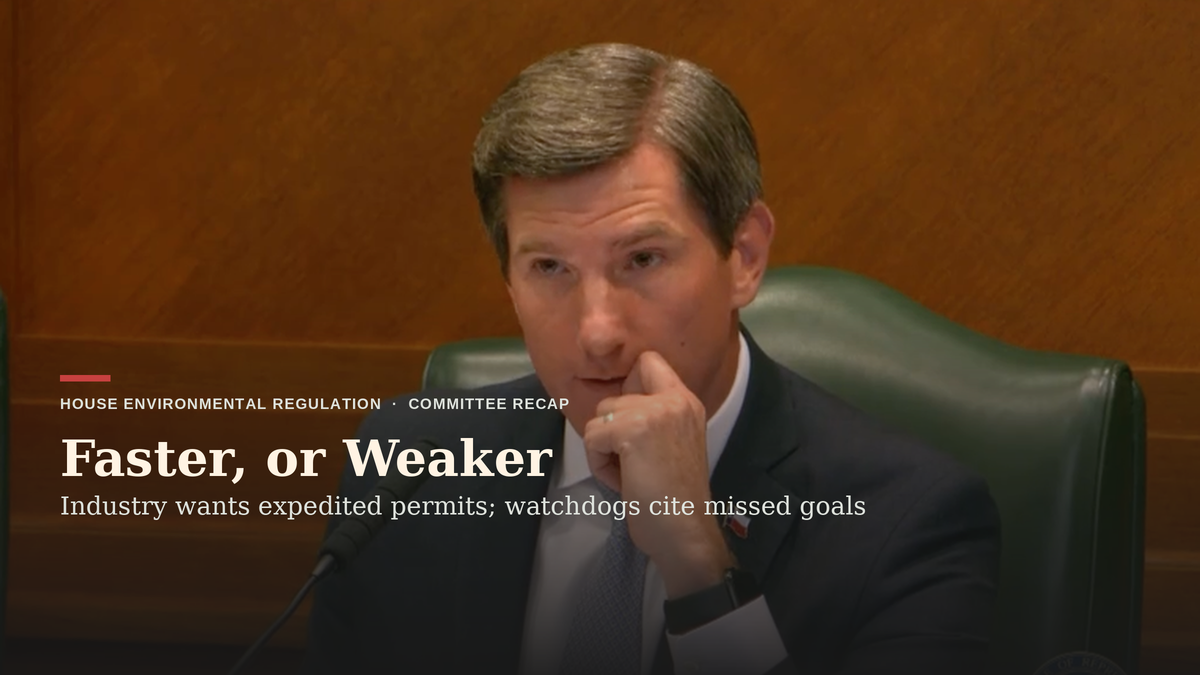
That anecdote anchored the longest block of the day — two hours and 13 minutes, about 68 percent of the hearing, on whether Texas permitting can be made faster without being made weaker. The answer depended entirely on which witness was at the table.
Sam Short, deputy director of the Air Permits Division at the Texas Commission on Environmental Quality, laid out the baseline. Permits drawing no public interest “are issued within eight months to a year,” he said. A public meeting adds “an additional 3 to 9 months,” and a contested case adds “an additional 1 to 3 years until final action is taken.” The agency’s expedited air permitting program, funded by an applicant surcharge since 2012, “can reduce timeframes by three months or more.”
Industry wants that model extended. Logan Harold, general counsel at the Texas Chemistry Council, made the committee’s clearest legislative ask: “TCC also recommends this committee consider legislation that authorizes the agency to implement an expedited wastewater permit program.” The surcharge would “cover expenses needed to improve the processing time for applications review,” including new staff and overtime. He also urged members to fund TCEQ’s exceptional items outright.
Michael Lozano of the Permian Basin Petroleum Association made the same argument from the oilfield. The Texas Produced Water Consortium estimates “about 20 million barrels a day of water is currently being disposed of in the Permian Basin alone,” he said — “1 billion gallons of water.” Only about seven operators have applied for permits to discharge treated produced water, and Lozano said the reason is scheduling risk: “when you apply for a permit and you don’t know on the back end when it’s going to come out, that doesn’t exactly encourage operators to continue to apply for these permits.”
Chair Brooks Landgraf, R–Odessa, asked what the expedited air program had taught the commission. Short credited money and headcount: “The most successfulness of the program came when we were, not only allocated the ability to spend the funds, but also allocated additional funds that are specific to the program.” He also put some of the delay back on applicants — “the quality of application directly corresponds to the speed in which we can apply” — and said of pre-application meetings, “Some do, many do not.”
Adrian Shelley of Public Citizen then turned the committee’s own frame against it, reading from TCEQ’s fiscal 2025 performance measures. “On the air quality side, we met 112% of our goal to issue air permits, almost 8000 of those issued,” he said. “Meanwhile, we’ve only got 42% of Texans living in areas with clean air.” The agency missed a goal to cut ozone by 3 percent — “Pollution increased” — met 36 percent of a goal to inspect 1,000 vehicles, and issued 90 percent of the water quality permits it targeted while “only 54% of our lakes and streams and rivers meet water quality standards.” Enforcement, he said, has thinned: “the agency has conducted the fewest on site investigations in eight years. More than half 53% of the facilities that are in the compliance history program have not been investigated in the last five years.”
Rep. Rafael Anchía, D–Dallas, tested that. “What if I say, hey, there are few enforcement cases because industry is, is self-policing and, and doing a great job,” he asked. Shelley pointed back at the outcome measures “as evidence that the current system is not working.”
Anchía then pushed Shelley onto the data-center permitting question the agency has publicly denied is a problem. Shelley described one operator filing four separate emissions calculations across two years, each landing just under the 100-ton nitrogen oxide threshold that triggers major-source review — “in all four cases, the amount of pollution that was going to be produced was about 99.8, 99.9 tons per year” — and a facility that got a permit for ten gas turbines “from the [TCEQ] in just five days,” then came back for 41 more. Anchía asked what recourse a resident has. “With a minor permit, there is no opportunity whatsoever,” Shelley said.
Vice Chair Claudia Ordaz, D–El Paso, said her constituents are asking the same thing. “Is there anywhere in the application process from your discovery where they have to be transparent that we plan our full build out will be 1000 acre campus?” she asked. Shelley: “No. There is no zoom out.”
Landgraf did not let that stand. He pressed Shelley on whether any facility had actually exceeded a permit undetected, and Shelley conceded he could not name one — “we cannot point to an example of, for example, a minor source permit.” The chair drew the line there. “I just wanted to be clear about that, because I think you’re trying to leave us with a different impression,” he said, and closed the charge defending the agency: “the agency is doing exactly what the legislature has asked it to do with this permitting process.”
Rep. Tom Oliverson, R–Cypress, framed what is coming next: Texas has told large loads to bring their own power, and the permitting system has not caught up. Shelley agreed on the volume — “We’ve got more than 70GW of gas generation proposed in Texas” — and disagreed about readiness: “we need an environmental agency that is equal to the task. And I frankly do not think we do.”
No votes were taken and no legislation was before the panel. Landgraf closed by noting it was “the last environmental committee hearing for the 89th legislative session.”
The committee spent about 39 minutes on agency oversight, where TCEQ conceded Texas does not test crops grown on land treated with sewage biosolids — the subject of the companion recap, “Texas Does Not Test Crops Grown on Biosolid-Treated Land, TCEQ Tells House Panel.” The day opened with 18 minutes monitoring four laws the panel moved in 2025. TCEQ reported 31 investigations under House Bill 3866, rules adopted in July 2026 under House Bill 4413, a Feb. 24, 2031 deadline for the next concrete batch plant protectiveness review under Senate Bill 763, and — the day’s one concrete legislative ask — that the agency received the Senate Bill 2037 liquefied natural gas permitting fee but no authority to spend it, and will seek an appropriations rider.
Fact box
- Issue
- Interim charge — improving the environmental regulatory process (approx. 2 hours 13 minutes, about 68 percent of the hearing; longest block)
- What happened
- TCEQ reported air permit timelines of eight months to a year without public interest and up to three additional years when contested; the Texas Chemistry Council asked for legislation creating a surcharge-funded expedited wastewater permit program; Public Citizen used TCEQ’s own fiscal 2025 performance measures to argue the agency meets permitting targets while missing pollution-reduction goals; members pressed on data center minor-source permitting; a Cedar Park developer described a two-year wait for one wastewater permit; no vote (interim hearing)
- When
- Tuesday, Sept. 15, 2026, 10:00 AM CT · run time 3:16:09
- Where
- Room E2.016, Capitol Extension, Austin
- Chair
- Rep. Brooks Landgraf, R–Odessa (HD-81); Vice Chair Rep. Claudia Ordaz, D–El Paso (HD-79)
- Key witnesses
- Sam Short and Philip Ledbetter, TCEQ; Logan Harold, Texas Chemistry Council; Michael Lozano, Permian Basin Petroleum Association; Philip Martin, Environmental Defense Fund; Adrian Shelley, Public Citizen; Luke Metzger, Environment Texas; Suraj Reddy, land developer, Cedar Park
- Archived video
- house.texas.gov video 22804