
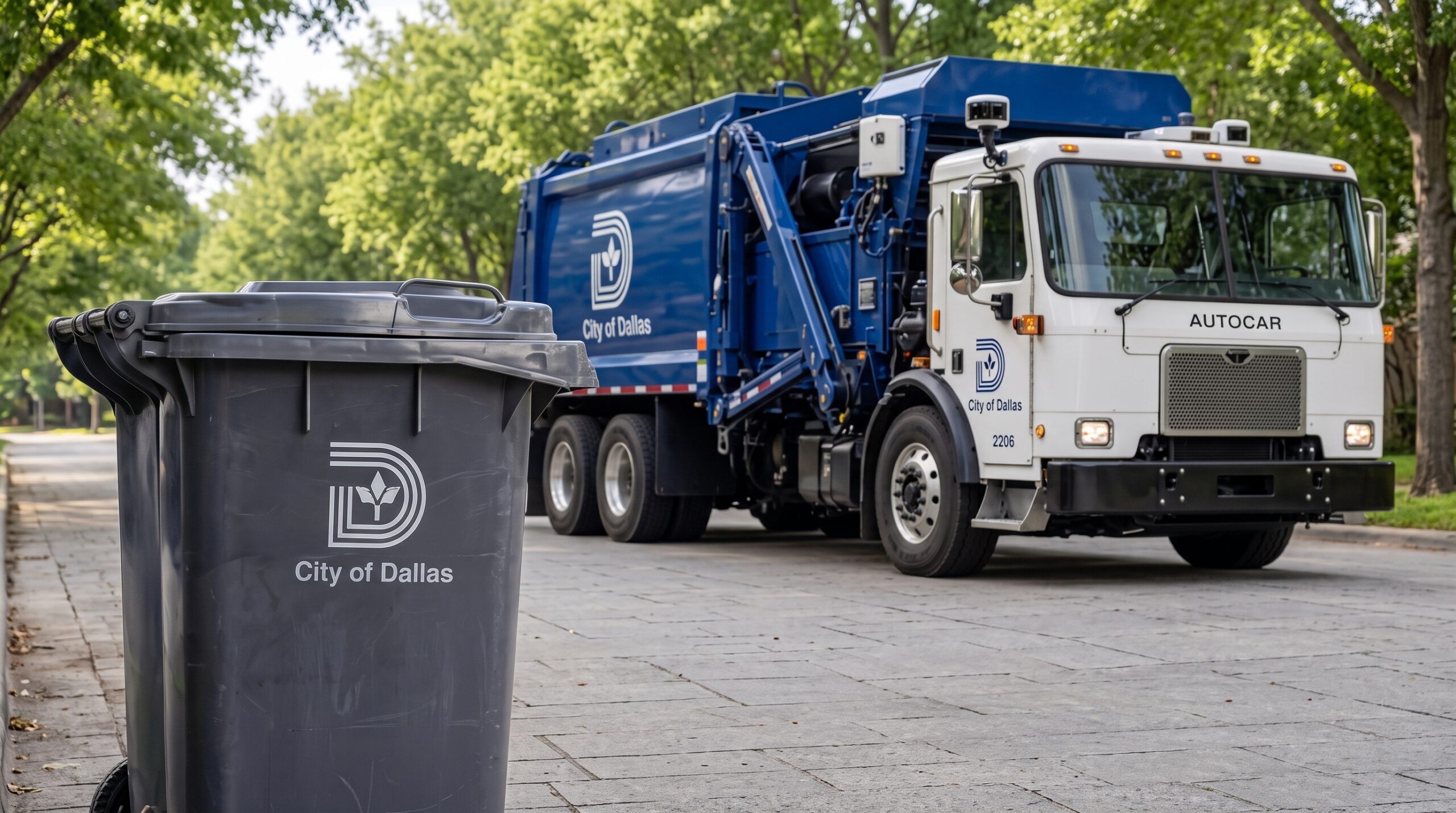
Dallas adopted a $5.97 billion budget on Sept. 16 that leaves in place a program mounting cameras on city garbage trucks to photograph houses along their routes and rate them for blight. A proposal to strip the program’s $852,000 and hand the money back to residents as a 20-cent cut in the monthly trash rate never reached the adoption-day floor. Instead, the city manager will answer for the program at a council committee on Oct. 19.
The cameras belong to City Detect, a vendor the city signed to a three-year contract worth about $2.5 million in December 2025. According to NBC 5 Investigates, which obtained city records, roughly 100 cameras ride on 50 brush and bulky-trash trucks, and the system has flagged more than 21,000 properties with blight scores on a one-to-four scale. The city has since sent about 3,700 courtesy notices and, as of mid-September, issued 57 citations covering 34 properties, according to reporting by Fox 4 and The Dallas Morning News. The stated target is 5,200 cases a year.
Council Member Chad West put the program on the chopping block in a straw-vote workshop Sept. 2. The city’s own budget amendment document lists his item plainly: “Eliminate the expense associated with the Sanitation and Code AI-camera initiative (SAN). 852,000,” with the savings used to “reduce the average Sanitation collection rate by 20¢ per month.” West was the only member on it. His concern, he told NBC 5, was who ends up paying: “My primary concern is that this could end up being inadvertently a tax on the poor.”
City management’s written answer in the same document was that “AI-camera technology allows city to maximize efficiency and minimize cost,” and it cited the 1,800 courtesy notices sent as of August as evidence the approach works.
West withdrew the amendment that day after City Manager Kimberly Tolbert agreed to bring the program before a council committee. CandysDirt, which covered the same meeting, reported that Tolbert is now expected to brief the Quality of Life, Arts and Culture Committee on Oct. 19 on the program’s cost, its privacy safeguards, its geographic impact and its measurable results. That committee can recommend, but it cannot appropriate; unwinding the contract or the funding would have to come back to the full council.
Whether the $852,000 survived by decision or by default is worth stating precisely. The council’s Sept. 16 amendment sheet, read in full, contains no sanitation or camera item at all — the adopted amendments moved $427,927 into a library and transferred $17,000 from youth commission travel to the inspector general. The appropriations ordinance funds Sanitation Services at $171,543,046 and appropriates at the department level, so it names neither the program nor the figure. The money stayed because nothing was adopted to remove it, and the 20-cent rate reduction did not happen. The budget passed 10-5 after roughly 14 hours, and the city’s property tax rate fell a tenth of a cent to 69.78 cents, its twelfth straight cut.
One finding is likely to shape the October hearing. KERA reported that about 68 percent of the initial citations landed in three southern Dallas council districts that are predominantly Black and Hispanic — the geographic question Tolbert has been asked to address.
Dallas is not the only Texas city weighing what to spend chasing illegal dumping, and as The Texas Dispatch found earlier this month, what Texas cities pay to handle their own waste varies sharply from one city to the next. San Antonio’s council, adopting its own budget Sept. 17, raised the annual solid waste fee $9 to $378 a household while budgeting for 12,500 illegal dumping collections in the coming year — fewer than the 13,200 the city estimates it will perform this year, and fewer than the 12,638 it actually performed in 2025. The city’s proposed budget book, 748 pages, carries no diversion-rate target and no illegal dumping enhancement of the kind it funded in 2022 and 2023. Houston, by contrast, raised its illegal dumping program to $1,549,000 from $1,234,000 and set a target of 9,776 cases investigated. Harris County adopted a budget the same day as San Antonio in which the phrases “illegal dumping” and “litter” do not appear once across 1,743 pages.
The gap between those approaches is about to be tested in public. Dallas is the only one of the four that has agreed to put its enforcement program on a committee agenda and explain, on the record, what it has bought.