
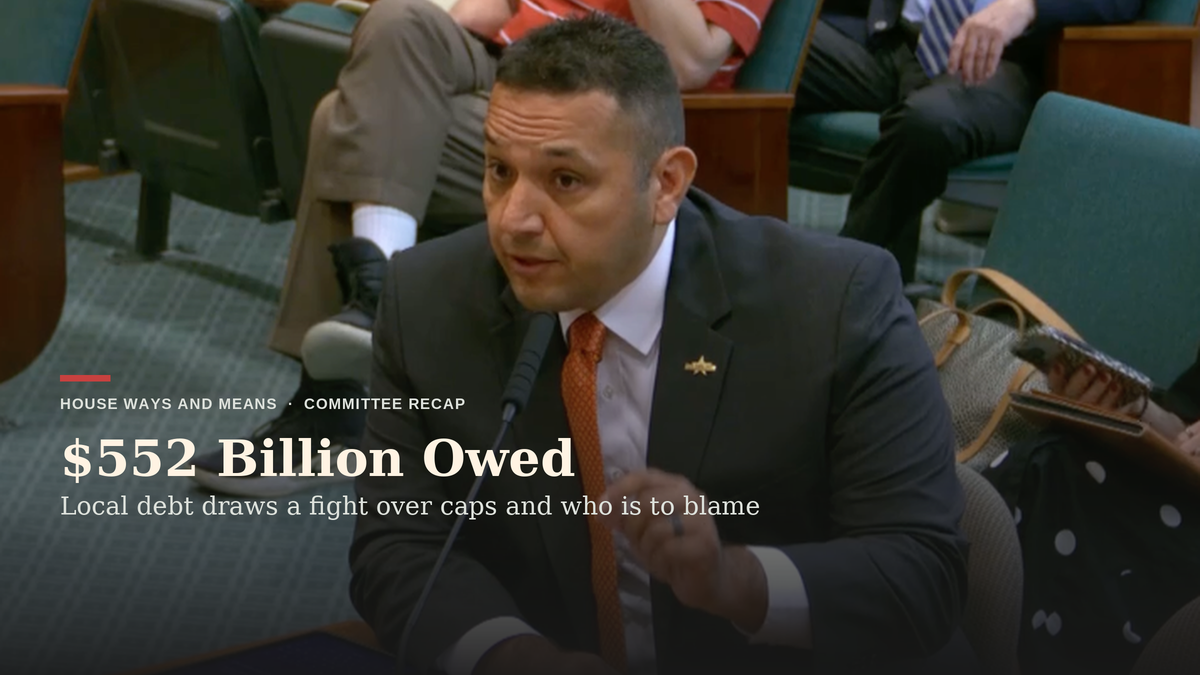
Texas local governments owe $552 billion in debt service, and $330 billion of that is principal. The House Committee on Ways and Means spent two hours and eight minutes Sept. 15 on what, if anything, the Legislature should do about it — and the answer split the room along a line that had nothing to do with the numbers.
James Quintero of the Texas Public Policy Foundation brought the figures. Local debt service outstanding “rose to $552 billion statewide” in fiscal 2025, he said, or “about $17,400 for his or her share of the debt burden” for every Texan. School districts hold the largest piece — “234.2 billion, or 42% of the total… about $42,000 for every student enrolled.” Certificates of obligation, the instrument cities and counties can use to borrow without asking voters, grew fastest: “debt outstanding rose from $13.24 billion to $30.85 billion. That’s 133% increase over a ten year period,” with Denton “the most prolific user,” accumulating “more than $1 billion of debt without voter approval.”
Quintero’s fix is arithmetic. Lower the voter-approval tax rate from 3.5 percent to 2 percent or below, and make certificate-of-obligation debt count against it. “A local government can issue certificates of obligation and go into debt without voter approval. And that item does not count towards the voter approval rate calculation,” he said. “I think that’s wrong.” He also urged a taxpayer-initiated rate-reduction election: voters “really only have one way to lower taxes at the local level, and that is to elect the right people.”
Then he named names — school superintendents earning $520,000 and $513,000, the Austin city manager at $538,000, and “San Antonio City Manager received an $87,000 one year pay raise” — and the hearing stopped being about debt.
Vice Chair Trey Martinez Fischer, D–San Antonio, went after the selection. “You talk about five cities out of 1200 to change an entire policy. But when you talk about the city of San Antonio, especially knowing that I’m from there,” he said. “You identify the city that I represent and have a second member from San Antonio sit on this dais, and you want us to be quiet to think you’re right.” He added: “if you’re going to single out my city, I want you to be prepared for debate.” Chairman Morgan Meyer, R–Dallas, stepped in to keep the charge alive. “But, James, getting back to your greater point,” he said. “Whether the $10,000 was ultimately returned, it should have never been spent… It could be Dallas, where I represent. It could be San Antonio.”
Rep. Chris Turner, D–Grand Prairie, forced two concessions. No local official’s salary is paid from certificate-of-obligation or bond proceeds, Quintero agreed. And the $552 billion is debt service, not debt: asked for the principal, Quintero said “it’s a little north of $330 billion.” Turner called that “an important distinction.”
Local officials spent the afternoon arguing the state wrote the bills it now wants capped. Jefferson County Judge Jeff Branick said industrial tax abatements have taken far more off his rolls than spending has added: “we’ve had about $80 billion worth of expansions over the last 15 years in Jefferson County have had ten year, 100% abatements awarded to them.” His county’s tax rate, he noted, has fallen from 42.5 cents per $100 of value to 35.7 cents.
Adam Haynes of the Conference of Urban Counties made the same case in dollars members could act on. “Bell county’s tax rate is somewhere in the, in the 32 cent range,” he said. “If you paid for your exemption that you authorize for veterans, rather than having the citizens of Bell County pay for that, it would cut your property tax rates $0.06 tomorrow.” On unfunded mandates he was blunter: “don’t make us buy another election equipment… if you don’t want us to increase property taxes, then direct TxDOT.” And on fees, he turned the committee’s premise around: “You’ve authorized, almost 100 fees that counties can charge.”
Rick Ramirez of the Texas Municipal League disputed the framing that property taxes drive city budgets at all. “There’s nearly six out of every ten general fund dollars that come from something other than property taxes,” he said, and where the money goes is not discretionary: “you have 41.5% of general fund revenue coming from property taxes, but around 53% of general fund expenditures going out to police, fire and EMS.”
On the school side, Amanda Brownson of the Texas Association of School Business Officials challenged the committee’s own accounting. Counting both the bond proceeds a district spends and the debt payments it later makes “is arguably double counting the same cost twice,” she said. School construction debt, she reminded members, already requires an election and an attorney general finding that the district can retire it at 50 cents or less.
Rob Lach, executive director of the Texas Bond Review Board, put the trend in narrower terms than Quintero did: “I think last year we had about 4 billion in [certificates of obligation]. This year we’re about 3.8.”
Fees drew their own panel. JD Hale of the Texas Association of Builders and former mayor David Billings, testifying for a group he identified as Reset Texas, asked for a cost-based standard: fees “should be cost base and they should be having a reasonable correlation to the cost to provide by the city,” Billings said. Sally Barkow of Galveston answered with her island’s math — a flat population “just over 53000” carrying “9 million tourists a year.”
Rep. Vincent Perez, D–El Paso, aimed the closing question at the premise of the whole charge. The salary and logo spending Quintero cited “all happened under a 3.5% cap,” he said. “Would a 2% cap have prevented any of that?” Quintero conceded the existing limit is “soft” — then said he supports the cut anyway.
No votes were taken. What members heard will shape the tax bills filed for the 90th Legislature, which convenes in January 2027.
The committee’s longest block, four hours 22 minutes, went to property tax relief — the subject of the companion recap, “Texas House Panel Puts a $29.2 Billion Price Tag on Ending the School Property Tax.” The day opened with 33 minutes monitoring House Bill 103, the statewide database of local bond and tax-rate election information, and House Bill 148 on appraisal district board qualifications. It closed with 45 minutes of comptroller oversight, where Martinez Fischer turned the day’s salary argument on the state and asked how many comptroller employees earn more than $153,750; general counsel Chris Blackwell answered that the number “is measured in the dozens. It wouldn’t eclipse 100.”
Fact box
- Issue
- Interim charge — local government spending, debt and fees (approx. 2 hours 8 minutes, about 27 percent of the hearing; second-longest block)
- What happened
- TPPF reported $552 billion in local debt service outstanding, $330 billion of it principal, and certificate-of-obligation debt up 133 percent in a decade; it urged cutting the voter-approval rate to 2 percent and counting certificates against it; the vice chair rebuked the witness for singling out San Antonio; county, city and school witnesses countered with abatements, unfunded mandates and state-authorized fees; no vote (interim hearing)
- When
- Tuesday, Sept. 15, 2026, 10:00 AM CT · run time 7:49:10
- Where
- Room E2.014, Capitol Extension, Austin
- Chair
- Rep. Morgan Meyer, R–Dallas (HD-108); Vice Chair Rep. Trey Martinez Fischer, D–San Antonio (HD-116)
- Key witnesses
- Rob Lach, Texas Bond Review Board; Amanda Brownson, Texas Association of School Business Officials; Jeff Branick, Jefferson County judge; Rick Ramirez, Texas Municipal League; Adam Haynes, Conference of Urban Counties; James Quintero, Texas Public Policy Foundation; Shannon Halbrook, Every Texan; Sally Barkow, city of Galveston; JD Hale, Texas Association of Builders
- Archived video
- house.texas.gov video 22814