
Sen. Judith Zaffirini, D–Laredo, asked the two bank lobbyists in front of her a question nobody else on the dais had put that plainly: how widespread is politically motivated debanking in Texas? “In my opinion, it’s not,” said Sarah Gutierrez of the Independent Bankers Association of Texas. “It is not an issue, especially for community banks.” Celeste Embry of the Texas Bankers Association went further: “I do not believe that there is banking based on political, religious or other viewpoints.”
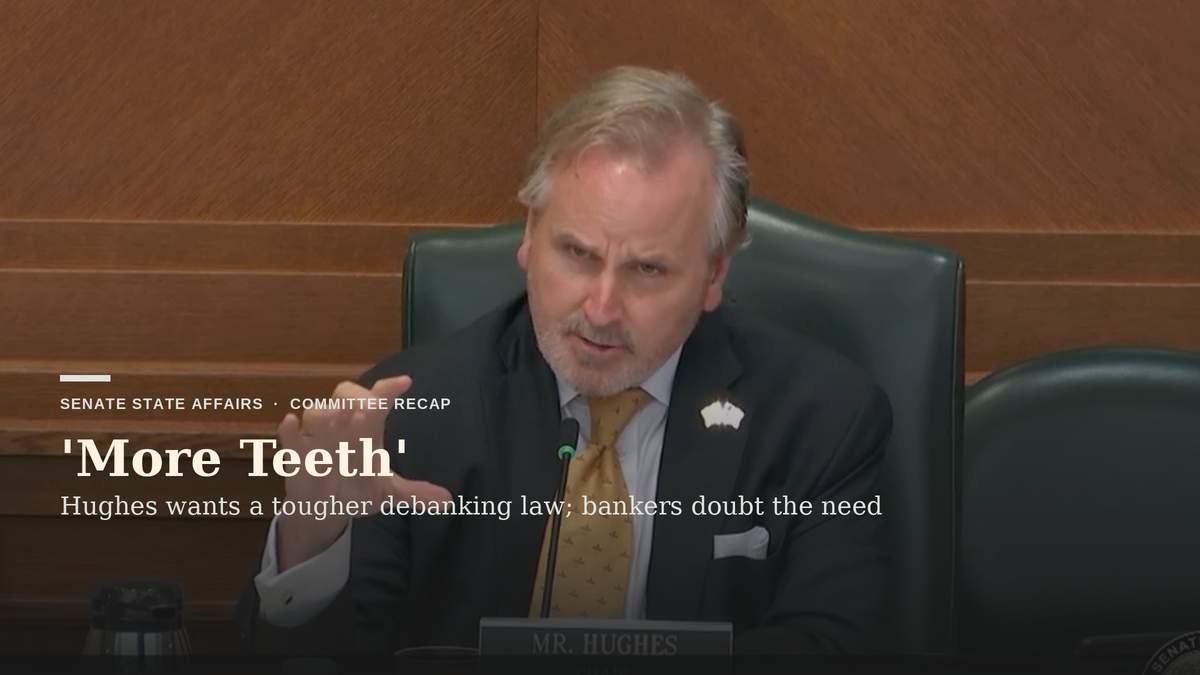
Chair Bryan Hughes, R–Mineola, had already decided otherwise. Before the Senate Committee on State Affairs finished the hour and 14 minutes it gave the fair banking charge on Sept. 15, he had described the bill he intends to write. “It sounds like we’re going to have to put more teeth than we did in Senate Bill 13,” he said. “If you’re going to be licensed by the state of Texas, you can’t do this. That’s a condition of your license. And as well as private civil enforcement.”
That is a materially larger instrument than anything Texas has passed. Senate Bill 13, enacted in 2021, bars state investment in firms that boycott fossil fuels — Hughes summarized it as “if you’re going to boycott oil and gas, we’re going to boycott you.” What he described Sept. 15 would condition a Texas license on not denying service for non-financial reasons, and would let private parties sue. Hughes’ own Senate Bill 946, which would have barred lenders from denying credit on “social credit or value-based standards,” passed the Senate in 2025 and died in House State Affairs.
The first panel ran roughly 40 minutes with Hughes the only senator asking questions. Will Hild, executive director of Consumers’ Research, defined the practice as “an attempt by the financial services industry to force a political agenda on Americans that they didn’t vote for,” and argued the problem outlived the coalitions that created it. The Net Zero Banking Alliance “was basically an open cartel,” he said, and its dissolution changed little: “it’s a little bit like you had a collusion of folks to get together and set the price of milk and you break up the cartel, but then they all keep the price.”
Pressed by Hughes on why documented victims are scarce, Hild pointed at fear: “because of the mafia style tactics that the ESG movement uses. It’s hard sometimes to find the victim businesses.” Asked whether President Donald Trump’s August 2025 executive order on politicized debanking makes a state law unnecessary, he said no: “if you have a new president, they could remove that regulation and it’s gone immediately.”
Jeremy Samek of Alliance Defending Freedom supplied the case list and the stakes. “Without a bank account, Texans can’t reliably receive a paycheck, pay utilities, rent a home, process donations or operate a lawful business,” he said. He named an organization founded by former U.S. senator Sam Brownback that he said “was shut down by Chase Bank,” a Tennessee nonprofit whose account Bank of America closed, and accounts belonging to Moms for Liberty and the gun manufacturer Ruger. “Once the power to exclude based on viewpoint is normalized, no one is truly safe from it,” he said.
Jason Isaac of the American Energy Institute made it personal, reading from an insurer’s non-renewal letter: “we have learned from your Facebook page that your operations include trade association involved in promoting social political causes related to energy production. This is not an acceptable exposure.” His ask was narrower than the rest of the panel’s — an evidentiary appeals process for the third-party climate risk scores insurers and lenders buy.
The bankers’ panel spent its time redirecting. Gutierrez, a senior vice president at a community bank in Elgin, said the headline cases involve “the nation’s largest financial institutions, not community banks,” and offered her own standard: “if your money is green and your transactions are clean, you’re welcome on our team.” Hughes would not accept the framing whole. “It wouldn’t be accurate to say no. It’s not a problem if the big boys are doing it and we’re not,” he told the panel.
Embry’s objection was about where the pressure originates. Examiners, not bankers, drive the behavior, she said: “the regulators are the ones that the banks are the most afraid of, right? Because they can stop them from doing their business entirely.” Her target was a specific supervisory concept: regulators’ “use of quote unquote reputational risk can be highly subjective and has little to no place in the examination process.” Asked whether Texas should legislate, she pointed to the bill carried by U.S. Sen. Tim Scott instead: “it becomes very challenging if individual jurisdictions pass different laws.”
Sen. Adam Hinojosa, R–Corpus Christi, found the narrower path. Codify the executive order in state law, he argued, “even if we don’t see it in Texas.” Embry raised a real conflict — adverse-action notices can collide with the federal confidentiality of suspicious activity reports — then volunteered a bill she would not fight: “legislation that says it is against the law for Texas state banking regulators to examine for climate 100%? Yes. Let’s have that discussion.” Hinojosa answered, “that’s kind of where we’re leaning.”
Sen. Charles Schwertner, R–Georgetown, walked Embry through Operation Choke Point and its cryptocurrency successor, then opened a second front on Sharia-compliant financial products, telling the committee he would write the state Banking Commission about it. Hughes said he would sign on: “we’ll join you.” Sen. Bob Hall, R–Edgewood, used his entire allotment on the same subject. Embry said that in 21 years at the association she had never seen the product: “I was able to say zero.” Hall did not accept it. “It’s my understanding they’re happening within,” he said.
Hughes closed by noting the federal order “gives various agencies 180 days to come up with some rules” — a deadline that lands while the 90th Legislature is in session. No votes were taken.
The hearing’s longest block, an hour and 41 minutes, went to prediction market gambling — the subject of the companion recap, “Texas Senators Press Kalshi on Election Bets and Weigh Suing Prediction Markets.” The day opened with 24 minutes on private-label liquor, where a Texas Alcoholic Beverage Commission attorney told senators “the term private label is not actually a legal term of art” and “does not actually even appear in the alcoholic beverage code,” leaving the agency to police the practice through broad tied-house provisions. A 49-minute charge on judicial integrity, which names no organization in the notice, was aimed by all three invited witnesses at the Environmental Law Institute’s Climate Judiciary Project and the plaintiffs’ firm Sher Edling; former Texas Supreme Court Chief Justice Nathan Hecht testified that the Texas Center for the Judiciary does “a great job” but that the episode “exposes a weakness in the processing.”
Fact box
- Issue
- Interim charge — guaranteeing fair banking for all Texans (approx. 1 hour 14 minutes, about 24 percent of the hearing; second-longest block)
- What happened
- Chair Bryan Hughes said he wants a law with “more teeth” than Senate Bill 13, conditioning Texas licenses for banks, insurers and card processors on not denying service for non-financial reasons, with private civil enforcement; Consumers’ Research, Alliance Defending Freedom and the American Energy Institute described account closures, insurance non-renewals and third-party climate risk scores; the Texas Bankers Association and the Independent Bankers Association of Texas said debanking is not a Texas problem and pointed to federal legislation instead; Sen. Adam Hinojosa floated barring state examiners from examining for climate; no vote (interim hearing)
- When
- Tuesday, Sept. 15, 2026, 9:00 AM CT · run time 5:12:55
- Where
- Room E1.012, Capitol Extension, Austin
- Chair
- Sen. Bryan Hughes, R–Mineola (SD-1); Vice Chair Sen. Angela Paxton, R–McKinney (SD-8)
- Key witnesses
- Will Hild, Consumers’ Research; Jeremy Samek, Alliance Defending Freedom; Jason Isaac, American Energy Institute; Sarah Gutierrez, Independent Bankers Association of Texas; Celeste Embry, Texas Bankers Association
- Archived video
- senate.texas.gov video 22784