
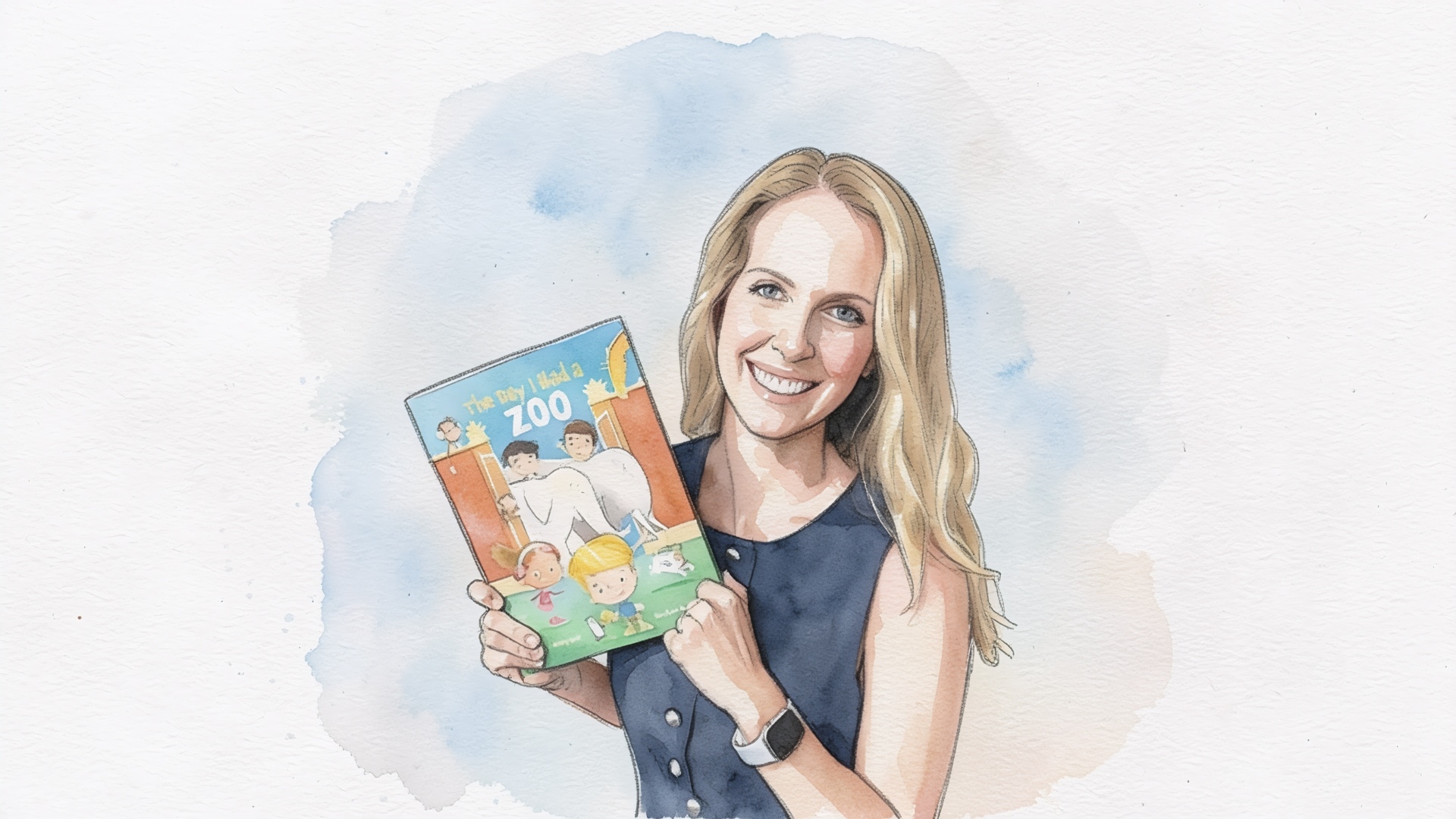
Ashley Wall told exactly one person she wanted to write children’s books, and he bought a company before she finished the sentence.
It was an August afternoon in Austin. Wall had spent the morning on a mother-daughter date at the ice cream museum in the Domain, and somewhere between the exhibits she was, as she describes it, flooded with a single insistent thought: you have got to write a book. She drove home. Her husband, Jeff, was in the backyard with their son.
“I want to write children’s books,” she told him.
“Cool, great,” he said. “We’ll start a publishing company.”
A few days later a giant teddy bear arrived on the front porch. Wall had no idea what it was. Jeff explained that he had bought the domain name — mamabearbooks.com — and the bear came with the territory.
“And I was like, oh,” she says. “We’re doing this.”
That was 2022. Four years later, MamaBear Books has ten titles in its catalog with more coming, a stable of authors from around the country, distribution into Barnes & Noble and independent bookstores nationwide and in Canada, a publisher profile from the Children’s Book Council, and a partnership that has put roughly 40,000 of Wall’s picture books into the hands of Houston-area children through the Barbara Bush Houston Literacy Foundation.
None of which she saw coming, because for a decade she was a middle school math teacher.
Cedar Park, and a kid who liked to argue
Wall grew up in Cedar Park, just north of Austin, the daughter of a mechanical engineer and a former regional director for child care centers who later stayed home with Wall and her sister. Her father was forever building things, sketching ideas, talking about businesses he might start.
“Probably where I got some of that from,” she says.
Her own first ambition was law. “I thought, I’m really good at arguing with my parents,” she says. That gave way to some version of working with children — pediatric therapy, maybe — and then, at Baylor, to a freshman year of cheerfully undirected exploration. She took a fashion design class. She took interior design.
Then she took an education class, and that was that.
The grade level took some trial and error. Elementary students were too young. High schoolers were too close to her own age — she was eighteen, walking into classrooms full of teenagers. Middle school landed exactly right: still carrying some of the elementary sweetness, old enough to hold a real conversation.
She had always loved math. She taught it for ten years — four in Leander ISD, back in the Cedar Park schools she’d grown up around, then Houston, then California.
It was the Houston stretch that marked her. She had always wanted to work in a lower-income school with students considered at risk, and in Houston she got one: a Title I campus that was, at the time, low-performing. She taught the same group of students for three consecutive years, sixth grade through eighth.
“That was really awesome,” she says — and it turns out to be the part of her résumé that best explains what she does now.
The notebook
Wall left teaching when she had children, and for a few years the question of what came next stayed open.
She considered a doctorate. She had loved her own education professors at Baylor and liked the idea of training future teachers. She thought about it, researched it, and prayed about it — she describes the period as asking, repeatedly, to be pointed in a direction.
Meanwhile she was reading to her kids. Constantly, and from the day each came home from the hospital. Board books, picture books, and — because she is an unreformed Baylor sports fan — game recaps and articles, read aloud to an infant who had no idea what a zone defense was.
Somewhere in there, the ideas started. She’d be singing to her son while changing a diaper and think: that would make a great book. After she put him down for a nap she’d go to her desk and write it down. Sometimes two sentences. Sometimes half a manuscript.
She did this for about a year and told no one.
Reading also taught her the shape of what she wanted. There were books she loved reading aloud, and books she dreaded. “There would be books that I couldn’t stand reading,” she says. “And that was like — well, I could do this better.”
Then came the ice cream museum, and the backyard, and the bear.
What “independent publisher” actually means
The obvious path, for a person with a manuscript, is the long one: polish the pages, write a query letter, find an agent willing to sign you, and hope the agent finds a publisher willing to buy. Most houses won’t look at unagented work.
“We’ve had authors come to us who have fantastic manuscripts and have been submitting for ten years,” Wall says.
MamaBear skipped that queue by building the other side of the table. The company is not a self-publishing service and not a vanity press — it operates, as Wall describes it, on the traditional model at independent scale. It signs authors. It pairs them with professional editors and illustrators, handles design and formatting, sends print-ready files to overseas printers, and moves the finished books through a distributor with a national sales team.
Her catalog now includes authors from across the country — Vicki Gardiner, Megan Duggan, Kimberly Lanza, Brandi Raae, Jamie McMahon, Lynsey Martin, Kristy Tussing, and the mother-daughter pair of Helen Wall and Claire Young among them.
The first book out the door, in 2023, was not the one that had been pressing on her at the museum.
It came instead from a conversation in the kitchen. She and Jeff were talking, her son down for a nap, when she said: How cool would it be if Davis’s toys came to life for a day?
“I went straight upstairs and I started typing,” she says.
The Day I Had a Bulldozer became MamaBear’s first title and remains its bestseller. It also became a series — the fifth installment, The Day I Had a Zoo, arrived this summer, in which the monkeys let every animal out and the kids have to round them up. This past June she published her first elementary chapter book, The Wildflower Girls: Quest to Save Unicorn Magic, built out of make-believe games with her daughter.
Her children have figured out how this works. They pitch ideas constantly. They are not always gracious when an idea doesn’t make it in.
The part she had to learn
The writing was the familiar half. The business was not.
“The jargon was so foreign to me,” Wall says. She had spent her entire working life in schools. Marketing, sales, advertising, distribution — she had to build all of it from research, from asking people, from watching operators a few years ahead of her. Jeff, who works in tech sales, took much of that side; the company now has marketing and PR directors.
Her reading shifted accordingly. She read Phil Knight’s memoir about building Nike and found it steadying — the reminder that the most recognizable shoe company on earth spent years with products that didn’t work and a founder who kept pivoting.
“They started out just like I am,” she says. “But they kept on going.”
She also read Who Not How, and took from it the metaphor she now uses for running a small company: everyone owns a slice of the pizza. “I know my slice and my slice is great and I can own my slice,” she says. “But I need the PR and I need marketing and I need someone to do graphic design.” She concedes the limits — at a company this size, she still wears several hats herself.
The competitive picture is genuinely hard, and she doesn’t pretend otherwise. The barrier to publishing a book has collapsed; AI has lowered it further. Bookstore shelf space has not expanded to match.
“I hate to say the competition part, because it’s like, pick my book over yours,” she says. “But it is a business.”
Why she thinks it matters
The argument underneath all of this is one the data supports.
American reading scores have fallen to their lowest point since the early 1990s for fourth and eighth graders, with declines that began before pandemic school closures. And reading for pleasure — the thing Wall is actually selling — has collapsed: only 37 percent of nine-year-olds and 14 percent of thirteen-year-olds now read for fun almost every day, the lowest figures on record.
“We need to bring them back to books,” Wall says. Her case isn’t primarily about test scores. It’s about what reading does that screens don’t. “It builds their imagination and their creativity. It helps them learn how to problem solve and to think for themselves.”
That is also why her books are loud, silly and full of machinery. A kid who is bored will not come back.
The Title I years show up here. Through a partnership with the Barbara Bush Houston Literacy Foundation — funded by a donor family — roughly 40,000 of Wall’s picture books have been given to children in Houston, and MamaBear puts the total reach at more than 49,000 children across Texas. The books go home with the kids. They are theirs.
She wants to build on that. MamaBear is developing a literacy experience that would bring authors into schools for visits, with every child leaving holding a signed book — starting in Austin and, she hopes, expanding to the states where her other authors live, with an emphasis on Title I campuses. An animated YouTube series based on The Day I Had is planned for next year. Longer term, she talks about building franchises rather than titles: “not just thinking, okay, I’m making a book, but I’m building a world.”
The proof at home
The best evidence that any of this works is running a small business out of Wall’s house.
Her two children started a company making bracelets and bookmarks. They sell them. Recently they noticed something about their mother’s operation that struck them as an unfair advantage.
How come you get orders online and we don’t?
So they are producing a commercial — to run on the family’s personal social media, for friends and relatives — in hopes of drumming up internet business.
It is, in miniature, precisely the thing Wall says she is after: kids with enough room in their heads to ask what if, and then go find out.