
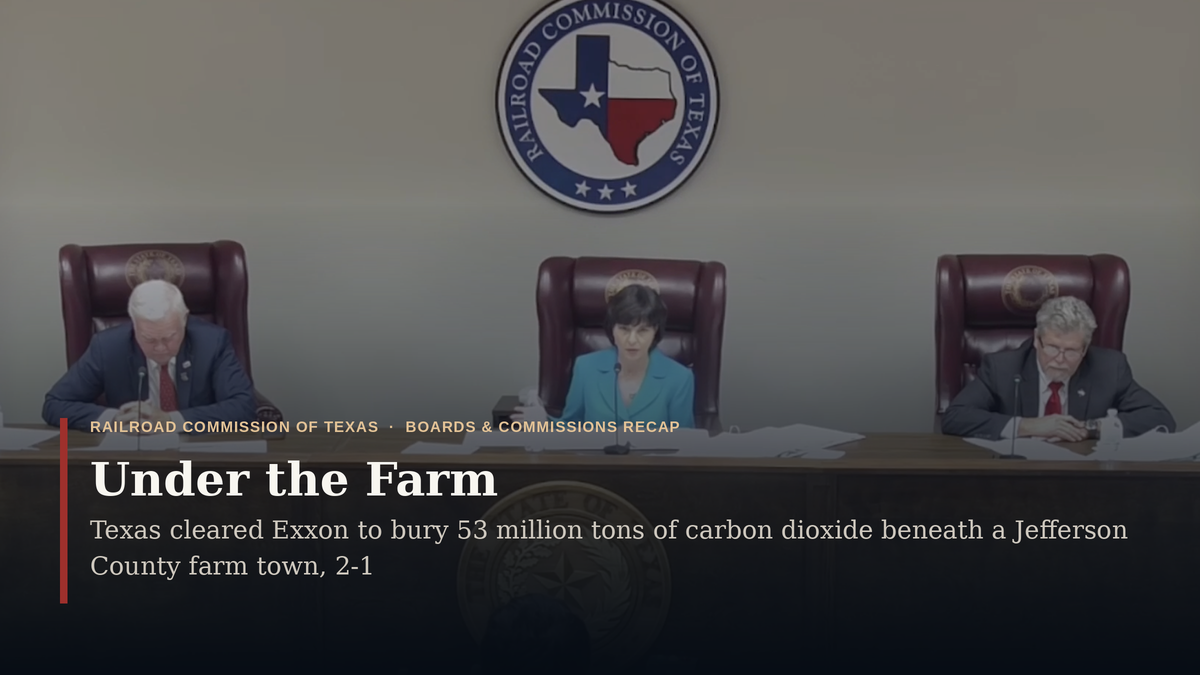
Texas regulators cleared ExxonMobil on Sept. 15 to bury 53 million metric tons of carbon dioxide in the rock beneath a farming community southwest of Beaumont, over neighbors’ objections that the nearest house sits less than a mile from a well.
The Railroad Commission of Texas approved the three wells 2-1, the agency said, with Commissioner Wayne Christian voting no. It is the first contested carbon storage permit the state has decided since taking the program over from federal regulators on Dec. 15, 2025, and the first new one it has issued itself — a template for the Gulf Coast projects behind it.
The wells would take about 4 million metric tons a year for 13 years, roughly six-tenths of one percent of the 679.9 million metric tons of energy-related carbon dioxide Texas released in 2024, by this newsroom’s arithmetic on federal data covering fuel burned. The gas would go 3,382 to 8,101 feet down. Above it live the farm families of Cheek and Fannett, who draw water from an aquifer the commission’s own file places at about 1,450 feet.
The fight is over one layer of rock. The commission’s fact sheet describes the cap as “a more than 500-foot-thick impermeable confining layer consisting of laterally continuous impermeable shales.” A geologist for the residents testified that the same interval is “a composite of small thin sands separated by thin shales and is therefore not a good seal,” with at least four zones porous enough to let gas migrate. The hearing examiners believed the company.
Christian did not. In prepared remarks the agency posted, he drew two more objections from the same record: faults too small to register on seismic surveys, which the residents’ side argued could step gas upward sand by sand, and four monitoring wells set at 350 and 2,500 feet with nothing at the 1,500-foot level where brine driven up by the injection would show first.
“So, in other words, the evidence in the record shows a very high concentration of carbon dioxide would be injected into a potentially non-confining layer of rock with faults that could lead toward the surface and a proposed monitoring network with a huge gap.”
He moved to remand the application to the hearings division. No one seconded it, Texas Scorecard reported. Commissioner Jim Wright disagreed. “Given that this thing has gone through a hearing process, with the best people we have that I know of, I think this thing is safe,” he said. Chairman Christi Craddick voted yes after scolding the company for walking away from the community.
“We’ve had it with Exxon right now,” she said. “You better show up and be part of the community.”
Sarah Spikes, who spoke for the Cheek Texas Community Association, said the company stopped meeting residents in the summer of 2025 once they hired lawyers, and that the site is 0.8 miles from the nearest home, not the two miles local coverage described. Another resident, Michelle Turner, told the commission: “The time to protect communities is now, before failure occurs, not after families are left to live with the damage,” the Houston Chronicle reported. They spoke only because Craddick asked: under a policy adopted Aug. 18 over her own objection, a registered speaker may address an agenda item “only if specifically requested to do so.”
Christian’s quarrel was as much with money as geology. Washington pays $85 a metric ton for industrial carbon put permanently underground, up to $4.5 billion across Rose’s volume, though the credit goes to whoever owns the capture equipment, and Rose takes its gas from other companies’ plants. Jason Isaac, who runs the American Energy Institute and once served in the Texas House, called the project “heavily influenced by government incentives”; Christian called carbon capture “the Green New Deal dressed in Republican colors” and told the room, “We are moving toward a socialist type system of government rather than free market,” per Texas Scorecard.
He also said the Petra Nova plant outside Houston “shut down after only a few years when it was no longer economically sustainable.” It did, in 2020; its new owner restarted it in September 2023, which he did not mention. The Texas Oil & Gas Association welcomed the outcome, its president, Todd Staples, saying “Texas leads because Texas builds.” ExxonMobil’s senior vice president for carbon capture, Dominic Genetti, said the commission “clearly recognizes the important role carbon capture and storage can play” in meeting demand for lower-carbon products.
Because the application drew public comment, the permits take effect 45 days after issuance. None had been posted as of Sept. 21; the commission’s carbon storage page still listed Rose as a draft. A second ExxonMobil project nearby, Sunflower, is under review. Wright, who lost his primary runoff in May, leaves in January; voters choose his replacement Nov. 3.
Also on the agenda
Wells nobody will plug. The 536-item notice posted for the meeting carried scores of proposals to strip small operators of the annual registration they need to work in Texas at all, for leaving wells idle without plugging them — the step that turns a private well into a state liability. The commission counted 10,029 orphaned wells as of August 2025, and said lapsed registrations alone added 3,410 in a single year. Two mines asking for their money back. Also posted: requests to release reclamation bonds on 774 acres at the long-closed Three Oaks and Jewett lignite mines, the state’s sign-off that the land has been restored. A collision across town. The Texas House Energy Resources Committee met the same morning on the commission’s new public-comment rules. Christian, who wrote them, did not attend.