
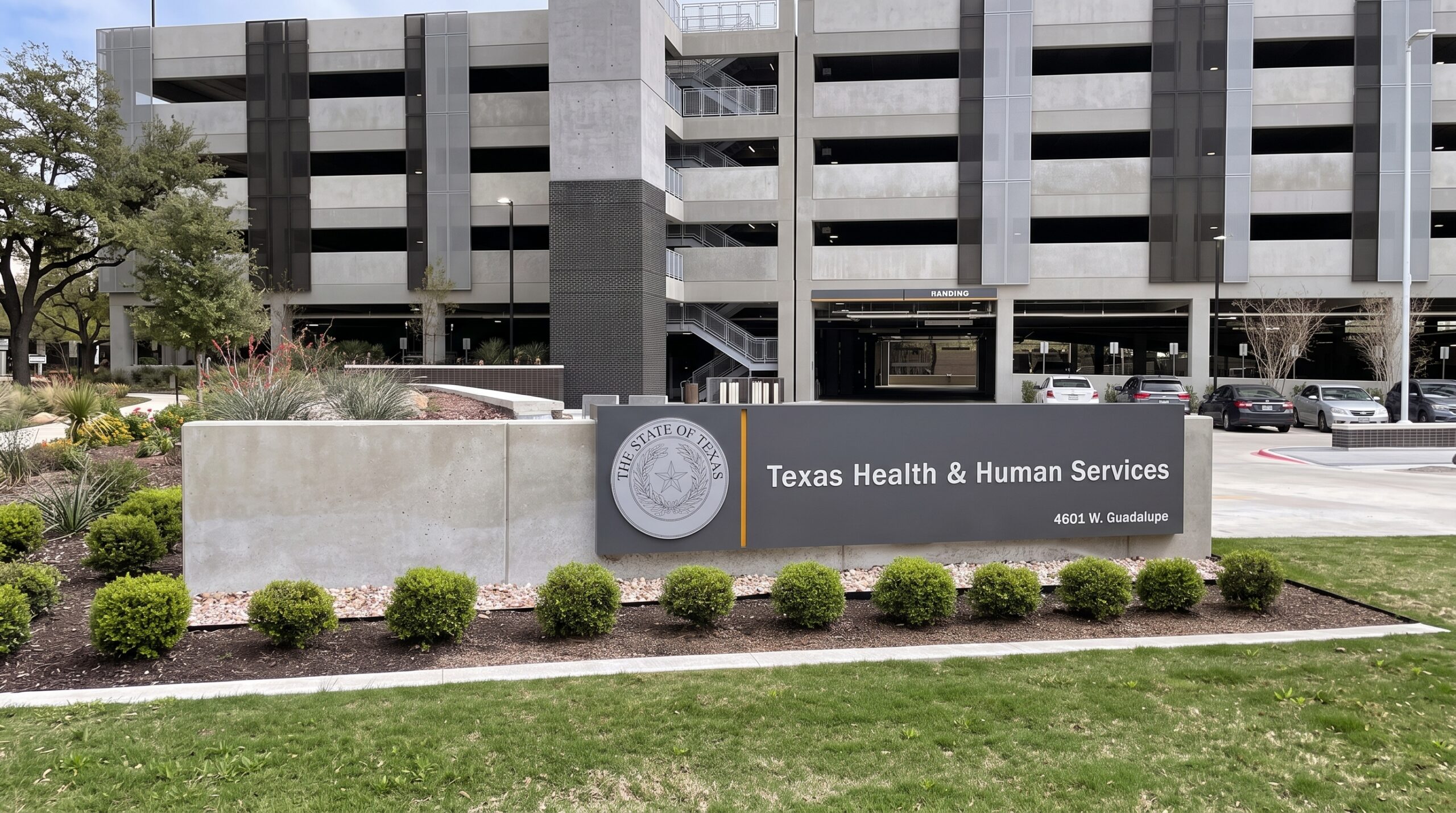
The agency that runs Medicaid, mental health care and food assistance for Texas has told state budget writers it can absorb a 3 percent cut without touching Medicaid — and the line-by-line list attached to that promise eliminates its autism program, eliminates its prescription drug savings program and takes $21.7 million out of women’s health.
The Health and Human Services Commission submitted its spending request for the 2028 and 2029 budget years to the Legislative Budget Board and the governor’s budget office on Sept. 4. It goes before both in a joint budget hearing at 10 a.m. Sept. 24 in Room E2.030 of the Capitol Extension, the first formal airing of what the agency wants and what it says it can live without before lawmakers convene in January 2027.
State agencies are routinely told to show what a 3 percent reduction to their base budget would look like. The commission’s summary of that exercise, signed by Executive Commissioner Stephanie Muth, says the agency “protected key core functions, including direct care services in state hospitals and state supported living centers, eligibility operations and regulatory oversight,” and that “Medicaid and CHIP were exempted.”
The itemized schedule shows who absorbed the difference. The Autism Program loses $13,663,084 over the two years — its entire appropriation. The Prescription Drug Savings Program loses $28,622,066, also its entire appropriation. Women’s Health Programs lose $21,682,392. Rural Hospital Stabilization and Innovation loses $22,000,000. Comprehensive Rehabilitation Services, which serves Texans with traumatic brain and spinal cord injuries, loses $11,005,974. Substance use services lose $12,000,000, community mental health services $4,866,610, and maternal and child home visiting $27,681,234. Family Support Services, the category that houses at-risk prevention work, falls from $305,339,356 to $210,588,020 — roughly 31 percent.
The Medicaid exemption also has an exception in it. The commission’s own numbers show a reduction of $1,907,372 against the strategy that funds the Youth Empowerment Services waiver, which the agency describes as covering “services and supports for children and adolescents (3-18) with severe emotional disturbance as an alternative to psychiatric institutionalization.” Of that, $79,872 is federal Medicaid money and $79,872 is the state’s matching share — a Medicaid waiver paying for direct services, trimmed in the same document that says Medicaid was set aside.
The reductions sit alongside $6.2 billion in new spending the agency is asking for. Its 38 exceptional items — the wish list that accompanies every agency request — total $6,221,494,466 and would bring the full request to $112 billion in all funds, against a baseline of $105.8 billion.
The largest item after Medicaid cost growth is a request to keep the people who decide who qualifies for benefits. The commission wants $212,354,420 to convert 642 temporary eligibility workers into permanent staff. Those positions were added to work through the unwinding of pandemic-era Medicaid coverage, and the budget instruction attached to them says lawmakers intended them to be “phased out by the end of the biennium,” which ends Aug. 31, 2027.
The agency argues it cannot let them go. “HHSC has experienced a significant increase in eligibility actions since 2017, and ongoing additional resources are necessary to meet state and federal standards for timely and accurate eligibility decisions,” the request says. Applications across food assistance, Medicaid, children’s health insurance and cash assistance are running 16.47 percent above pre-pandemic levels, while eligibility staffing has grown 10 percent since 2019. “Texas has not met federal timeliness standards since March 2020,” the document states, with food assistance applications processed on time 84 percent of the time in the 2025 budget year against a federal requirement of 95 percent.
What makes that arithmetic urgent is a federal law. Under the budget reconciliation act signed this year, Washington will reimburse states for only 25 percent of the cost of administering food assistance beginning in the 2027 federal year, down from 50 percent — a $166,512,881 hit the commission has asked the Legislature to cover. The same law makes states pay part of the benefits themselves when their error rate is too high. “Texas’ current error rate would exceed the 6% threshold and trigger State matching of 10% or $700 Million per year,” the request says. Muth put the two-year exposure at “up to $2 billion” and called reducing the error rate “my top priority since becoming executive commissioner.”
Elsewhere the request quantifies need the cuts would not meet. Early Childhood Intervention has lost 22 percent of its providers in a decade. Domestic violence shelters “turned away 23,290 people requesting shelter (51%) in 2025.”
Whether the autism program and the rest come back is a decision for the appropriators who hear from the agency Sept. 24.