
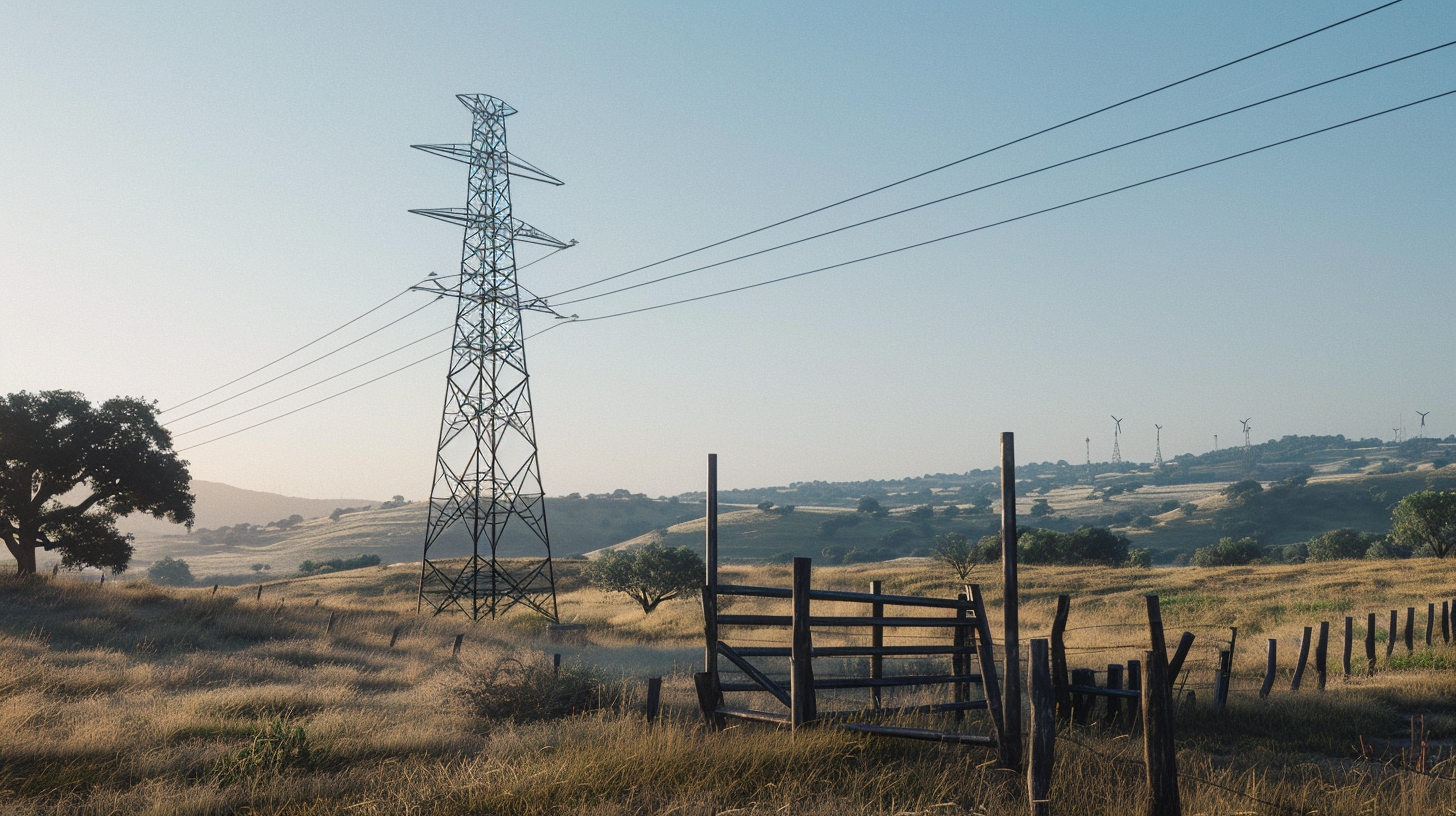
Two state administrative law judges have recommended that Texas regulators approve the Howard-Solstice 765-kilovolt transmission line along Route 4, a roughly 371-mile path estimated at about $2.18 billion, clearing one of the last procedural hurdles before the Public Utility Commission decides the case next month.
The Proposal for Decision, signed July 27 by Administrative Law Judges Sarah Starnes and Amy Davis of the State Office of Administrative Hearings, was filed in PUC Docket 59336 and posted to the commission’s Interchange the same day.
The judges concluded that the applicants, AEP Texas and the City of San Antonio’s CPS Energy, met their burden and that “the record evidence demonstrates that Route 4 should be selected.” In the 138-page recommendation, the judges wrote that Route 4 “presented a balanced option that performs consistently well across cost, community impacts, environmental considerations, prudent avoidance, and engineering feasibility.”
Route 4 would place 67 habitable structures within 500 feet of its centerline, the fewest of the routes the judges compared, and would avoid golden-cheeked warbler critical habitat and the karst zones near San Antonio.
The line is one of three 765-kV “import paths” in the Permian Basin Reliability Plan, a set of high-voltage projects planned after House Bill 5066 of the 88th legislative session to carry more power into the fast-growing, oil-and-gas-heavy region. It would run from a substation near Fort Stockton to one southwest of San Antonio across 14 counties.
The judges found the plan “sufficiently answers” the questions of need under state law. They declined to weigh a broader argument, pressed by the intervenor group American Stewards of Liberty, that regulators should slow the plan in favor of local generation, writing that such a choice “will be made outside the narrow confines of this CCN proceeding.”
State Sen. Kevin Sparks of Midland and Rep. Brad Buckley of Salado filed a letter earlier this month urging regulators to delay a final decision until after the 2027 legislative session so ERCOT can reappraise whether the 765-kV lines are still the right answer given growth in the natural-gas generation queue. The Dispatch has followed that request and the earlier motions to reopen the record. Neither the Sparks-Buckley letter nor the motion to reopen appears in the judges’ recommendation, which was confined to the evidentiary record from the May 19-22 hearing.
The recommendation now moves to the three-member commission on a compressed timeframe. The judges noted that the statutory deadline for a final decision is August 31, 2026, and that state law “does not provide any exception or opportunity for extension.”
Even so, they acknowledged the commission “does not necessarily consider itself bound,” citing its June 17 decision to abate a separate Oncor 765-kV case past a deadline and Chairman Thomas Gleeson’s statement that regulators are “never going to make a decision that is not fully informed just to meet a 180-day timeline.”
Parties have until August 5 to file exceptions to the recommendation and until August 12 to reply, according to a memorandum from the commission’s Office of Policy and Docket Management. The Senate Business and Commerce Committee, chaired by Sen. Charles Schwertner of Georgetown, is scheduled to take up the state of the grid, including 765-kV routing and landowner rights, on July 29.