
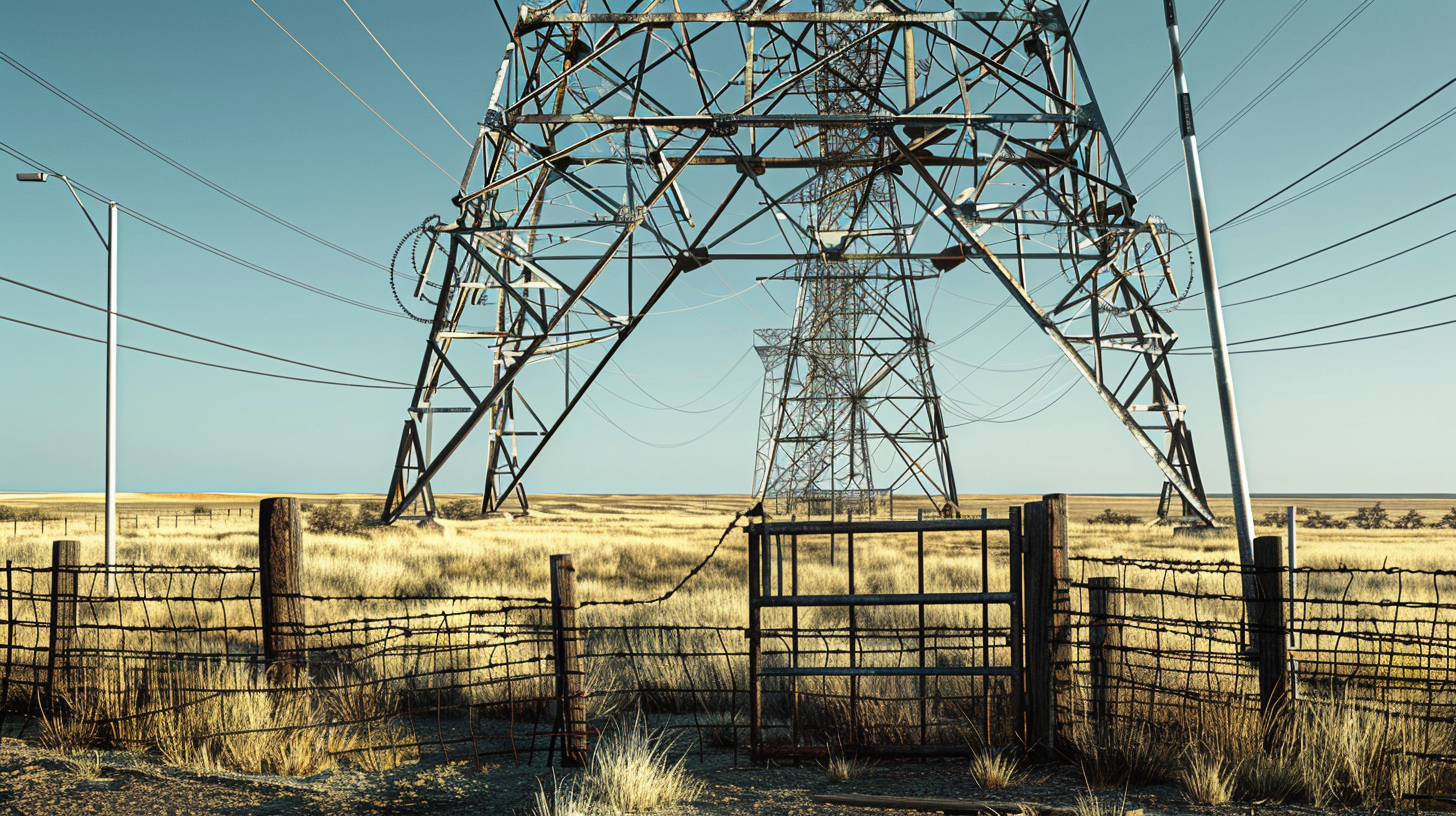
A rancher who is representing himself in one of the biggest transmission cases in Texas history told state utility regulators on Sept. 5 that if they approve two enormous power lines over their own judges’ recommendation, landowners will take them to court.
John B. Bradley, who owns the Lazy S Ranch and intervened without a lawyer in Docket 59475 at the Public Utility Commission of Texas, filed a two-page letter at 9:49 p.m. that Saturday. “I respectfully ask the Commission to accept the Administrative Law Judges’ Proposal for Decision (PFD) and deny the Applications because the Applicants failed to provide the notice and public participation required by the Texas Administrative Code,” he wrote.
The commission takes the case up Sept. 11. It is one of three 765,000-volt line applications — the highest-capacity design built anywhere in the country — on that morning’s agenda, and the commissioners are under a legal clock: state law requires a final order in Docket 59475 by Sept. 22.
In an Aug. 20 recommendation, State Office of Administrative Hearings judges told the commission to deny both the Bell County East to Big Hill line and its companion, Big Hill to Sand Lake, outright. Oncor Electric Delivery and the Lower Colorado River Authority’s transmission arm “failed to establish that the Projects are necessary,” the judges wrote, and separately failed to hold the public meetings the commission’s own rules require. “Because Applicants deprived the process due under the rule to approximately 1,400 landowners,” they concluded, “a denial of the Application is the only meaningful remedy.”
The number comes from a sequence the judges laid out in detail. The companies mailed 2,809 invitations to public meetings held in June 2025. After those meetings they expanded the study area and added roughly 400 miles of new route segments, which pulled about 1,400 more landowners into the project’s path. By the time formal notices went out in March 2026, they went to more than 4,200 people. No further public meetings were held.
Bradley’s letter presses exactly that point, arguing the commission cannot substitute one form of notice for another. “An opportunity for a person to intervene after an application has been filed is not equivalent to the opportunity required by the Commission’s rules to participate in the pre-application public meeting process and community-values period,” he wrote. He also took aim at the commission’s own staff, saying that when staff recommends a particular route rather than testing whether the routes meet the legal criteria, “that recommendation can reasonably create the appearance that approval of the project is already assumed.”
Then the warning. If the commission approves the applications anyway, he wrote, landowners representing themselves “will have to consider the remedies available under Texas administrative law,” including asking a court to reverse or remand the decision where it is “affected by unlawful procedure, error of law, action in excess of statutory authority[,] lack of substantial evidence, or arbitrary or capricious action.” He cited the section of the Government Code that governs judicial review of agency orders.
Nine other parties filed between Sept. 4 and Sept. 6, but none of them argued anything on paper. Each is a single paragraph asking for a speaking slot at the Sept. 11 meeting under the commission’s oral-argument rule. Among them is a unit of local government — the Burnet County Commissioners Court, whose entire filing reads that it “files this its timely Request for Oral Argument at the Open Meeting on September 11, 2026.” The others are landowner coalitions in Docket 59475 and in the separate Howard-to-Solstice and Big Hill-to-Sand Lake cases. One group asked only for time to respond if someone else is allowed to argue.
The money at stake is large and, by the judges’ account, growing. They noted that in 2024 the state grid operator put the total cost of the wider Permian Basin transmission plan at $13.77 billion, and that the estimated cost per line mile has since risen from $6.2 million to roughly $7.5 million, a 21 percent increase. The Bell County East line runs 214 to 244 miles across 15 counties; the Big Hill to Sand Lake line is estimated at $976 million to $1.3 billion, plus about $728 million for substation work.
Oncor and LCRA have told the commission the judges got it wrong, warning in an 81-page filing Sept. 2 that denial would leave Far West Texas exposed to more than 2,000 megawatts of forced outages, as the Dispatch reported. If the commissioners reject the denial recommendation, the judges named a fallback: Route 894.
The meeting begins at 9:30 a.m. Sept. 11 in the commissioners’ hearing room on the seventh floor of the William B. Travis Building in Austin.