
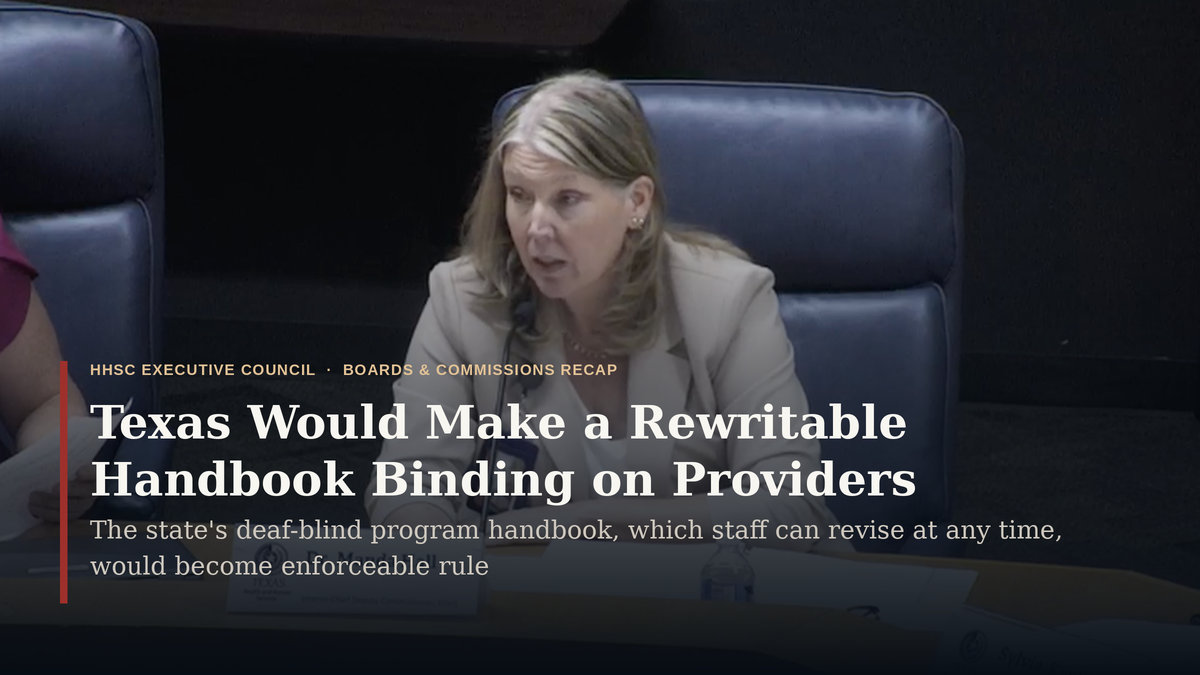
Texas health officials want a handbook they can rewrite at any time, without notice or public comment, to carry the force of law over the agencies that care for Texans who are both deaf and blind.
The people at the end of that chain are few and expensive to serve. As of August 2025, the most recent count the Health and Human Services Commission publishes, 347 Texans were enrolled in the state waiver that pays for their care, with 2,324 more on the list waiting for a slot. About 19 agencies hold contracts to serve them, by the Dispatch’s own count off the commission’s regional provider lists dated July 31.
The change itself is one line. A rule the commission published for comment Sept. 11 adds a seventh item to the short list of things those agencies must obey: the commission’s own program manual for the waiver — the operating handbook, posted on its website, that staff can revise whenever they choose. Every other item on the list is a chapter of state regulation or a federal requirement, none of which can change until the public has seen a draft and had a month to object.
One provider came to the commission’s Executive Council on Sept. 17 to say that difference is the whole point. Heidi May of Deaf Blind Services of Texas, a Katy agency, told the council she has worked with the program for more than 20 years, and opened by giving the commission the easy part: “I am not opposed to following the program manual. We are already doing this.”
Her question was what the rule adds. When the commission changes a regulation, she said, the draft is published and “the public can see it.” The manual can simply be edited. So, she asked, “what prevents HHSC from putting new requirements into the program manual and enforcing that requirement against the program”? She said she was not asking on providers’ behalf: “it’s about protecting the DBMD individuals we serve.”
Then she gave the commission a number. A clause already on the books lets commission staff demand additional supporting documents within ten days — unremarkable on its face, she said, until staff began asking for records outside the published requirements and refusing services when those records did not arrive.
“In 2025, more than half of my clients ended up in a hearing and risk losing services because of that one statement that sounded innocent enough.”
The Dispatch cannot test that. The commission does not publish appeal counts by provider, and the two-page handout May said she gave the council is not posted anywhere. No one at the meeting asked her about it, and no commissioner asked a question.
The commission had already heard the objection and turned it down. Kate Layman, director of program policy for its Medicaid and CHIP division, told the council the agency floated the rule for informal comment in April and that providers said then that writing the manual into regulation could have the effect of “limiting opportunities for public input on program policies.” She said the agency expects the formal comments now coming in to say the same thing.
“We do still hold the position that we are actually enhancing transparency by making it clear that the existing requirement for those providers to comply with the program handbook is also in our rule and not just their contract.”
That is the agency’s strongest argument and it is not a small one. Every one of these providers already promises in its contract to follow the manual; the commission’s published notice says so plainly. If that is right, the rule moves an obligation from one document to another and imposes nothing new — which is why the commission’s economic analysis finds “no adverse economic effect on small businesses, micro-businesses, or rural communities as the proposed rule does not create a change in business practices,” and why it tells the public the rule costs regulated businesses nothing at all.
The same notice, a few paragraphs earlier, also states that the proposal “will create a new regulation”.
No Texas provider association or disability group has taken a public position on the broader question of agencies writing their handbooks into regulation, and none has filed anything yet on this rule. The council itself decided nothing. It has no power to: state law lets it gather comment for the executive commissioner, who adopts the rules alone. Comments on the proposal are due Oct. 12, and the commission may adopt it any time after that.