
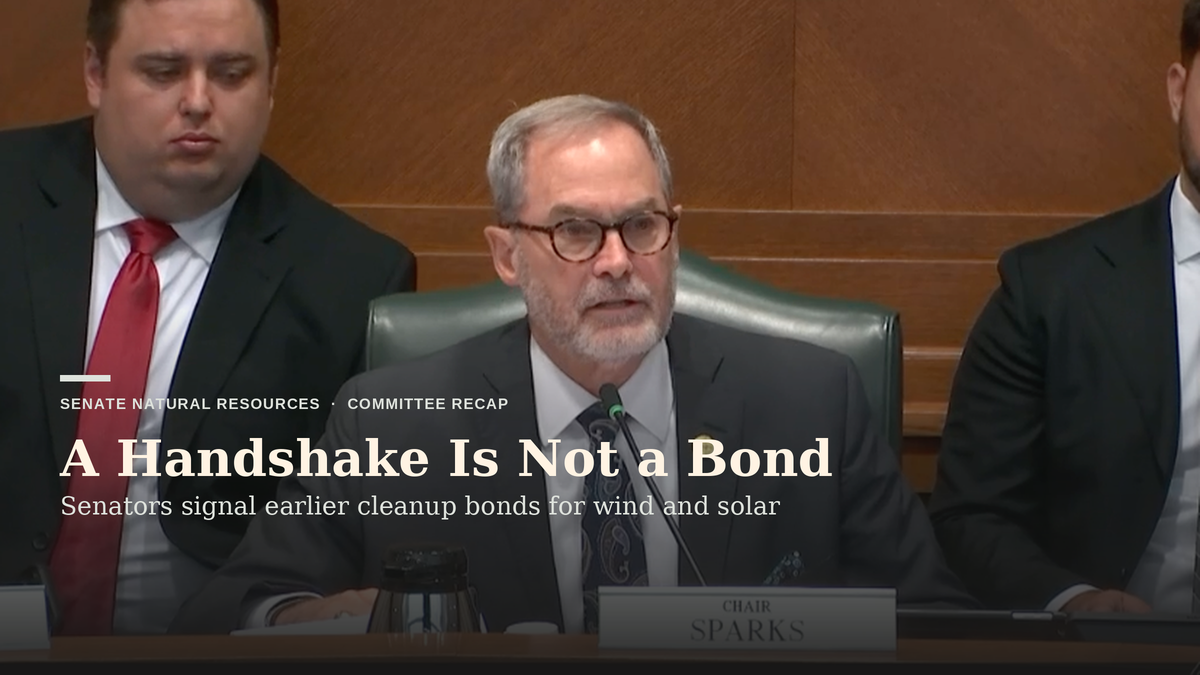
Texas lets a solar developer run a project for 20 years, and a wind developer for 10, before posting a dollar toward tearing it down. After a day of testimony about a Nolan County dump the local prosecutor calls “the wind blade cemetery,” members of the Senate Committee on Natural Resources said Sept. 21 that they expect to change that when the 90th Legislature convenes.
“I believe that we will be looking at legislation to try and help firm this up some,” Chair Kevin Sparks, R–Midland, told the industry panel at the close of a three-hour, 35-minute block on renewable decommissioning — the longer half of a hearing that ran nearly seven hours. Sparks opened the charge by saying landowners must not be “left holding the cost of decommissioning,” so that “rural towns like Sweetwater do not continue to face the consequences of sham recycling.”
The law at issue is the pair of statutes the Dispatch laid out in its preview of the hearing: House Bill 2845 of 2019, now Chapter 301 of the Utilities Code, and Senate Bill 760 of 2021, now Chapter 302. Neither requires the developer’s financial assurance until the 10th year of a wind lease or the 20th of a solar lease, and no agency checks the amount.
Sen. Bryan Hughes, R–Mineola, read the wind statute’s list of acceptable instruments aloud — a letter of credit, a bond, “or another form of financial assurance acceptable to the landowner” — and drew the conclusion: “it could be a handshake, right.” He added, “there’s no statutory floor.” Asked who picks the engineer who estimates the cleanup cost, none of the three industry witnesses knew.
Then he asked whether the industry would object to posting the money before a project is licensed. “We’re open to having that conversation,” said Mark Stover, executive director of the Texas Solar and Storage Association. Judd Messer of the Advanced Power Alliance said the delay was a legislative choice to “push off the obligation until the risk was the highest,” and when Hughes asked whether earlier bonding would mean fewer projects, answered, “my instinct is probably no.” Hughes told the panel, “there’ll be bills filed.”
Ricky Thompson, district attorney for the 32nd Judicial District covering Nolan, Mitchell and Fisher counties, said the operators of a blade recycling site in Sweetwater have been indicted for illegal dumping “because they have not disposed of one wind blade in Nolan County,” kept dumping after a Texas Commission on Environmental Quality cease-and-desist order, and left a cleanup he put at “15 million.” Sparks said “there should be some culpability for those generating companies that contracted with this group,” and put the pile at “more than 3000 blades,” many trucked in from Kansas.
Sen. Pete Flores, R–Pleasanton, went after the penalty. Charlie Fritz, deputy director of the TCEQ waste permits division, said fines “can be up to $25,000 per” day. “A Day, $25,000? Nothing. So we can start there,” Flores said. “That’s lunch time for those people.” The alternative, he said, is to “put it into the penal code, which I chair, criminal justice.” Thompson said illegal dumping tops out at a state jail felony — “one wind blade will get you to the state jail amount.”
Sparks pressed Fritz on whether the recycler reporting created by House Bill 3229 leaves “a loophole for retired panels and or blades to be hauled across county lines, dumped on rural land without TCEQ’s knowledge.” Fritz: “Potentially.” Five recyclers have filed reports, he said, but the agency does “not have a number” on how many exist.
The industry panel argued the framework works. Stover said about 40,000 megawatts of Texas solar exist and “over 85% of it has been developed since Texas passed its solar decommissioning law.” Daniel Giese of the Solar Energy Industries Association said “Texas already has one of the strongest decommissioning frameworks in the country.” Messer called Sweetwater “abhorrent” and said “our members entered into a contract in good faith and were taken advantage of.”
When Vice Chair Judith Zaffirini, D–Laredo, asked, “Is the financial assurance required under current law sufficient to protect landowners and their properties?” Stover and Giese said yes; Messer said the landowner “effectively has a veto authority.”
Sparks was not persuaded. He asked whether the 2024 TCEQ study ordered by Senate Bill 1290 “could have been tainted a little bit or slanted a little bit” by industry participants — “the answer is no,” Stover said — and described a panel stockpile in his district: “It’s solar panels stacked up taller than I am.” His skepticism, he said, comes from 40 years in an oil industry “that still winds up having a lot of orphan wells.”
The comparison panel made his point for him. Jennifer Gilmore of the Railroad Commission said oil and gas bonds of $25,000 to $250,000 are required before a drilling permit issues. Curtis Chubb of the Council to Modernize Governance said his group graded all 50 states and gave Texas a “C” on renewables; “Texas should create a statutory minimum,” he said, with assurance “at the project’s inception, just like it is for oil and gas.”
Author Michael Shellenberger said “any solar company can operate in Texas for two decades without posting any money for waste disposal” and predicted taxpayers would bail out landowners. Sen. Carol Alvarado, D–Houston, pressed him: “I want to make sure that what you’re saying is not just, you know, something that is exaggerated.” He conceded, “it’s a prediction. So I hope I’m wrong about it.”
Sen. Tan Parker, R–Flower Mound, said “those developers need to be on the hook along with the landowner.” Chris Mitchum of Waste Management said the company “has not identified any reasonable, economical, scalable recycling solution for blades” and asked for a dedicated blade landfill program.
No votes were taken. The committee’s report will shape bills for the 90th Legislature, which convenes in January 2027.
The hearing opened with three hours and 10 minutes on the 2025 oilfield theft laws, where the DPS unit created by House Bill 48 reported 289 arrests and every law enforcement witness said prosecution is now the bottleneck — the subject of the companion recap. Sparks said no further interim hearings are planned for the committee.
Fact box
- Issue
- Interim charge — life cycle and decommissioning of wind and solar facilities (approx. 3 hours 35 minutes, about 53 percent of the hearing; longest block)
- What happened
- Four invited panels and four public witnesses on whether Texas’ 10-year (wind) and 20-year (solar) financial-assurance deadlines protect landowners; a Nolan County prosecutor described the indicted Sweetwater “wind blade cemetery” and a $15 million cleanup; Sen. Flores called TCEQ’s $25,000-a-day maximum “Nothing”; Sen. Hughes said current law allows “a handshake” and industry witnesses said they are “open” to bonding before licensing; Chair Sparks said the committee “will be looking at legislation.” No vote — interim hearing.
- When
- Monday, Sept. 21, 2026, 9:00 AM CT · run time approx. 6:45:00
- Where
- Room E1.012 (Hearing Room), Capitol Extension, Austin
- Chair
- Sen. Kevin Sparks, R–Midland (SD-31); Vice Chair Sen. Judith Zaffirini, D–Laredo (SD-21)
- Key witnesses
- Michael Shellenberger; Dr. Sabina Lang and Charlie Fritz, TCEQ; Rachel Meidl, Rice Baker Institute; Chris Mitchum, Waste Management; Dr. Eleftherios Iacovou, Texas A&M; Ricky Thompson, 32nd Judicial District DA; Nick Orman, GLO; Jennifer Gilmore, Railroad Commission; Curtis Chubb, Council to Modernize Governance; Mark Stover, TSSA; Daniel Giese, SEIA; Judd Messer, Advanced Power Alliance; Peyton Schumann, TSCRA; Cyrus Reed, Sierra Club
- Archived video
- senate.texas.gov video 22731