
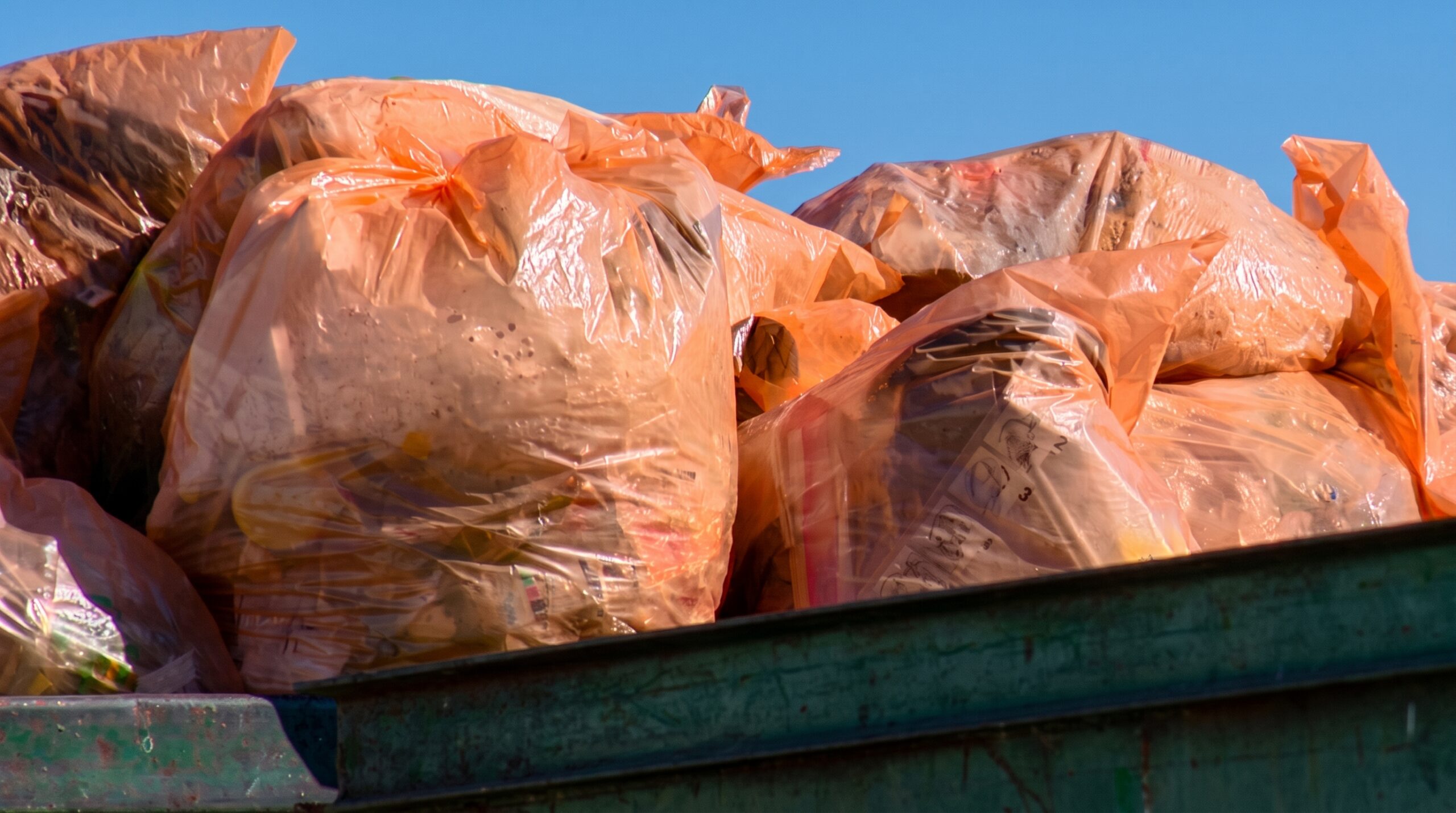
For about ten years, households in eight American cities bought a special orange trash bag, filled it with the plastics their curbside program would not take — chip bags, plastic film, foam cups — and set it out with the recycling. The bag was sold by Hefty. The program was paid for by Reynolds Consumer Products, the company that makes it. It was the leading example of the voluntary, industry-funded alternative that manufacturers point to whenever a state proposes to make them pay for what happens to their packaging.
Reynolds is ending it. The company posted a phase-out notice that replaced the Hefty ReNew program page, first reported Aug. 24. Bags come off retail shelves by the end of 2026, collection stops June 30, 2027, and unused bags can be returned for a refund after that.
The company’s own accounting of what it accomplished is the part Texas should read.
“Over the last decade, the program expanded to eight communities, brought curbside collection opportunities to more than 2.3 million households, and diverted over 3,500 tons of hard-to-recycle materials from landfill,” the notice says.
Divide it out. Across ten years and 2.3 million households, 3,500 tons works out to roughly three pounds of plastic per household — total, for the decade.
Reynolds does not blame residents. “While participation has remained strong, the recycling infrastructure needed to consistently manage such a broad range of materials and align with community preferences has not developed at the pace or scale anticipated,” the notice says. “This decision reflects the challenges of operating a program with such a broad material scope at the scale envisioned and does not diminish the commitment and enthusiasm shown by participating communities and residents.”
That is a manufacturer stating, in writing, that the collection was never the hard part. Nobody would buy the material.
The distinction matters because it is precisely the distinction between the two systems states are choosing between. A program like Hefty ReNew collects a wide, mixed, low-value stream and hopes an end market appears. A container deposit system does the opposite: it collects a narrow stream — aluminum cans, plastic bottles, glass — that is already worth money, and it keeps that stream clean by paying people to keep it separate. The economics are not close. Aluminum used beverage cans have been fetching around 93 cents a pound this summer, while recycled clear plastic bottle bale prices have been running in the low single-digit cents, as The Texas Dispatch reported Aug. 17. Mixed film and foam have essentially no market at all, which is what the notice is describing.
Texas has no deposit system and no producer-responsibility law of the kind California, Oregon, Colorado, Maine and Minnesota have passed. What Texas has instead is voluntary programs — this class of program — and the largest and best-funded example just told its participants why it did not work.
The nearest comparison the Dispatch has reported runs the other direction. Connecticut’s return rate reached 92 percent after the state doubled its container deposit, and Ireland’s deposit system returned 1.4 billion containers in its second year. Those are narrow-stream systems with a price attached, and they recover material by the hundreds of thousands of tons rather than by the thousand.
The live decisions now belong to the eight host cities, which have to decide whether to replace the service or let it lapse. Boise, whose public works department has said the program kept roughly 2,000 tons out of its landfill since 2018 — more than half the national total by Reynolds’s own count — has indicated it does not plan to stand up a replacement.
That leaves a plain finding for legislators who will be asked in 2027 to keep waiting for the market to sort out hard-to-recycle plastics. A packaging manufacturer spent a decade and reached 2.3 million households trying, and has now written down why it stopped: the end markets did not develop. Any Texas policy that assumes they will should say what it expects to be different.
Collection under the program continues until June 30, 2027.