
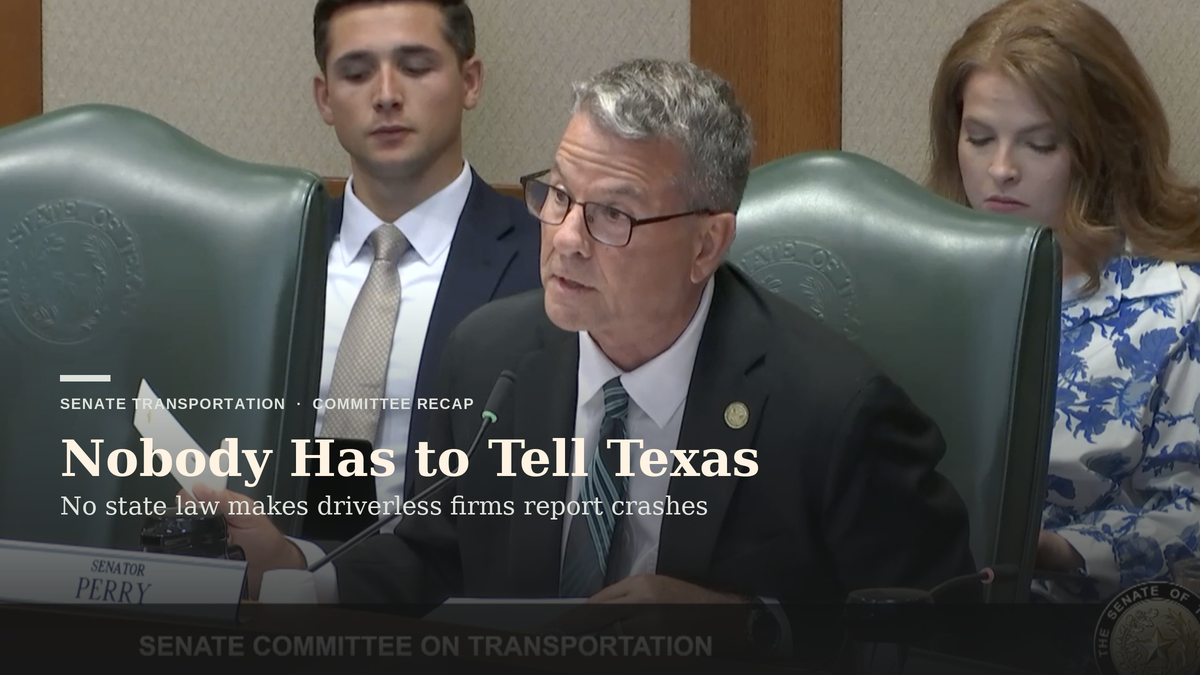
Texas made itself the gatekeeper for driverless commercial vehicles last year. On Aug. 25 the agency holding the gate told senators it has no legal right to be told when one of those vehicles kills somebody.
“The current statute is written, does not have a mandate for reporting to the department,” a Texas Department of Motor Vehicles witness said, “but the department does have the ability to self initiate based on information received.”
Sen. Charles Perry, R–Lubbock, had asked what happens “if there’s a fatality and heaven forbid, it’s systemic, something software wise is going to run cars out in the middle of the T-Bone in the intersection. How do you guys get notified and how long is that process take?” The answer landed hard. “So you gave me the answer that scares the living out of me as a legislator,” Perry said, “because we’re going to have someone get killed, heaven forbid, and somebody’s going to show up and say, why didn’t you guys pull their authorization? And you’re going to say, we didn’t know, but the statute didn’t require.”
The exchange framed the longest stretch of the Senate Transportation Committee’s seven-and-a-half-hour interim hearing. Chaired by Sen. Tan Parker, R–Flower Mound, the panel gave autonomous vehicles roughly 3 hours 20 minutes — about 45 percent of the day. Senate Bill 2807, the 2025 law under review, requires operators of vehicles at SAE Levels 4 and 5 to hold a TxDMV authorization the agency can restrict or revoke.
Asked directly whether the agency needs anything more from the Legislature, TxDMV said no: “the department has not identified any needed legislative changes at this point. We have the authority to administer this program.” The Automated Vehicles Regulatory Program has produced 42 complaints to date, Corey Thompson, director of the agency’s Enforcement Division, told members — “Waymo having the most complaints, also having the most number of vehicles registered in the system with 691 at the time, AV ride with 344 vehicles and four complaints received. Tesla three complaints, 181 vehicles, Zoox with one complaint and 44 vehicles to date.” Most, he added, “relates to what I would say is the vehicles being overly courteous, that a vehicle might have stayed at a stoplight too long.”
Austin’s police told a different story. Lt. William White of the Austin Police Department’s Highway Enforcement Division said incidents “range from rather minor incidents of AVs getting caught in special events, closures to very serious issues of AVs blocking our emergency response to a recent mass shooting.”
His complaint was about accountability. “Obviously, the AVs cannot sign a ticket or be arrested,” White said. “the process is overly cumbersome and officers are significantly less motivated to go through the process each time they witness a violation by an AV, which is common. We believe AV should be accountable for their driving behavior the same way Texans are.” He asked for a statutory fix: “It is our hope in the upcoming session that is remedied, and Avs will be equivalent to human drivers for enforcement.”
Perry pressed the same Austin incident from the state’s side, asking whether a company “was first involved in a first responder issue regarding shooting on the sixth Street” had updated its emergency-services plan. A Department of Public Safety witness said no such update had followed: “I’m not aware of the first responder interaction plan being updated as a byproduct of that. We did. Waymo reached out to us directly. We did sit down and meet with them and discuss the incident, review footage from the vehicle itself.”
Sen. Juan “Chuy” Hinojosa, D–McAllen, went after the evidence base. “I don’t think we have we have enough data to be able to make a decision of how safe some of these trucks are,” he said, then posed a mechanical problem: “if we have a fully automated truck, commercial truck and they have a blowout and it loses a track… are you able to stop that truck?”
Chandler Ludwig, southwest policy manager for Waymo, said the company runs paid rides in 11 cities, four of them in Texas, and drives “4 million miles a week, which is equivalent of to the moon and back more than once a day.” His safety claim: “we are over 16 times safer than the average human driver right now.” Jeremiah Koontz of Aurora said that “As of 20 of June of 2026, the Aurora driver has logged over 6 million commercial miles, with more than 440,000 fully driverless miles on public highway.”
Ludwig also volunteered how self-reporting works in practice, describing his own notification chain after an incident: “That happened at 1133 on a Friday night. I was pulled in at 3 p.m., and I let DMV know at 1024 the next morning.” His reasoning was reputational rather than legal: “trust is really hard to gain and really easy to lose. And so I want them to hear from me.”
Labor asked the committee not to take that on faith. Robert Mealy, president of Teamsters Local 988 in Houston, urged senators to “Judge success by proven safety results, and not by how fast a company can take drivers off the road,” and pushed for “standardized reporting and independent verification. Collision reports are alone are not enough.”
Sen. Paul Bettencourt, R–Houston, tested the industry’s failsafe assumptions, asking whether a lost communications link triggers “a teleoperated event.” Renee Gibson of the Autonomous Vehicle Industry Association said it does not: “Senator, to my knowledge, I don’t know of any companies that are doing tele operations at this point.”
Because this was an interim hearing, the committee took no votes. Parker said at the outset he wanted the panel “to produce a road map that is clear, that is also actionable, with recommendations that the members of this committee can carry into the next legislative session.” The 90th Legislature convenes in January 2027.
Also heard
The committee’s third charge, roughly 2 hours 16 minutes after a midday recess, examined commercial driver license testing and oversight, where DPS reported sharply increased covert audits of third-party testing sites and a civil rights attorney said the state revoked thousands of licenses without notice. The day opened with about 67 minutes on rail grade crossings, where TxDOT rail division director Don Franks said applications for the Senate Bill 1555 program covering 72 crossings far exceeded the $250 million appropriated, and walked members through the federal award the state won this month. A railroad-industry witness asked lawmakers to keep the $250 million in place next session.
Fact box
Issue
Interim charge on studying the deployment of autonomous vehicle technology, including implementation of SB 2807 and the technology’s effect on traffic collisions (approx. 3 hours 21 minutes, about 45 percent of the hearing and the longest of three charges)
What happened
TxDMV told the committee state law does not require driverless operators to report crashes to the agency and that it has identified no needed legislative changes; Sen. Perry called that gap alarming; the Austin Police Department said autonomous vehicles blocked its response to a mass shooting and asked lawmakers to let officers cite AV companies by mail; Waymo, Aurora and the industry’s trade association offered mileage and safety comparisons; the Teamsters asked for risk-tiered standards and independent verification of collision data; no vote (interim hearing)
When
Tuesday, Aug. 25, 2026, 9:00 AM CT · run time 7:32:48, including a 35-minute midday recess
Where
Room E1.016 (Hearing Room), Capitol Extension, Austin
Chair
Sen. Tan Parker, R–Flower Mound (SD-12); Vice Chair Sen. Royce West, D–Dallas (SD-23)
Key witnesses
Clint Thompson and Corey Thompson (directors, Motor Carrier and Enforcement divisions, TxDMV); Col. Freeman Martin and Capt. Oscar Luna (Texas Department of Public Safety); Lt. William White (Austin Police Department); Renee Gibson (Autonomous Vehicle Industry Association); Chandler Ludwig (Waymo); Jeremiah Koontz (Aurora); Blake Calvert (Kodiak AI); Robert Mealy (Teamsters Local 988)
Archived video
senate.texas.gov video 22725