
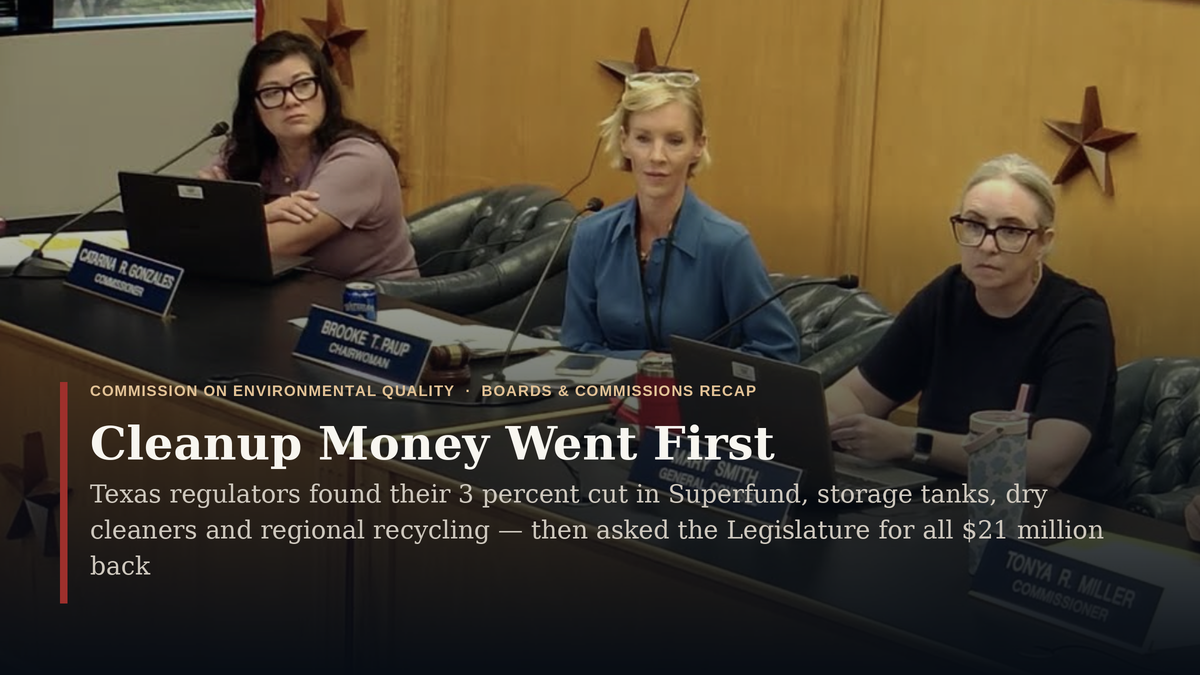
In July, the Governor, the Lieutenant Governor and the Speaker told every state agency to build its next budget request around a 3 percent cut to general revenue. Agencies were free to ask for more — but only in the exceptional items column, the part of a budget request that exists to be negotiated away.
On Aug. 17, in a special called work session that ran 31 minutes, the Texas Commission on Environmental Quality showed what it chose to put in that column. To find the 3 percent, the agency took $21 million out of four programs: the state Superfund cleanup program, petroleum storage tank remediation, dry cleaner remediation, and the grants that pay for regional recycling and solid waste planning across Texas. Then it asked the Legislature to give all of it back.
“This resulted in a reduction of 21 million impacting the remediation programs for super fund, petroleum storage tanks and dry cleaning and the grants for the municipal solid waste,” Elizabeth Sifuentez Koch, who runs TCEQ’s Chief Budget and Efficiency Office, told the three commissioners. “These programs will be highlighted in the request for exceptional items.”
They are exceptional item six — the last of six, and the only one that buys nothing new.
What those programs do is assess and clean up contaminated ground. “Remediation funds are essential to perform assessments and cleanup at contaminated sites potentially impacting groundwater,” Sifuentez Koch said. The reductions she itemized: $3.4 million from Superfund, $4.2 million from petroleum storage tanks, $1.9 million from dry cleaner remediation. The fourth was not trimmed at all. The municipal solid waste grants program “was removed totaling 11 million” — more than half the entire reduction, taken from a single line.
That line is not an agency overhead account. Under the Health and Safety Code, a third of the state’s landfill tipping-fee revenue is dedicated to local and regional projects and passed through the state’s 24 councils of governments. Sifuentez Koch described the work it pays for: developing and maintaining inventories of closed landfills, regional coordination and planning, regional solid waste management plans, and local recycling and diversion projects. “These grants support regional solid waste projects and planning efforts,” she said.
Staff gave the six exceptional items a combined total of $73 million and 126 FTEs, and stated five of them individually. Those five come to $52.4 million, which leaves $20.6 million for item six. The reductions itemized for item six come to $20.5 million. The five stated FTE counts — 42, 31, 10, 28 and 15 — sum to exactly 126, which means item six carries no positions at all. It is pure restoration. (Both sums are the Dispatch’s arithmetic on the figures spoken aloud.)
| Exceptional item | General revenue | New FTEs |
|---|---|---|
| 1. Statewide water resources | $14.6M | 42 |
| 2. Frontline support | $9.2M | 31 |
| 3. Permit process efficiencies | $1.7M | 10 |
| 4. Continuity of operations | $10.0M | 28 |
| 5. Mission critical support | $16.9M | 15 |
| 6. Restoring the remediation and grant reductions | ~$20.6M | 0 |
| Stated total | $73M | 126 |
Items 1–5 as stated aloud Aug. 17. Item 6 and the totals row are the Dispatch’s arithmetic; staff did not state item 6 separately.
Commissioner Tonya R. Miller named the principle that governed which lines took the hit. “And also wanted to note that our three protects 3% reduction does not impact our current staff,” she said. “I think it’s very important and I know the leadership of this agency always tries to protect our staff and make sure that they have the resources needed to do their jobs.”
Read straight, that is a statement about where a 3 percent cut lands when payroll is held harmless. It lands on programs. At TCEQ this session, it landed on the four that pay to characterize and clean contaminated sites and to keep regional waste planning running.
None of this is irregular, and none of it is hidden — the agency put the restoration request on the record in open session and said plainly what it was. It is also the second time in four days the Dispatch has watched the same maneuver. On Aug. 14 the Texas Water Development Board cut its StratMap geospatial program from $14 million to $3.5 million in its baseline and asked for $10.5 million back as an exceptional item — the cut and the ask matching to the dollar. Two agencies, one instruction, the same shape: a program moves out of the column the agency may assume and into the column the Legislature has to choose.
The FY2028–29 baseline TCEQ approved is $944 million, which staff described as an increase of about $7 million, attributed mostly to federal money from the Methane Emissions Reduction Program. That attribution deserves a flag rather than a correction: TCEQ’s $134.15 million MERP award was obligated in May 2024 and survived the 2025 rescission, which reached only unobligated balances — but the underlying federal appropriation expires Sept. 30, 2028, one year into the biennium being requested.
The largest exceptional item is water. Statewide water resources, $14.6 million and 42 positions, covers wastewater permitting, district applications, beneficial use of reclaimed water, water occupational licenses, toxicology and the associated compliance work, plus targeted funding for the Clean Rivers program that tests and monitors water across the state. Frontline support, $9.2 million and 31 positions, is investigations, emergency response and enforcement — against a regulated universe Deputy Executive Director Steven Schar and the commissioners both put at “over 834,000” facilities. TCEQ’s own annual enforcement report gives that number as 834,000 public and private facilities and individuals; the count includes roughly 55,000 occupational licensees, so it is not 834,000 regulated sites.
Permit process efficiencies, $1.7 million and 10 positions, is the one item tied directly to public access. Staff attributed the need to the agency’s Sunset legislation, which added public-engagement requirements to permitting, combined with rising application volume: the agency, Sifuentez Koch said, “requires additional staff to meet demand for public meetings and to respond to comments.” The staff characterization that TCEQ “has successfully implemented” the 2023 Sunset recommendations runs ahead of the agency’s own written position, which is that many are fully implemented and the rest are substantially underway.
On the operating side, staff put the FY2027 budget at $636 million against $752 million for FY2026 — a decrease of roughly $117 million, or 15 percent — and said it is mostly one-time money leaving: supplemental information-technology funding, federal methane and dam safety grants, and front-loaded riders. Four offices absorb most of it: Air down $39 million, Administrative Services down $27 million, Water down $20 million, Compliance and Enforcement down $13 million. Staffing goes the other way, up three positions. Neither the $636 million nor the $752 million could be verified — TCEQ has not published the FY2027 operating budget, and its last adopted total, for FY2026, was $687.8 million.
One number was disputed on the record and left that way. Sifuentez Koch said fee funds are 82 percent of the budget, with the Texas Emissions Reduction Plan trust at 32 percent and general revenue–dedicated accounts at 50 percent, and general revenue at 3.5 percent. A moment later a commissioner asked her to go back a page and restated it differently: “A huge point to be made here is 50% of our budget is fee funds. 50%. I don’t know. There are very few agencies that have to work with that type of budget.” The two figures are reconcilable — 32 and 50 make 82, so the 50 percent restated from the dais appears to be the general revenue–dedicated line rather than the fee-fund total — but nobody reconciled them aloud. “Yes, we we collect over a hundred different fees,” Sifuentez Koch added.
Chairwoman Brooke T. Paup moved approval and Commissioner Catarina R. Gonzales seconded; the marked agenda records the outcome as “BP/CG; all agree.”
“It really asks for what we need, but there’s no fluff in this this either,” the chair said of the document before the vote. “We will be asking for the resources we need because the only thing they can do is tell us no.”
They can also say yes to five items and no to the sixth. That is the specific risk the structure of this request creates, and it is the checkable question for the 90th Legislature: the five items that add staff and systems are competing for approval against one item that only restores ground already given up. If the baseline holds and item six does not, TCEQ enters the 2028–29 biennium with $21 million less for contaminated-site assessment and cleanup and regional waste planning than it has now — not because anyone decided those programs mattered less, but because they were the lines available when payroll was off the table.
Archived video
Commissioners’ Work Session — August 17, 2026, TCEQNews. Posted Aug. 18, the day after the meeting.