
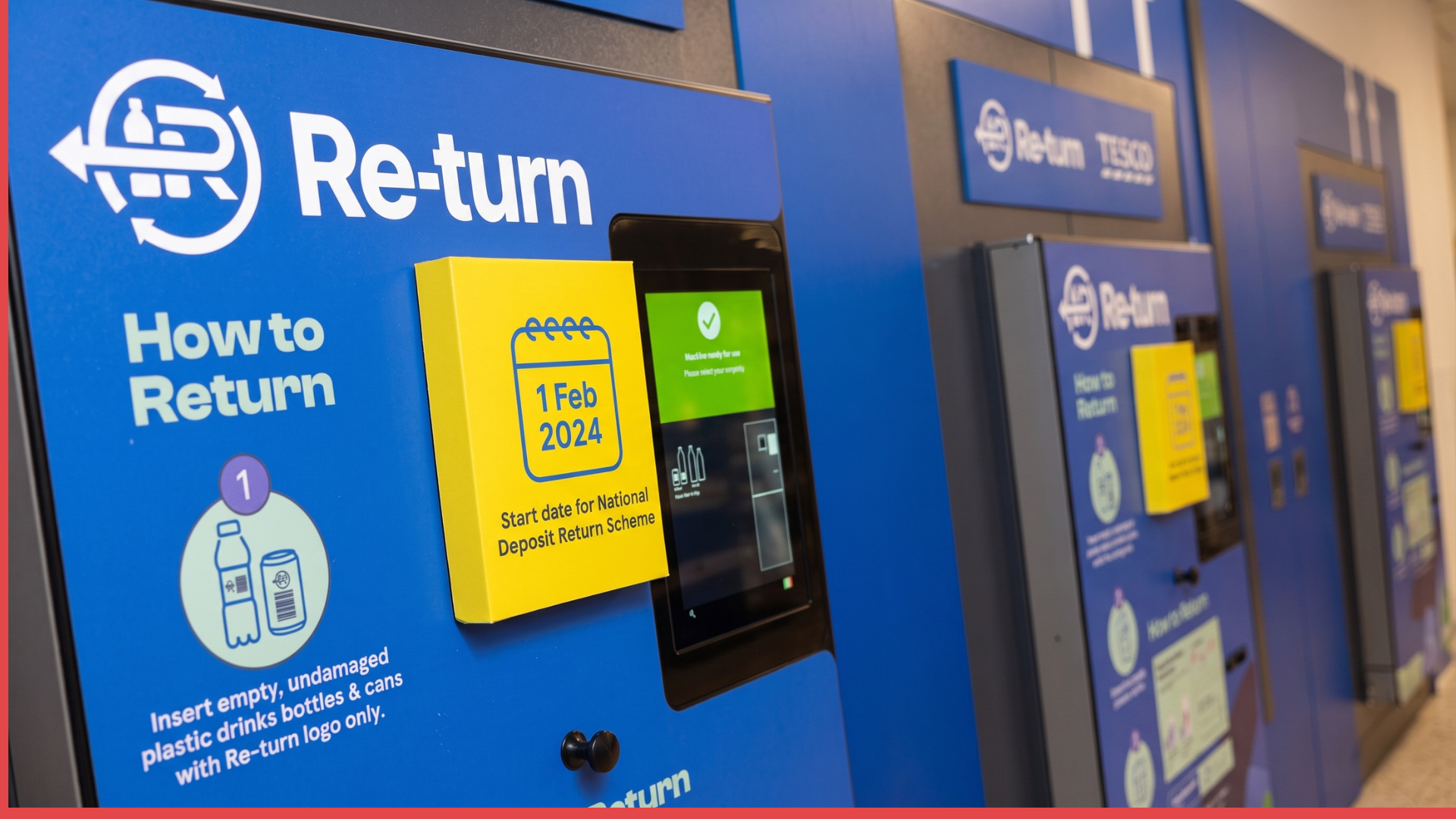
Irish consumers returned 1.4 billion bottles and cans for deposit refunds in 2025 — a 76.4 percent return rate in only the system’s second year — while leaving €60.1 million in deposits unclaimed, according to the 2025 annual report published July 31 by Re-turn, the not-for-profit company that runs Ireland’s Deposit Return Scheme, as reported by RTÉ.
The 1.4 billion containers returned in 2025 compare with 877 million in the first eleven months of 2024, and the tonnage tells the same story: 30,917 tonnes of material went back for recycling in 2025, up from 18,893 tonnes the year before.
The system is simple. Since February 2024, every plastic bottle and aluminum or steel can sold in Ireland carries a deposit of 15 or 25 euro cents — roughly 17 to 29 U.S. cents — refunded when the empty container comes back to a shop or reverse vending machine. The economics run through the deposits themselves: consumers who do not redeem left €60.1 million in the system in 2025, down from €66.7 million in 2024 as participation rose. Chief Executive Ciarán Foley said in the report that the Irish public’s “response to the deposit return scheme has been incredible.”
The performance numbers place Ireland near the top of the deposit world almost overnight. Before implementation, Ireland recycled 49 percent of its drink containers; by mid-2025 the national rate for those containers was an estimated 91 percent — 76 percent captured directly through the deposit system and another 15 percent through household recycling bins, according to Re-turn’s report on its first full year.
For comparison, the highest-performing U.S. deposit state, Oregon, redeems about 87 percent, and no U.S. state without a deposit approaches either figure, according to redemption data compiled by the Container Recycling Institute. Momentum has continued into 2026: a record 5.8 million containers came back in a single day on June 27, and cumulative returns have passed 3 billion, The Irish Times reported.
The clearest street-level effect is on litter. The Coastwatch marine litter survey recorded the lowest average levels of bottle and can litter on Irish shores in 25 years in 2024, per Re-turn. The business group Irish Business Against Litter reports container litter has been cut by more than half since launch — but its June 8 national survey also carried a caution: plastic bottle litter appeared at 19 percent of sites surveyed and can litter at 22 percent. “If we had hoped that the DRS would see this litter disappear from our streets entirely, that’s not happening,” IBAL’s Conor Horgan said. “15c or 25c does not appear enough to incentivise some people to return a bottle or can. That said, by reducing this litter by 50%-plus, the scheme’s impact on overall cleanliness levels is beyond dispute.”
The system is also reshaping where Ireland’s material goes. Re-turn said it is advancing the country’s first on-island PET bottle-to-bottle recycling facility, now in a tender process, so that plastic bottles collected through the scheme can be recycled domestically instead of being exported for processing — the supply-chain argument American can and bottle makers make when they note U.S. mills and PET plants import recycled feedstock that domestic collection fails to capture.
Texas, which has no deposit law, buried or littered roughly 80 percent of the 23.7 billion beverage containers its consumers bought in 2021, according to a Texas A&M Mosbacher Institute analysis — a gap between what a functioning deposit market captures and what a landfill state leaves on the table, a contrast The Texas Dispatch has examined in its coverage of deposit-system economics.
Re-turn’s stated next target is the roughly 15 percent of containers still going into household recycling bins and 9 percent going into general waste. “The environmental and social impact so far has been significant, but this is just the beginning,” Foley said. “It’s vital that we continue returning containers to maintain momentum and ensure lasting change.”