
The pension fund covering Texas public school teachers is no longer actuarially sound, and the reason is the teacher pay raise lawmakers passed last year. Brian Guthrie, testifying for the Teacher Retirement System of Texas, told the House Pensions, Investments & Financial Services Committee on Aug. 18 that the fund’s funding period has stretched to 35 years — four years past the statutory line. “The definition of actuarial soundness in statute is to have a funding period of less than 31 years. So we’re very close to that. But it is something that needs to be addressed,” he said.
The fund itself is large and performing. The trust “just north of $225 billion, that is even higher now,” Guthrie said, and returns are running well ahead of assumptions: “As of today, we are still in terms of a fiscal year to date return above 13%, and that is well above our projected target of 7%.” None of that closes the gap. “It’s not going to come down below 31, but it’s going to get a lot closer,” he said of the coming valuation.
Guthrie was explicit about the cause. The period was “actually 27 years or 28 years when we were discussing this during the legislative session. But at that time, we also were aware that if the teacher pay raise legislation passed as expected, that would create an additional liability for the retirement fund. And it has.” The raises in House Bill 2 were aimed at veteran educators, he said, which compounds the cost: “Because they are later in their career, they’re going to be retiring sooner and not have enough time to contribute to the system.”
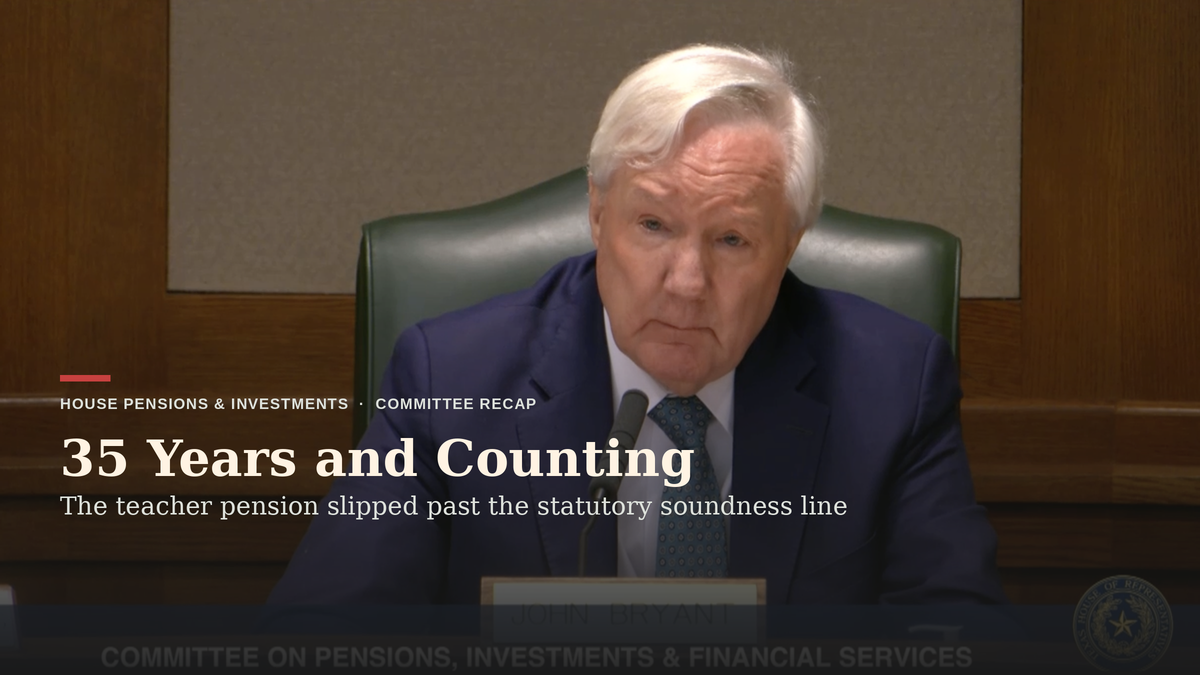
Rep. John Bryant, D–Dallas, drove the hearing’s central exchange and would not let the number go. “The average monthly annuity being paid to our retired teachers is $2,317,” he said. “If your most productive years are spent in public education and you retire with $2,300 a month, you can’t live on that.”
Asked whether Texas is competitive nationally, Guthrie declined to defend it: “I’m not going to sit here and tell you that it’s a tremendous benefit that leads the country. That is certainly not the case.” Bryant pressed anyway. “If instead of $2,317, the average monthly annuity was twice that, you still couldn’t live on that, at least in the city I live in,” he said.
Bryant then went after the 31-year standard itself. The system’s actuary, Gabriel Roeder Smith, treats “a funding period of less than 25 years” as best practice, Guthrie said, and among peer systems “the average is probably around 22 to 25.” Bryant asked what the statute is worth against that. “Somehow somebody wrote a state law saying it’s 31. What validity does a state law saying it’s 31 have relative to what experts in the economy say it is?”
Guthrie would not defend the figure, saying only that “that was a standard that was assumed by actuaries decades ago.” Bryant summarized: the number “is essentially irrelevant in terms of judging the actuarial soundness of our teacher retirement system in 2026.” Guthrie’s reply: “I would say that it is unusual to have that number set in statute.”
The system has already told the state what it will take. Guthrie confirmed the actuary recommends a contribution rate increase “of 1.5% of payroll to get the fund back on track,” and said the request is in writing: “We have our LAR. It was just submitted last week. And in my administrator’s statement, I speak to the 1 to 1.5% contribution rate.” A rate at that level, he said, “would get us down to a funding period of around 22 years.”
Bryant put the sequence on the record. Texas “passed our school finance program, our teacher salary increase program, our voucher program, without changing, simultaneously changing or adjusting the underlying statutory contribution rates. Therefore, we moved from 31 years to 35 years. Is that correct?”
Guthrie corrected only the starting point: “Yes. We were actually at 28, so yes. We went from a situation where we were actually sound to no longer being actuarially [sound].” On the education savings account program, Guthrie said TRS ran a fiscal note and “the impact on the system would be very, very small,” but that the program “has only been in place for a year.”
Bryant closed with a rhetorical question and then answered it. “What are the chances that the state would go 20 years without giving a cost of living adjustment to the majority of teacher retirees?” he asked. “It was a rhetorical question because we did go 20 years without giving a cost of living adjustment to a majority of our retirees. That is the price paid for being out of compliance with actuarial standards.”
Republicans on the panel pushed in a different direction. Rep. Alan Schoolcraft, R–McQueeney, asked what a member of a private plan would fear. “I guess I would be pretty worried about default because there’s no backdrop,” he said. “What’s the chances of the state ever defaulting on the obligations to the teachers?” Guthrie rated it “extremely low,” and Schoolcraft used the answer to defend the statute: “So would that maybe be a reason that a 31 year funding period might be acceptable for a state government as opposed to a private fund?” Guthrie called that “a reasonable conclusion.”
Rep. Richard Hayes, R–Hickory Creek, arrived at Bryant’s conclusion by another road, arguing that fixing the teacher shortage takes “not only better pay, but better retirement system.”
An equity question also surfaced. Charter schools and other non-district employers pay the full 2 percent employer contribution regardless of the state minimum salary schedule, while districts effectively pay less — a differential Guthrie estimated “to be about $14.5 million.”
Because this was an interim hearing, the committee took no votes. The record feeds the interim report and the contribution-rate fight lawmakers will take up in the 90th Legislature, which convenes in January 2027.
Also heard
The committee took invited testimony only across four charges in 1 hour and 48 minutes, running the two pension reviews first and the two implementation charges last. Chair Stan Lambert’s panel spent about 11 minutes on House Bill 201 and the expansion of the Texas Financial Crimes Intelligence Center into motor fuel theft, where a witness said the center has “either prevented or recovered $349 million worth of fraud” this year and warned that some agencies hand seized vehicles full of stolen fuel back to the criminals because nowhere will take the hazardous load. A final seven-minute charge covered House Bill 3526 and the Bond Review Board‘s local debt database, due Sept. 1; the board said seven municipal utility districts missed the May election reporting deadline and that it has “no mechanism, no stick other than public shaming.”
Fact box
Issue
Interim charge reviewing the actuarial soundness of the Teacher Retirement System (~43 minutes, ~40% of the hearing — the largest charge by time)
What happened
TRS told members the fund’s funding period has stretched to 35 years, past the 31-year statutory soundness threshold, because last session’s teacher pay raise added liability without a matching contribution increase; the system’s actuary recommends raising contributions 1 to 1.5 percent of payroll, an ask now in the agency’s legislative appropriations request; no vote (interim hearing)
When
Tuesday, Aug. 18, 2026, 10:00 AM CT · run time 1:47:45
Where
Room E2.012, Capitol Extension, Austin
Chair
Rep. Stan Lambert, R–Abilene (HD-71)
Archived video
house.texas.gov, video 22752