
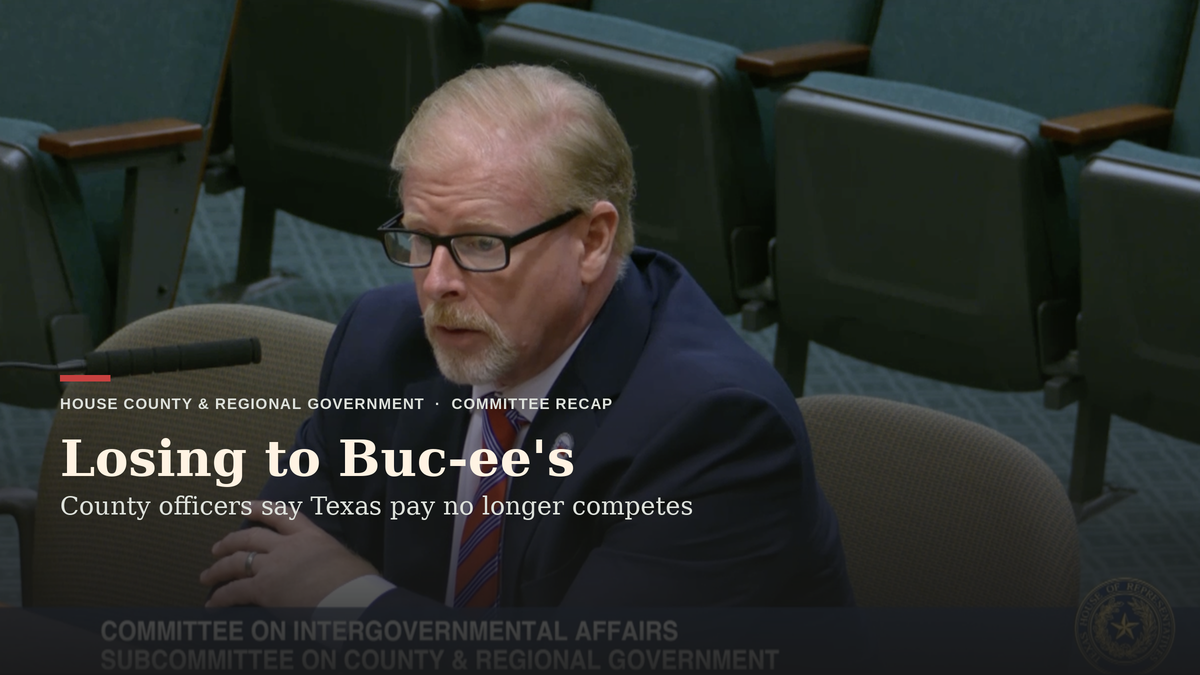
Texas has spent three sessions pushing state money into rural sheriff’s offices. County law officers told a House panel Aug. 25 that the money is not reaching the officers who need it most, and that county pay has fallen far enough to lose recruits to a convenience store.
“It is shameful that you can start at Buc-ee’s and make more than a county deputy in the sheriff’s department or a Constable’s department,” Robert Leonard, executive director of the Combined Law Enforcement Associations of Texas, told the House Permanent Standing Subcommittee on County and Regional Government. His group represents nearly 30,000 law enforcement personnel statewide.
The subcommittee, chaired by Rep. David Spiller, R–Jacksboro, took up county law enforcement recruiting and retention second on its agenda and gave it the larger share of the hearing — roughly 87 minutes of the two-and-a-half-hour meeting. The state’s main tool is the rural law enforcement salary grant program created by Senate Bill 22 in 2023 and administered by the comptroller. Witnesses spent most of the charge arguing about who it leaves out.
Constable Chad Jordan of Hood County Precinct 4, vice chair of the legislative team at the Justices of the Peace and Constables Association of Texas, brought a statewide survey. “In those S.B. 22 eligible counties, 21% of the constables had no agency owned vehicle, 23% have no current ballistic vest, and 10% have no radio communications at all,” he said. “67% are still carrying their own personally owned firearm because their county does not issue one, and 74% have no support staff or clerk at all.”
“The median constable salary is 54,000, less than half of the $120,000 median in counties of 300,000 or more,” Jordan said. “Nearly a third of constables in eligible counties, 31% are still paid below $45,000 minimum.” He pointed the subcommittee at legislation that already failed once: “During the 89th legislative session, Representative Katrina Pierson and Senator Bob Hall recognized this disparity and filed House Bill 3253 and Senate Bill 1471. Those bills would have removed the county match requirement, raised the minimum salary, and expanded how grant funds could be used, bringing constables closer to parity with sheriffs. Neither Bill reached the governor’s” desk.
Sheriff Brian Hawthorne of Chambers County, immediate past president of the Sheriffs’ Association of Texas, said some counties are turning the state’s money away outright. “Unfortunately, we still have a handful of eligible counties who refuse to accept the grant funding,” he said. “Some express concerns about the perpetual nature of the grant, and some simply don’t want the sheriff to make a higher salary than other elected officials.”
Hawthorne’s harder number was the state’s training fund. “My agency receives $11,000 a year. That’s about $130 per deputy,” he said. The account “was appropriated $5.4 million for the year to assist more than 2600 agencies and more than 83,000 officers” — less, he said, than the roughly $6 million it drew 23 years ago. He also framed the scale of the problem the state is trying to fund: “We have more than 2600 law enforcement agencies in the state. That’s two times more agencies than California and Florida combined.”
Members pushed back on the technology sheriffs say they need. Rep. David Lowe, R–North Richland Hills, said automated license plate readers are the subject he hears about most. “House district 91 constituents. Call me frequently about” license plate readers and flock cameras, Lowe said, asking “where is the line between community safety and being a surveillance state? Because, you know, we, we have seen you give the government an inch. Oftentimes it takes a mile.” Hawthorne answered that the systems are narrower than critics assume: “Alpr does not track your movements. It does not listen to your conversations, and it does not tell you where who the vehicle belongs to.”
Rep. Erin Zwiener, D–Driftwood, turned the charge toward the jails that consume sheriff budgets. “we passed SB eight last session that required these 287 agreements between local law enforcement and Immigration and Customs Enforcement,” she said, referring to Senate Bill 8. “And my understanding is that’s really increased the number of folks sitting in jail and increased stress on our jailers.” Hawthorne, a participating sheriff for six years, disagreed on the jail-population effect, saying most of those held “were being arrested for a criminal offense.”
Zwiener said staffing, not capacity, is the binding constraint in her district: “I know it’s been a challenge for Hays. You probably know, we built a new jail and we can’t fully use our jail because of trying to hire adequate numbers of jailers.” Leonard said the jail is where county forces bleed out. “these 18, 19 year olds who are going into the jail get to be 21 years old, they all want to leave the jail,” he said. “One of the highest turnovers in the law enforcement profession are detention officers.”
An attorney with the Texas Civil Rights Project, testifying in public comment, urged the subcommittee to look past salaries. “the criminal legal system has become one of the largest providers of mental health services,” she said. “This problem is particularly acute in rural counties where hospital closures are common and diversion programs or community based resources are limited.” She argued county resources “are being expanded on the federal government’s priorities, even at a cost to counties via the 287 G agreement,” and asked members to “invest in behavioral health services, crisis response, homelessness services, substance use treatment.”
Because this was an interim hearing, the subcommittee took no votes. Its findings feed the Intergovernmental Affairs interim report and the county bills lawmakers file for the 90th Legislature, which convenes in January 2027.
Also heard
The subcommittee opened with its other interim charge, on whether more Texas counties should be required to run a medical examiner’s office, and gave it about 64 minutes. A Williamson County justice of the peace, a Fort Bend County chief medical examiner and a Travis County deputy chief medical examiner all urged lawmakers to lower the 2.5 million-resident trigger in state law. Sheriff Bob Hager of Jack County was invited to the law enforcement panel but withdrew the morning of the hearing to return home to a wildfire; the chair said he submitted written testimony instead.
Fact box
Issue
Interim charge on strengthening county law enforcement — recruiting, training and retention, and disparities between counties in how agencies are funded, contracted with and staffed (approx. 87 minutes, about 57 percent of the hearing)
What happened
Constable, sheriff and police-association witnesses told the subcommittee the SB 22 salary grant program has left constables far behind sheriffs, that some eligible counties refuse the money outright, and that the state’s officer training fund is smaller today than 23 years ago; members pressed on license plate reader surveillance and on jailer staffing under the state’s ICE cooperation law; a Texas Civil Rights Project attorney urged investment in behavioral health instead; no vote (interim hearing)WhenTuesday, Aug. 25, 2026, 9:00 AM CT · run time 2:33:53
Where
Room E2.028, Capitol Extension, Austin
Chair
Rep. David Spiller, R–Jacksboro (HD-68); Vice Chair Rep. Sheryl Cole, D–Austin (HD-46)
Key witnesses
Robert Leonard (executive director, Combined Law Enforcement Associations of Texas); Constable Chad Jordan (Hood County Precinct 4, Justices of the Peace and Constables Association of Texas); Sheriff Brian Hawthorne (Chambers County, Sheriffs’ Association of Texas); an unnamed attorney for the Texas Civil Rights Project
Archived video
house.texas.gov/videos/22743