
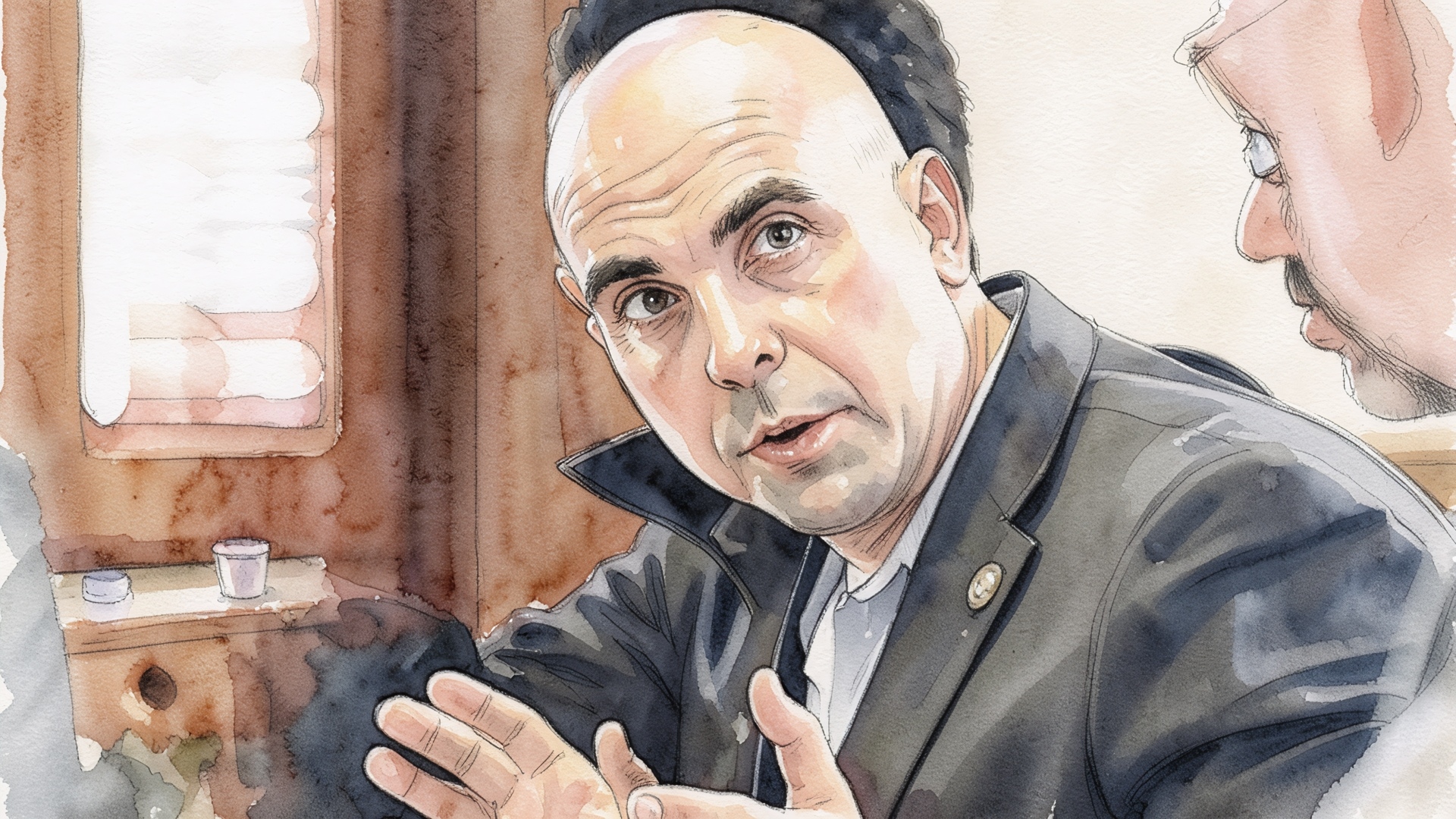
When a hurricane closes the highways into the Rio Grande Valley, the roads stop being the answer. Rep. Armando Martinez has spent his career at the point where that problem becomes concrete: he is a firefighter and licensed paramedic, spent years as a critical care flight paramedic, and holds a pilot’s license with instrument, commercial and multi-engine ratings.
That combination has produced a conviction he now brings to the Capitol. Texas’ network of small general aviation airports, he argues, is not a hobbyist amenity. It is transportation infrastructure, economic development infrastructure, and — when a flood or a fire cuts a region off — emergency infrastructure that the state has never fully funded.
“When you’re talking about relief and response to disasters, you think about where could you access” the region, Martinez says. “Airports just make sense. Especially general aviation airports.”
Martinez has represented House District 39 in Hidalgo County since 2004 — eleven terms covering Weslaco, Mercedes, Donna, San Juan, Alamo and Progreso. He sits on Appropriations and serves as vice chair of the House Natural Resources Committee. This interim he took on something new: Speaker Dustin Burrows created a nine-member Select Committee on General Aviation in March, naming Rep. Keith Bell chair and Martinez vice chair.
It is an unusual committee, and Martinez is one of the few members who can evaluate an airport from the left seat.
The disaster case
The committee’s charges include examining the condition and capacity of the state’s general aviation airports and identifying capital improvements needed for transportation access and aviation safety. Martinez’s interest runs through the first responder’s question: when the region is cut off, what is still reachable?
The precedent is well documented. During Hurricane Harvey, general aviation fields became the connective tissue of the relief effort — the airport in Conroe dedicated a hangar as a distribution center for supplies flown in by private aircraft, and Stinson Municipal near San Antonio staged humanitarian cargo while the major commercial fields were consumed with their own operations. The complication that year is precisely Martinez’s argument: relief was slowed not because airports were closed but because flooded roads made it hard to move anything from them. Where the airfield sits, and what it can handle, determines how fast help arrives.
Commercial airports, he notes, are congested with commercial traffic even in normal conditions. A general aviation field is often simply closer to the damage. “You may have a general aviation airport that may be closer to an area that’s just been impacted,” he says. “If you have the infrastructure in place, if you have the money that’s been invested into those airports, then you can receive those supplies… much quicker.”
His own district offers the working model. Mid-Valley Airport in Weslaco sits in the middle of the community, near the expressway, and is being built into a regional staging hub for disaster response south of San Antonio — covering the corridor from Laredo to Corpus Christi and across the Valley. Gov. Greg Abbott announced roughly $26 million in state funding for Weslaco projects last September, including $10 million for runway expansion, $8 million for water and drainage improvements, and $8 million for an emergency and first responder facility at the field. The airport already serves as a base of operations for the Department of Public Safety, the National Guard and Customs and Border Protection.
The runway math explains the rest. Mid-Valley’s runway currently runs 6,000 feet long and 75 feet wide. The plan is to widen it to 100 feet and add another 1,000 feet — dimensions that determine whether a heavy aircraft carrying supplies, personnel and equipment can land there at all. “You want to be able to attract larger aircraft with these type of supplies, especially when there’s a disaster,” Martinez says.
The economic case
The disaster argument tends to persuade people once a disaster has happened. The economic argument is what makes these airports worth maintaining in the years between.
Texas general aviation airports support more than 48,000 jobs, $2.5 billion in payroll and $9.3 billion in annual economic output, according to TxDOT’s statewide analysis. The mechanism, Martinez says, is site selection. Corporate decision-makers fly in, tour a property, take a meeting and leave the same afternoon — what pilots call a land turn. Weslaco has hosted exactly that: a Challenger business jet in and out before evening for a single meeting.
“You have a lot of these large corporations that want to go see what’s available in those communities,” he says. “When you have an airport that can accommodate those type of aircraft, they can go study the area, make an investment.” A community without a runway that fits is a community that doesn’t make the list — and, he notes, one whose prospects are measured by how many hours a visitor must drive after landing somewhere else.
The funding gap
Which brings Martinez to the problem the committee exists to solve. Most general aviation airports in Texas were built and are maintained primarily by the cities and counties that own them, supplemented by competitive federal and state grants. Of more than 1,600 landing facilities statewide, 292 airports and two heliports are included in the Texas Airport System Plan — the set TxDOT considers essential to the state’s economic and social function.
The grants that exist are both competitive and narrow. Federal money flows largely to pavement — runways, taxiways, aprons — and generally not to the hangars and fixed-base operations that make an airport usable and generate the fuel sales, hangar rents and landing fees that let it pay for itself. “A lot of these facilities say, hey, not only do I need to improve my runway or my apron or my taxiway, but I also need a facility,” Martinez says.
His proposed fix borrows from a tool he came to know during his years on the House Transportation Committee: the state infrastructure bank, which lets local governments take low-interest loans to build roads and repay them over time. Martinez has drafted legislation applying the same structure, with a cap, to general aviation airports — a way for small communities to build out facilities they cannot win a grant for and cannot fund outright.
He has already moved the needle on a related barrier. Last session’s House Bill 4520 cut the local match required to qualify for state aviation grants and loans from 10 percent to 5 percent for facilities in economically disadvantaged counties. Martinez wanted zero. “We were hoping to get it to zero. But of course we got it to 5 percent,” he says. “It’s a win for small communities across Texas.”
The people to run them
Runways are only half of it. The committee is also charged with examining barriers to expanding regional air service and the workforce that sustains it — and Martinez has spent the interim on a shortage he says gets overlooked next to airframe and powerplant mechanics: avionics, the navigation, communication and autopilot systems inside the aircraft.
Until recently there was no avionics training program anywhere south of San Antonio; the nearest was in Waco. Martinez raised it with board members at South Texas College, and the college moved. Its avionics technician program — the first in the Rio Grande Valley — launched this fall, based at Mid-Valley Airport, where students train on a donated aircraft doing wiring, navigation and lighting work. Coursework covers FAA regulations and prepares students for FCC and industry electronics certifications, and there are two tracks: one for adults, who can finish a certificate in five to six months, and one for high school juniors and seniors.
“Students hadn’t applied here because there wasn’t a program,” Martinez says. “But now that we have a program, now it’s attracting those students.” The first cohort is full.
For Martinez, the through line is that none of this is parochial. His committee will spend the interim cataloguing what small airports across Texas need, from West Texas to the Gulf Coast, and reporting back before the 90th Legislature convenes in January.
“I represent district 39 and the Rio Grande Valley, but I represent Texas,” he says. “How can we make sure all of our communities are successful and give them the tools to be successful? Because there’s different needs in different areas.”