
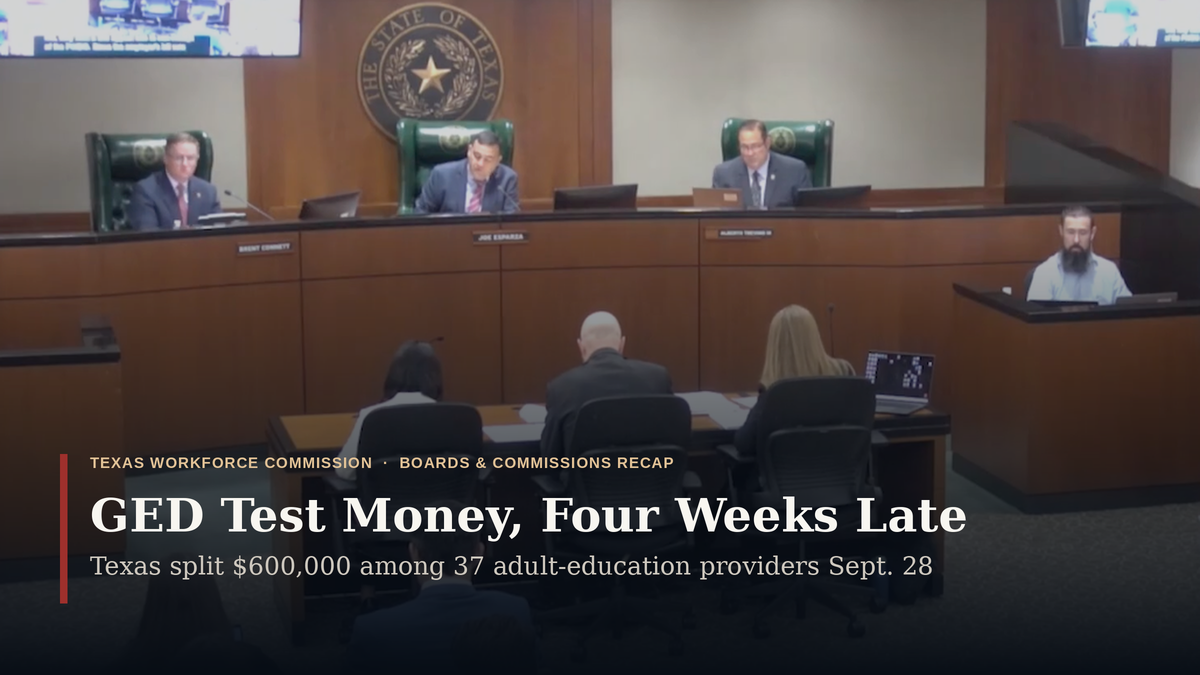
Texas divided $600,000 among 37 local providers Sept. 28 to pay for adults to take the high school equivalency exam — enough to carry roughly 3,550 people through the complete four-part GED. More than 21,000 Texans sat all four tests last year.
The subsidy exists because the test is not cheap and the people who need it are the people least able to pay for it. A full GED costs $145 at a testing center and $169 online. State law lets anyone 21 or older have one exam covered, and 13.3% of Texans 25 and older hold neither a diploma nor an equivalent, by the Census Bureau’s 2024 survey. The money goes to adult-education grantees — school districts, community colleges, literacy councils, regional service centers — who hand the vouchers out locally.
The three commissioners who run the Texas Workforce Commission approved this year’s split nearly four weeks after the deadline the agency’s own rule sets. The rule runs one sentence.
“The Commission will approve an initial voucher allotment, by September 1, for each grant recipient.”
The budget year those vouchers cover began Sept. 1. In each of the three years before this one the commission signed off in August — on Aug. 22, Aug. 20 and Aug. 19. Nobody at the meeting mentioned the date. Whether an adult walked into a provider during those four weeks and was told to come back is not on the record either way.
The split follows test-taking. Providers were ranked by their share of equivalency tests given between August 2025 and June 2026. Socorro ISD, on the east side of El Paso, drew the largest share at 11.9% and $71,400. Restore Education in San Antonio took $45,000 and the Harris County Department of Education $42,600. At the other end, Grayson College, South Texas College, Victoria College and Weatherford ISD get $2,400 apiece — enough funding for about 14 complete GEDs each.
What the commissioners approved alongside the table is a rationing valve. The $600,000 is only the opening allotment; the deal between the two agencies moves $750,000 a year, and staff asked to hold the balance back and steer it to providers who can show they need it. A grantee “must have used a minimum of 70% of their initial allotment before they can request additional vouchers,” the workforce development staffer presenting the item told the commissioners. Vouchers go first to people enrolled in adult-education classes or within a year of leaving them; providers may write local policies covering everyone else, including “referrals from other community partners or those not yet enrolled in the program.”
A GED is four separate subject tests, and the state calculated each provider’s share using $42.25 — the online price of a single subject, and the highest of the three prices a Texan can pay. The staffer said the share was worked out “using the maximum cost of $42.25 per GED test to ensure adequate funding.” At that figure the opening allotment buys about 14,200 individual subject tests, or some 3,550 full batteries, and the entire $750,000 buys about 17,750 — which squares with the agency’s own statement this month that it had “awarded more than 17,000 vouchers this year to help Texans over the age of 21 obtain a GED,” as The Texas Dispatch reported Sept. 15.
Real coverage runs further, because a test-center seat costs $36.25 and a retake $16.25. Even so, the pot reaches on the order of one in six of the Texans who finished the exam in 2025 — a calculation of this newsroom’s own, from the agency’s per-test figure and the state’s count.
No provider group, literacy coalition or legislator has taken a public position on the size of the pot or on the timing, and nobody was called for this account. The agency’s own case is not weak: it used the highest test price so the money would stretch rather than run short, and held back a fifth of the year’s transfer so it can follow demand instead of guessing at it in the summer.
The larger question lands next summer. The contract that moves the $750,000 from the education agency to the workforce agency runs through Aug. 31, 2027, and the vouchers approved Sept. 28 must be spent by that same date. The statute behind the program carries no dollar figure and no expiration, but nothing found from the 2025 legislative session extends the transfer past next August. The commissioners meet again Oct. 6.
$67.8 million out of the employer-penalty fund. The commissioners adopted an order spending “67,764,824 from the special administration fund” — money built from penalties and interest collected from Texas employers — on unemployment insurance work for the 2028–29 biennium. Next year’s adult-education targets. Immediately after the voucher vote the commissioners adopted contracted measures for adult education providers, among them a negotiated skills-gain target of 46.3 percent and an incentive that pays grantees when 25 percent of their exiters enroll in a high school equivalency or postsecondary program — the same students the vouchers are meant to pay for. The statewide enrollment target is not printed here: the captions garbled it, and the appropriations floor in the posted paper is a different measure. Apprenticeships for Texans with disabilities. A report owed to the Legislature by Oct. 1 found “a growth trend with more registered programs, increased participation, broader geographic coverage” since the last inventory.