
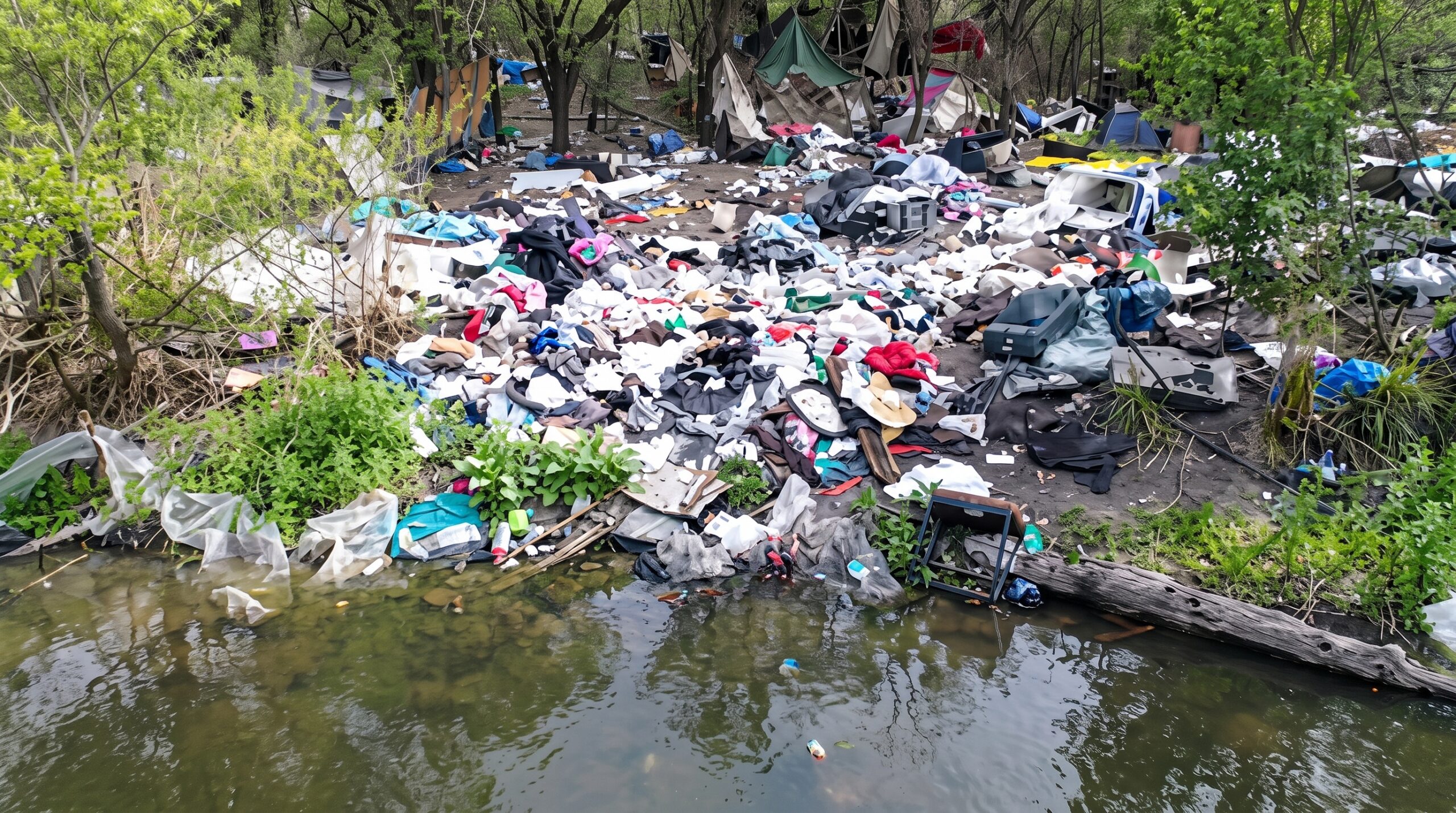
For years, a half-acre lot outside Converse, in northeast Bexar County, disappeared under trash — mattresses, a couch, a barbecue pit and truckloads of other debris that kept arriving no matter how many times neighbors complained. This month, volunteers finished hauling it all out, saving county taxpayers a cleanup bill that would have consumed more than half of the county’s entire annual budget for cleaning up illegally dumped waste.
It is one of the state’s clearer wins against illegal dumping this year — and, by the numbers, a reminder of how much bigger the problem is than any single cleanup can reach.
The property sits near 7715 Elm Cove Drive, in the precinct represented by Bexar County Commissioner Tommy Calvert. For years the county could do little about the dumping because it could not locate the property’s owner, according to Libby Day, Calvert’s chief of staff. The land had also become an encampment for the homeless in the area.
Before any cleanup or law enforcement began, the county worked with Haven for Hope, a San Antonio shelter and services provider, to connect the people living there with beds and other resources. “We did a lot of outreach with Haven for Hope, made sure folks got connected with services and resources,” Day said. “And once that outreach took place, then enforcement started.”
With the property owner’s cooperation finally secured, the Bexar County Sheriff’s Office can now enforce trespassing and illegal-dumping laws at the site, Day said — a change that had eluded the county for years. But removing what had already piled up was a separate problem, and an expensive one. The county’s initial quote for a professional cleanup crew came in at $100,000, according to Day — more than half of Precinct 4’s total budget for abating, or cleaning up, illegally dumped waste.
Instead, the job went to volunteers. River Aid San Antonio, a nonprofit focused on the health of the San Antonio River watershed, organized four cleanup events that drew about 170 volunteers, who hauled out roughly 43,000 pounds of trash — nearly 22 tons. For a sense of scale, Texas law treats dumping 1,000 pounds or more of waste in a single act as a state jail felony, the toughest tier in the state’s illegal-dumping statute; the debris hauled from the Elm Cove property, had it been dumped all at once rather than accumulated over years by parties the county was never able to identify, would have cleared that threshold roughly 43 times over.
“When we first came here, we were walking through a lasagna layer of garbage that had accumulated over several years,” said Vic Gomez, River Aid San Antonio’s operations manager. The effort also drew people from the surrounding neighborhood, not just River Aid’s regular base: “We’ve had a good handful of the neighbors come out to help us clean, and I think they’re very excited to help us make that difference,” Gomez said.
Elm Cove is one site among many, and volunteers cover only a fraction of what accumulates statewide. The Texas Litter Database, run by Keep Texas Beautiful, a statewide anti-litter nonprofit, has logged 5.7 million pounds from 3,448 volunteer-run cleanups across all of Texas between February 2020 and June 2024 — four-plus years of reported effort statewide. Elm Cove’s 43,000 pounds, gathered in four Saturday mornings at one address, is a meaningful haul for one neighborhood and a small fraction of that total.
The debris keeps arriving faster than volunteers can log it: the Texas Department of Transportation’s Don’t Mess with Texas campaign estimates roughly 362 million pieces of litter land on Texas roads in a typical year, even after a 63.2 percent drop in large roadside litter it measured between 2013 and 2023.
Government spending dwarfs what volunteers collect, and by the state’s own numbers, it still isn’t enough to keep pace. Keep Texas Beautiful estimated in October 2024 that Texas taxpayers already spend about $50 million a year clearing litter from state roads alone — up from the $47 million the Texas Department of Transportation cited a decade earlier — before counting what counties like Bexar spend fighting illegal dumping site by site.
Fort Worth’s 2025 push to clear 20 million pounds of litter needed $3.5 million in new street sweepers and a paid contract expanded to 13 crews; its biggest volunteer event of the year, the Cowtown Great American Cleanup, brought in 84,813 pounds — less than half a percent of the target. Keep Texas Beautiful’s own policy platform calls on the state to expand grant funding for local governments and pay for more code-enforcement officers and cameras, arguing the spending “more than pay for themselves by offsetting the costs of litter clean-up to the state and taxpayers.”
River Aid San Antonio has one more cleanup planned at Elm Cove, from 9 a.m. to noon on Nov. 7, and is inviting volunteers to meet the group at the Elm Cove Drive address. What happens after that is an open question statewide: nothing in Texas’s own litter data suggests volunteer labor alone is on pace to outrun the roughly $50 million a year in public spending and 362 million pieces of litter already moving through the system annually. Elm Cove was one address, cleared four Saturdays at a time, in a state with 254 counties and no shortage of others like it.