
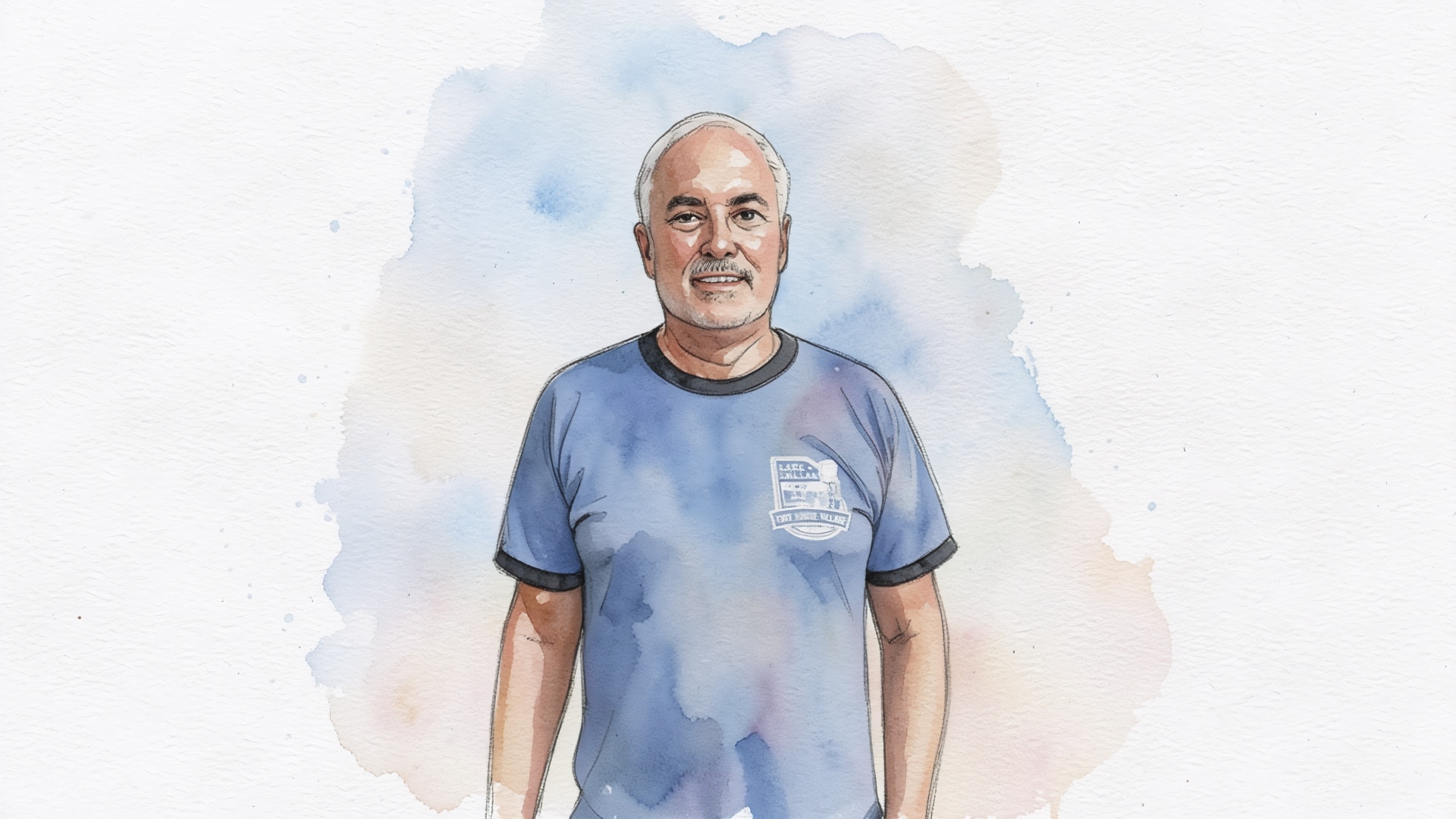
Terry Lantrip’s life turned on a card in a file drawer.
He was sixteen, growing up in Aubrey, a small town on the far side of the lake from where he would spend the next four decades. His mother drove him to the Texas Employment Commission office in Denton, the nearest town of any size, because he wanted a job.
The counselor asked what skills he had.
“I’m 16,” Lantrip told him. “I don’t have any skills.”
They could get him into any fast food restaurant in town, the counselor said — just name it. Lantrip said he wasn’t above that, but what he really wanted was somewhere he could learn something. So the counselor went back through the punch cards, one at a time, and finally pulled one out with a note of apology.
I don’t know if you’d like this one. It’s a janitor position at the Denton Record-Chronicle.
“That sounds good,” Lantrip said. “I’ll take that.”
He is now the developer who built the first tiny home community inside a city’s limits anywhere in the United States — a project in downtown Lake Dallas that has drawn regional, national and international press for seven years running. He got there by way of a mop.
Aubrey
The childhood was modest and mobile. The family traveled — Colorado, and much of the rest of the country — which he credits with giving him an eye for buildings he wouldn’t be able to name for years. The rest of the time he rode his bike. “We grew up in a small town, so there wasn’t a whole lot to do.”
He wanted to be a teacher. That never happened, and he says so without evident regret.
But another seed had gone in earlier, around age six, when he started tagging along with his grandfather. His grandparents owned rental houses, and Lantrip liked watching an old, unlovely house become something else.
“I thought, that’s really cool,” he says. His parents later had rentals. His siblings have them now. It has been a family business for three generations without anyone quite calling it that.
Learning every department
The janitor’s job at the Record-Chronicle turned out to be the education he’d asked for. He was building porter, gofer, whatever needed doing — and the assignment carried him through every department in the building.
“I learned at every department and what they did, and I thought it was very cool, and everybody was really nice,” he says. “I was the kid.”
He didn’t stay the janitor. He picked up some writing, a great deal of production work, and a liking for the whole apparatus of putting out a paper. He enrolled at the University of North Texas and majored in journalism while still working at the Chronicle.
Then, at twenty-three, he bought a newspaper.
The woman who ran the Lake Cities Sun in Lake Dallas was getting older and wanted out. Lantrip heard about it, talked to her one day, and that was that.
“Might not have been the best choice,” he says now, then offers a defense of his younger self. “At 23, I don’t think your brain’s completely formed, and that’s probably part of it.”
It was rough. He had almost no money, which meant he had to supply hours instead. The paper came with a small staff; he let nearly all of them go and did most of the work himself. It became, over time, an award-winning paper, and he owned it for twenty-one years.
He is plain about why that mattered beyond his own ledger. “Newspapers and journalists cover the news and cover the cities, and it really makes the cities better,” he says. Officials “have to be accountable. And when nobody knows what they’re doing, they’re really not accountable.”
Most of the small hometown papers are gone now. He calls it “a sad thought on society in general.”
Fourteen thousand dollars
The first building was a problem of arithmetic. Lantrip needed somewhere to put the newspaper and somewhere to live, and could not afford both.
What he could afford — exactly, with everything he had saved — was $14,000 for the Woodman Building on Main Street, put up in 1908 by Woodmen of the World, the fraternal benefit society that built lodge halls across small-town America and rented out the ground floors. In Lake Dallas, the downstairs had been a general store. Local lore holds that Bonnie and Clyde shopped there.
The building was not quite a teardown and not quite a fixer-upper. It took a long time. His family helped. He hired college students. When it was finished, the newspaper occupied the first floor and the apartments upstairs were, by his account, very nice.
They were also the point.
“It was an old-school newspaper, where if you wanted to talk to the newspaper editor, you just walked in the door,” he says. “And the newspaper editor — who some of the time was me, and me alone — that might be the person that answers the front door.”
After that, properties started finding him. People came to him specifically because of what he wouldn’t do. He now holds thirteen properties, all in the same neighborhood, all within walking distance of one another — commercial space, restaurant space, offices, apartments, houses, even a room or two he rents out.
Some of the renovations, he concedes, did not pencil out. “There’s a little bit more passion sometimes than profitability,” he says. “If you can save an old building or an old house, then you really have to.”
In 2013 he sold the paper to go full-time into development. The print shop went later.
The property he didn’t know what to do with
In 2002 an elderly couple came to him about an acre of land with an old farmhouse on it — what was left of a much larger farm that had been sold off in pieces over generations. The woman was, he believes, the great-granddaughter of the original owners. She and her husband were in their eighties and could no longer keep the place up.
They did not ask him for the best price. They asked him for two promises.
“We know you’re not going to tear down the house,” they told him. “We know you’ll fix it up.” And they didn’t want the trees cut.
He bought it, and then for years he had a beautiful worn-out farmhouse and an acre of land and no idea what to do with either.
The answer arrived at an Earth Day event at Fair Park in Dallas. Nine tiny homes were on display — people had hitched up their own houses and hauled them there — and the lines to tour them were far too long.
So Lantrip walked around behind them.
“I was looking at the homes and seeing how well they were built,” he says. “And they weren’t mobile homes. They were actually built like a regular house. They just happened to be on a trailer.”
He went home with a question: what if the farmhouse sat in the middle, with tiny home lots around it?
Three blocks from Main Street
Most cities did not want tiny homes. Lake Dallas officials had spent twenty years watching Lantrip renovate their downtown, which bought him a hearing.
He hedged his first pitch, proposing a mix of tiny homes and RVs because he wasn’t sure demand for the former would fill thirteen spaces. The council told him no on the RVs — but if he came back with a tiny-homes-only plan, they’d consider it.
He went to the region’s tiny house community for help designing it, including an advocate named B.A. Norgaard whom he describes as a leader of the movement, and brought back a proposal. The Lake Dallas City Council approved it on Oct. 27, 2017, over a dissenting vote. Lantrip remembers the whole effort as a narrow, contested thing.
Ground broke in February 2019. The village opened that October — thirteen landscaped lots of 800 to 1,000 square feet, a shared firepit, a community garden, a wash house, and a location that is the real product: two or three blocks off Main Street, a community park across the road, a middle school and an elementary school within walking distance, restaurants, a biking trail, ball fields, and Lake Lewisville a few blocks away.
“There’s just not a lot of opportunities anywhere where you can find a place to put a tiny home that’s 2 or 3 blocks from Main Street,” he says.
Only one tree had to come out. The farmhouse is still standing, now renovated and expanded into the village’s center — a library and board room, a workshop, his office, a workout room, and a large room in back for residents’ gatherings.
Fifteen minutes
Lantrip badly underestimated what he had.
“I remember we put together a Facebook page and we got 300 people on there, and I thought, oh my goodness, that’s a lot of people,” he says. It is approaching eight thousand.
More than a hundred people applied for the thirteen lots. Not all were realistic — some couldn’t afford it yet, some were simply hopeful — but the waiting list has never emptied. When a resident leaves, someone is ready.
“I told the city council, I said, look, we’ve got 15 minutes of fame on this. How are we going to play it?” That was eight years ago. The press has not stopped.
His own theory of the appeal is more clear-eyed than the coverage usually is. Affordability is part of it — lots now rent for roughly $700 to $750 a month including water, sewer and trash, and because the houses are small and efficient, some residents’ electric bills run about $25. The homes themselves aren’t cheap, running $50,000 to $150,000.
But the residents, he says, mostly aren’t there because they have to be. “Most of our residents could afford a nice house somewhere, but they choose to live this way so that they don’t have to pay huge bills and they don’t have to pay huge tax bills.”
Then there is the part almost nobody admits. “There’s a lot of people out there that love tiny homes, and they love the idea of simplicity, and would never, ever think of actually living in a tiny home and getting rid of all their stuff,” he says. “But it just captivates them.”
He’d like to put a rentable tiny home on one of his other properties so the curious can try one — because the village itself bars short-term rentals. He wants residents, not tourists.
Phase two, approved after two and a half years of work, adds fourteen more units on the adjoining side, with the farmhouse and garden in the middle.
The bus
There is one story he’d rather tell another time, and it is the closest thing in his account to a wound.
He owned a double-decker bus, meant to become a stationary food truck on one of his properties. It never happened. Lantrip says the newspaper printed things city officials didn’t like — “it was all facts, we didn’t make anything up” — and the friction that followed made the project not worth having.
“Being in the newspaper business and doing development, not the easiest thing to do,” he says. “Because when you piss off the city, they’ll get you.”
The bus is still sitting somewhere. He’s not sure what happens to it. Lake Dallas, he allows, is probably not the place for it.
What’s left
Ask him for advice and he gives the answer of a man who bought early. “Buy everything you can,” he says. In the late nineties and early 2000s, property in Lake Dallas wasn’t worth much. He bought what he could reach, and he is still developing it thirty and forty years later.
He is also, at last, talking about stopping. There are two things left on the list. The farmhouse is done. And then there is a house he has not gotten to yet — a hundred years old, likely built as the First Baptist Church’s classroom building before someone moved it and made it a home, sitting where phase two is supposed to go.
He could knock it down. It is in the way.
Instead, he is working out how to move it somewhere else and fix it up, because losing it isn’t something he’s prepared to do. Only once that’s settled can the bulldozers come.
“Then I think it’s time to let somebody else take over,” he says. “It’s time to let some younger people take over.”
Until then he is out on the grounds most days, doing the landscaping himself, earbuds in.