
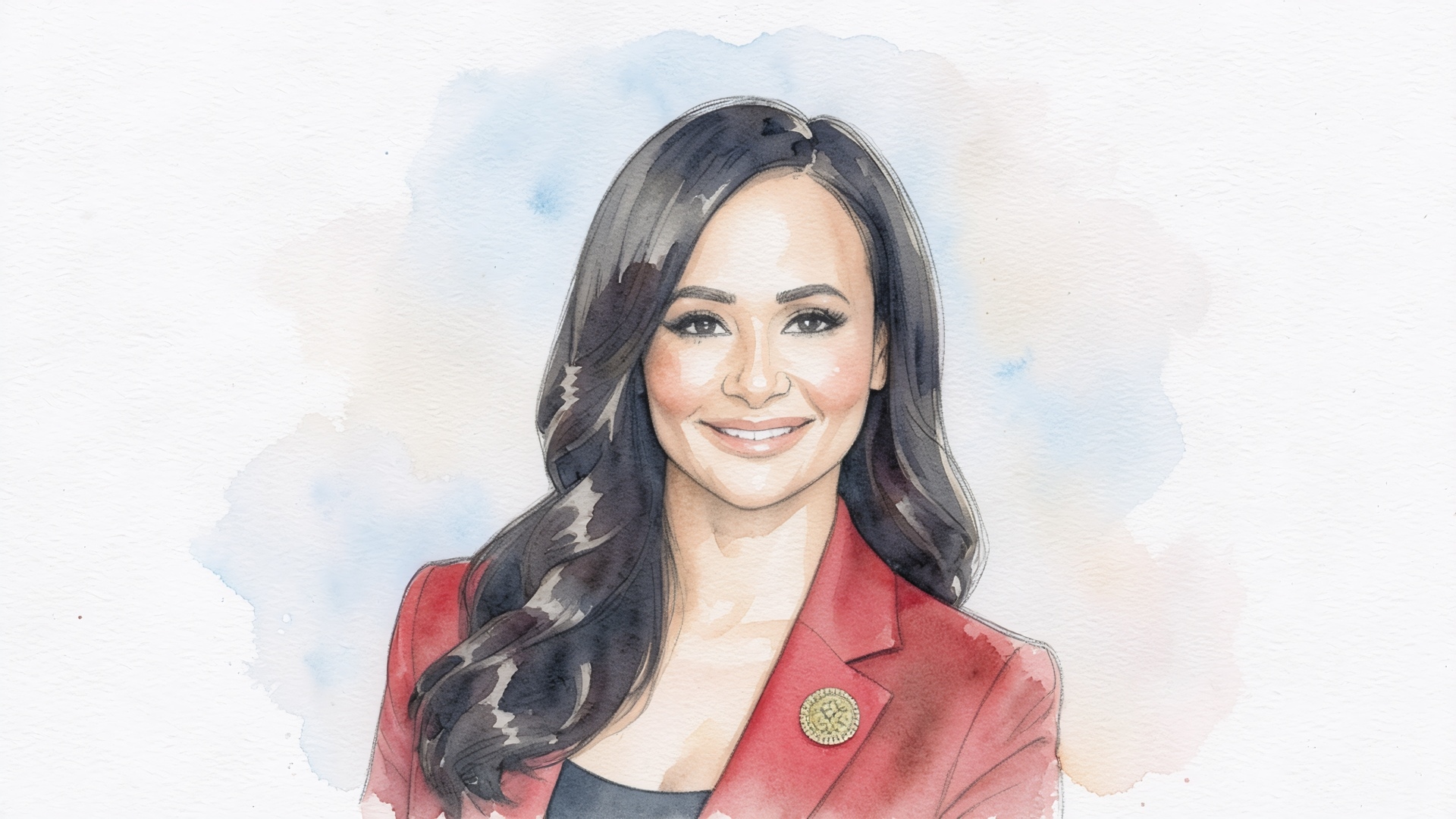
Katrina Pierson was working full time, going to school and raising a child when she told her doctor she was exhausted and something felt wrong.
The doctor’s assessment was depression. She wrote a prescription. Pierson — who by then had spent years working in medical practices and holds a biology degree — walked out with it and never filled it.
“I said, yeah, I don’t think I’m depressed,” she recalls. “And for the life of me, I couldn’t figure out why that was just the automatic answer.”
It turned out to be iron.
That story is the entry point to the policy package Pierson has spent the past year building. The Rockwall-area Republican, elected to House District 33 in 2024 after unseating an incumbent in the primary runoff, now chairs a subcommittee created specifically for the subject — and she is trying to move a set of women’s health bills through a Legislature where, she argues, the topic almost never gets discussed on its own terms.
“Women’s health is politicized,” she says. “It is heavily politicized, and it shouldn’t be.”
An unusual credential
Pierson arrived in Austin with a national profile — she was Donald Trump’s national campaign spokeswoman in 2016 and a senior adviser to his 2020 campaign, a run of television appearances stretching back to 2009. It is not the résumé line she leads with here.
“I think for this topic of discussion, it’s helpful to include my background in healthcare,” she says. Before politics, Pierson spent 14 years working in medical practices across nine specialties, including OB-GYN, psychiatry and substance abuse treatment.
She is also, as she puts it bluntly, 50 years old and not planning to have more children — which she offers as a qualification rather than an aside, because most policy conversation about women’s health in Texas concerns women of childbearing age.
In August, Speaker Dustin Burrows created the Subcommittee on Maternal Health, Menopause and Access to Evidence-Based Medicine under the Public Health Committee chaired by Rep. Gary VanDeaver, and named Pierson to lead it. Its interim charges cover hormone health and menopause care, maternal nutrition, newborn coverage and access barriers. The first hearing was held this month; a second, on menopause and perimenopause, is expected next month and will include patient testimony.
The bill that got no hearing, and the ruling that changed things
Pierson’s first women’s health bill, filed in March 2025 during her freshman session, was about as simple as legislation gets: whatever a physician prescribes for perimenopause or menopause must be covered by insurance.
It never got a hearing.
Then, in November 2025, the federal government moved. FDA Commissioner Marty Makary, appearing alongside HHS Secretary Robert F. Kennedy Jr., announced the agency would remove the black box warning — the strongest warning label the FDA issues — from menopausal hormone therapy products containing estrogen. Makary argued the warnings rested on outdated readings of decades-old research and had deterred a generation of women from treatment.
Pierson saw an opening. “This is an opportunity for me to bring this bill back with clinical evidence behind it,” she says. She took an expanded package to Burrows, who converted it into interim charges.
The FDA’s action is not uncontested, and a fair accounting of her pitch has to say so. Critics including Diana Zuckerman, president of the National Center for Health Research, argued that moving risk information out of a boxed warning and into lengthy labeling “many doctors and most patients will not read is taking women’s health backward.”
The underlying science has genuinely shifted, though — in a specific direction. Reanalyses of the Women’s Health Initiative data, along with the later KEEPS and ELITE trials, support what researchers call the timing hypothesis: that the risk-benefit calculation for hormone therapy depends heavily on when a woman starts it. Women who began within ten years of menopause showed roughly 24 percent lower coronary heart disease risk and about 30 percent lower total mortality than placebo groups in those analyses, and menopausal hormone therapy is associated with fracture reductions in the range of 20 to 40 percent.
Pierson cites higher figures — a 30 to 50 percent reduction in cardiovascular disease and a 65 percent reduction in fractures. Those sit above the commonly published ranges, though within the spread of individual subgroup findings.
Her point about timing tracks the literature closely. “The studies that caused the black box were all done in women over 50,” she says. “But what the studies show now is that if you start hormone replacement therapy within ten years of menopause… you do reduce all of these things, including your risk for dementia.”
The pharmacy problem
The most concrete item in Pierson’s package has nothing to do with hormones, and it is the one where the facts most clearly support her.
She wants Texas physicians to be able to hand patients basic medications in the office — antibiotics, vitamins, routine prescriptions — rather than sending them to a pharmacy.
“It’s common sense, probably, to you and your listeners, that if a physician writes a prescription, he should probably just be able to hand it to you if it’s in his office,” she says. “But that’s not the case.”
She’s right, and Texas is a genuine outlier. State law reserves the dispensing of non-controlled prescription drugs to licensed pharmacists, with narrow exceptions for immediate need, certain rural areas, free samples and a 72-hour supply provided at no charge. It makes Texas one of only five states in the country without general physician dispensing — a restriction that survived a court challenge brought by the Institute for Justice on behalf of Texas doctors.
Pierson’s explanation for why a seemingly obvious reform keeps failing is equally direct. “The pharmacists don’t like that,” she says. “And everybody has a lobby in Austin.”
Texas pharmacy organizations have opposed and defeated recent reform efforts; state law also affords pharmacies a 15-mile buffer from certain competition. The Texas State Board of Pharmacy has defended the restrictions on safety grounds, arguing pharmacists receive more pharmacology training than physicians and are better positioned to catch drug interactions.
What makes the issue land in a women’s health package is rural access. At her subcommittee’s first hearing, a physician testified about running a mobile unit in rural Texas where patients may be hours from a hospital and often lack transportation. Being able to dispense on site would solve much of that — including, Pierson notes, the awkward fact that Medicaid requires a prescription for prenatal vitamins and iron, sending pregnant women on a second trip they may not be able to make.
“If we can just let the physicians give them the vitamins in the office,” she says, the problem largely disappears.
Iron, folate and the months before conception
Pierson asked the maternal-fetal medicine physicians at her hearing which single supplement mattered most. The answer, every time, was iron.
“Iron is the one that we have to make sure women are taking,” she says. Folic acid ranks close behind — and both, she stresses, need to be adequate roughly three months before conception, not after a positive test. “Most women don’t even know they’re pregnant for the first month or two. And by then, it’s almost too late.”
She also wants the medical community to consider defaulting to methylated multivitamins, on the theory that a meaningful share of women carry genetic variations affecting folate metabolism and that routine genetic screening isn’t realistic. “Why not just start them on methylated multivitamins and then we won’t have that problem?”
The backdrop is a maternal health record Texas has been wrestling with for years. Roughly 80 percent of pregnancy-related deaths in the state have been assessed as preventable, severe maternal morbidity has been rising, and the disparities are stark — Black women in Texas experience severe complications at nearly double the rate of white women.
The state’s next biennial maternal mortality report, which Pierson referenced as forthcoming, was originally due September 1 and has been moved to December 1 without a stated reason. Maternal health advocates have criticized the delay; the committee has not publicly explained it. Pierson’s position is that she’ll have a fuller answer once the data lands.
She also points to the Maternal Health Accelerator, a North Texas pilot operating with the state that partners with churches and community centers to distribute iron, and reports monthly outcome data. Its iron supplementation program, she says, has sharply reduced infusion rates. “We know these things work. It’s a matter of now how to scale that.”
Baseline testing, and the misdiagnosis question
Running underneath the package is Pierson’s contention that women’s symptoms are frequently attributed to mood disorders before anyone checks the hormones that might explain them.
“You go into the doctor, you tell them you’re tired, you’re not getting sleep,” she says. “And the first thing they tell you besides diet and exercise is, oh, you’re just anxious. Oh, you’ve got kids at home. Oh, you’re depressed.”
She proposes studying whether Texas should establish best practices for baseline hormone testing before prescribing — and she is specific about the clinical mechanics, drawing on fertility medicine: estrogen tested on days two through five of a cycle, progesterone roughly a week to ten days later.
The misdiagnosis problem is documented, if not quite at the magnitude she cites. Pierson says studies show 50 percent of women are misdiagnosed; the most-cited recent figure comes from a 2025 industry-commissioned survey of U.S. women aged 30 to 60, in which 39 percent said they felt misdiagnosed while seeking care for perimenopause symptoms, with a third treated for anxiety and roughly a quarter for depression. A separate hospital audit found that 78 percent of women diagnosed with depression had significant perimenopausal symptoms that had been overlooked.
The cost fight ahead
Pierson expects the central objection to come from her own side of the aisle: that coverage mandates raise premiums.
“I’m on a mission to prove that’s not the case,” she says — pointing to NIH and World Health Organization cost analyses and arguing the savings from preventing cardiovascular events and osteoporotic fractures are large enough to carry the rest.
Notably, she doesn’t oversell it. “Not all prevention is cost savings,” she says, and on several of her proposals she expects the interim study to conclude the fiscal effect “is probably going to end up being a wash.”
She is also trying to keep the package clear of the debate that dominates women’s health politics in Texas. Pierson says she made it explicit when launching the initiative that she would not take up abortion, and she is not routing the effort through the Legislature’s existing women’s health caucus — a decision that carries obvious political friction, though she says she has found bipartisan interest in the underlying bills.
“I’m not going to let these issues fall again to the wayside just because the politics is too extreme,” she says.
Whether that holds through a session is the open question. But for now the subcommittee has a docket, a second hearing coming, and a chairwoman whose argument rests on a proposition that is hard to argue with in the abstract: that a woman who says something is wrong should get her hormones checked before she gets a prescription for something else.