
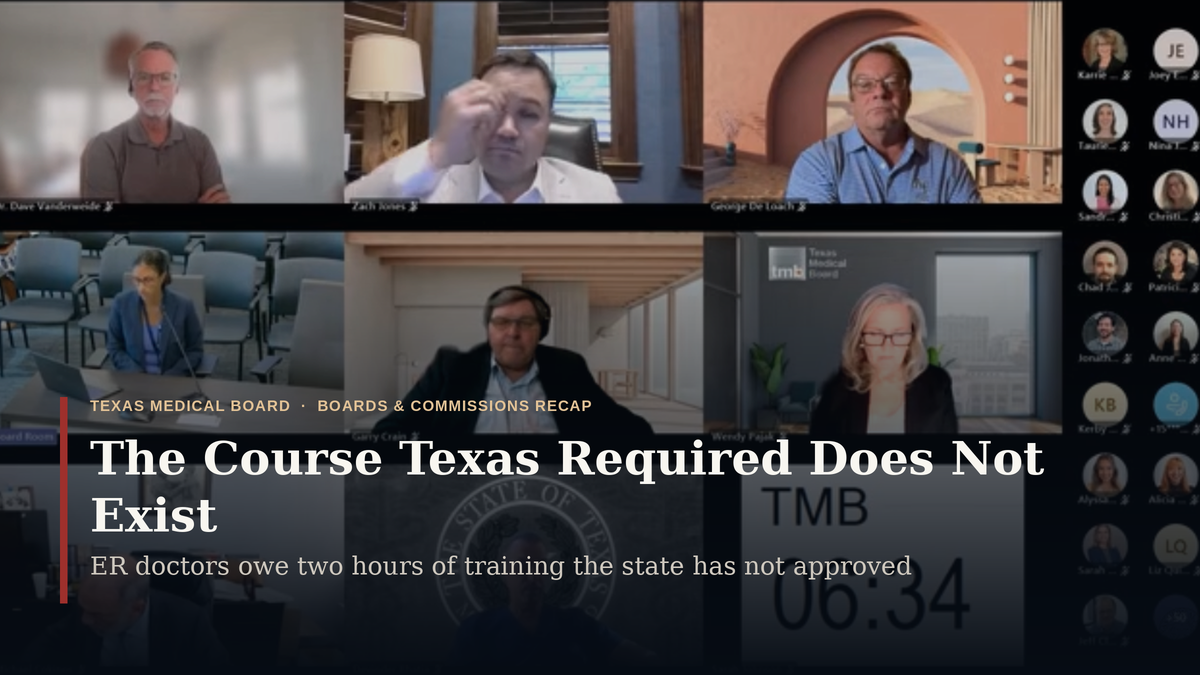
Texas ordered emergency room doctors to learn how to treat sexual assault survivors and collect the evidence that a prosecution later rests on, a requirement that took effect Sept. 1. The training they are supposed to take has not been written.
The state medical board says so on its own website, on the page physicians go to when they are trying to work out what they owe: “Currently, there is no approved coursework available for continuing education in forensic evidence collection”. Rather than enforce a rule nobody can satisfy, the board has moved the real start date to licenses that expire Feb. 28, 2027.
Who this lands on is harder to pin down. The board licensed 102,602 physicians as of September 2023, the most recent total it has published, but it does not publish how many work in an emergency room or an urgent care clinic — the group the requirement actually binds. At the other end of it are the people the training was written for: survivors who walk into a Texas emergency department and whose case may turn on whether the physician examining them knows how to handle what they find.
The board adopted the rule anyway at its Aug. 14 meeting, along with an identical one covering physician assistants. Both grew out of House Bill 47, an omnibus sexual assault measure the Legislature passed in 2025 built on recommendations the governor’s own task force made in November 2024. The bill required two hours of continuing education — the periodic training every licensed physician must document to keep practicing — on trauma-informed care, survivors’ rights, evidence collection and the law on who may take custody of that evidence.
The catch is that lawmakers did not just order the training, they specified whose training would count. Under the rule, the board will recognize “any course found acceptable to the Governor’s Sexual Assault Survivors’ Task Force”. That task force has not produced one. “The problem is that we don’t have the CME yet from the task force that was tasked to come up with the CME,” the board was told as it worked through its own report.
“It is something that was specifically mandated by the legislature and the CME that was mandated to be taken was also specified by the legislature. So, we’re kind of in this limbo. We we have to have it from that task force specifically.”
The task force has not so much gone quiet as gone in a circle. Its own page for health care professionals, which calls the bill “SASTF’s Omnibus Bill”, names no course and no provider and gives no date for one. Physicians who want to know more are told to “visit the following Texas Medical Board webpages and scroll to the Forensic Evidence Sections.” Those are the pages that say no coursework exists.
The board’s answer was to stand down. It said it would write to the physicians affected to tell them the requirement is delayed, and that “we will not be enforcing it” until a course exists. That is close to the only position available: a licensing board cannot invent coursework the statute assigned to somebody else.
It leaves a second group holding a smaller bag. Because the rule reaches physicians by where they work rather than what they trained in, doctors who never set foot in an emergency department still have to get themselves out of it. A commenter asked the board to spell out who is exempt. The board declined, pointing instead to the tracking system the state now uses: “There’s actually a workaround on CE broker where you can verify and attest that you’re not in that kind of practice.”
The Texas Medical Association tells members the test is not their specialty but whether they are “actually acting or being assigned as an ER or urgent care physician or physician assistant in the ER or urgent care setting.” It has taken no public position on the requirement or the delay.
Staff told the meeting they had compared the physicians due to renew from September through November against the physicians who had set up accounts in the tracking system, and that “it does not equal the number of people that that should have an account.” The board did not say how large the gap is.
Both the board and the task force now put the start at licenses expiring Feb. 28, 2027. Until somebody approves a course, the requirement exists only on paper.
The ketamine rule slips again. The board extended the public comment period on its proposed ketamine rule, which has now trailed across several meetings without reaching a vote. It was not an action item and drew no discussion beyond a status note. A line drawn on artificial intelligence. The board restated its position that AI is a tool rather than a substitute for a clinician, and that “there needs to be a physician in the loop and responsible for using AI as a tool.” No rule was proposed. A license revoked in absentia. The board adopted an administrative law judge’s recommendation and revoked the license of a physician who had not complied with a 2022 board order and who did not appear; the record indicates board staff had last heard from him in March 2025. Money. Staff projected revenues of roughly $44 million to $45 million for fiscal 2026, above the prior year, with expenditures “just in the black slightly.”