
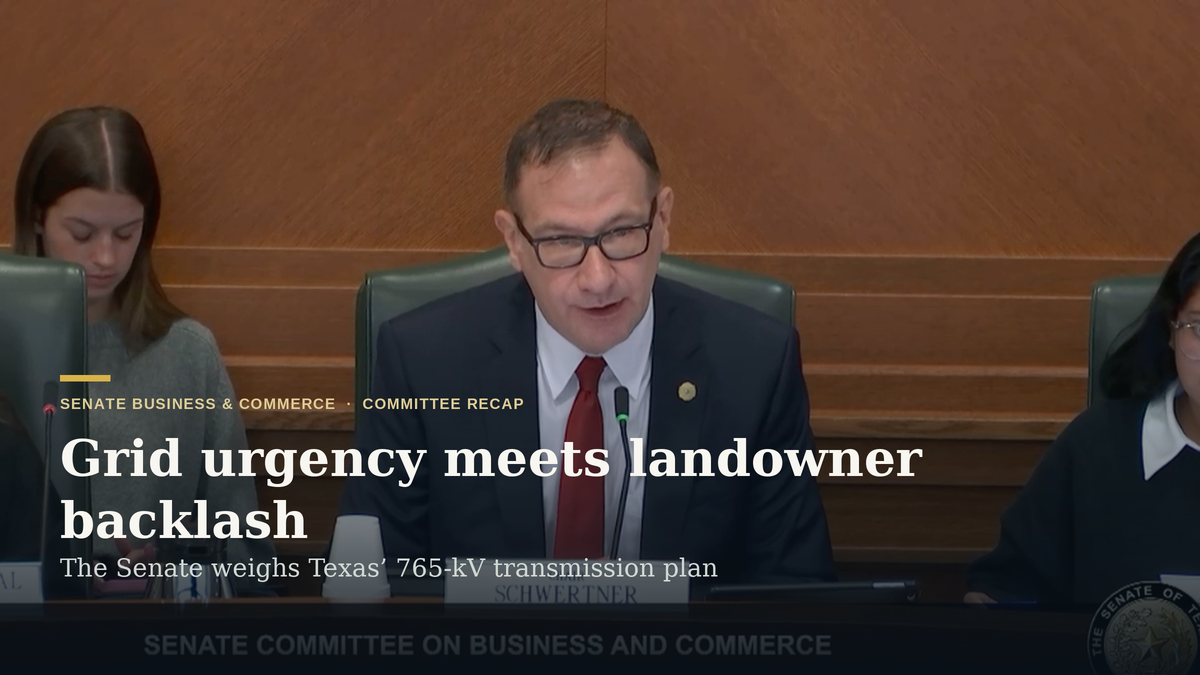
Texas is moving to string a new backbone of ultra-high-voltage power lines across the state — and on Wednesday the people whose land sits in the path came to the Capitol in numbers rarely seen for an interim hearing.
The Senate Committee on Business and Commerce heard from 156 witnesses on the 765-kilovolt transmission expansion tied to the Permian Basin Reliability Plan, a turnout so large it stretched the hearing past 15 hours before Chair Charles Schwertner, R-Georgetown, recessed the panel. The message from the dais by the end was blunt: the build-out may be necessary, but the way the state has treated landowners has not worked.
The charge directed the committee to weigh how the new lines — part of a 765-kV backbone the Public Utility Commission approved in 2025 and ERCOT’s board endorsed, now working their way through the commission’s route-approval process to serve surging demand in the Permian Basin and strengthen the statewide grid — affect homes, businesses and communities, and whether current permitting and siting timelines protect the people in the right-of-way.
Chair Schwertner set the tension in his opening, saying the committee’s task was to manage load growth and “encourage new technologies and respect homeowners, businesses and landowners all at the same time.” The witness list suggested how hard that balance has become: charge one, on the grid and data centers itself, drew 51 witnesses; this charge drew 156.
Much of that testimony was personal. Janice Douglas, who told members she owns a tract in Salado, just north of Schwertner’s own district, described months of contradictory answers about the routing near her property. “I have been round and round with at least this many people,” she said, gesturing to the crowd, “and every one of them tell me the wrong story.” She said she had only belatedly learned that a 138-kV line near her land was being tied into the 765-kV system — the kind of detail, she suggested, that landowners should not have to piece together themselves.
Her account was echoed across a day of testimony. Ann Tarrillion appeared “representing the Medina County Pearson Community Intervenors,” one of several organized landowner groups; Amanda Short of Corpus Christi identified herself as founder of the Texas Infrastructure Stewardship Initiative. Again and again, witnesses returned to the same grievance: that route changes moved faster than the notices meant to warn the people affected.
Against that backdrop, Schwertner turned to industry and experts to test whether the lines are worth the disruption, calling a three-witness panel — Mark Bell, Dr. Brent Bennett and Todd Staples. Bell, appearing for the Association of Electric Companies of Texas, argued the build-out is unavoidable. Electricity demand has grown “two and a half times the rate of the rest of the nation” over five years, he said, with Texas adding well over a thousand residents a day.
When the Public Utility Commission approved the Permian Basin Reliability Plan in 2025, he noted, it leaned on 2024 peak-demand estimates of 133 gigawatts that “didn’t account for the extraordinary growth we’re seeing among large load customers.” Transmission and generation are not rivals, Bell argued: “the development of new transmission supports investment in generation,” and a stronger grid “benefits the existing generation by ensuring that power is not trapped behind transmission constraints.” His warning was blunt. “The greatest risk to the ERCOT system today is inaction,” he said, noting the plans were “approved more than a year ago to meet transmission needs identified 5 to 10 years prior to that.”
Todd Staples, president of the Texas Oil and Gas Association, cast the stakes in human terms. Picture a family finishing a new home, or an owner opening a warehouse or convenience store, ready to “cut the power on,” he said — “and you’re told, wait, you can’t get power for five years? Oh, you may not get power at all. That’s what’s happening in West Texas today. And that’s what’s happening in the Permian Basin.”
The shortfall is neither new nor a surprise, Staples stressed: ERCOT “had published studies and reports and public documents since 2019 about” the region’s lack of transmission “to meet the needs of a growing industry,” followed by years of “exhaustive studies … workshops, meetings.” He said he would not “interject myself on the CCN process” — “that’s not my area of expertise” — but insisted the underlying need was long settled, and delay the real danger.
The panel’s third witness challenged the premise itself. Dr. Brent Bennett of the Texas Public Policy Foundation testified that building “more energy dense, reliable generation, close to demand centers would eliminate the need for these cross-state transmission lines while decreasing total system costs and improving reliability.” The 765-kV plan, he argued, “was conceived under the assumption that the market would continue to build diffuse wind and solar far from demand centers” — and warned it could backfire: the statewide build-out “will make the system less reliable by perpetuating the overbuilding of wind and solar … thereby necessitating even more transmission in the future.”
Bennett pressed the committee to slow the timeline and “give the legislature a chance to debate these alternatives before any of these proposed lines are given final approval,” cautioning that the projects carry “generational, irreversible impacts.” His testimony planted the committee’s hardest question: whether Texas is about to condemn a corridor across the state for lines a different generation strategy might not require.
When Schwertner turned to his vice chair for “final thoughts,” Sen. Phil King, R-Weatherford, delivered the day’s verdict. “It’s been a long day. It’s been a hard day, for a lot of reasons,” he began — then singled out an empty chair. “I’m very disappointed that ERCOT is not here. I think that they’re at the center of this,” King said. “I actually think that’s kind of discourteous to the legislature … and certainly to everybody who testified.”
The utilities, he said, “are good companies and they’re not out to offend property owners.” But “the process did not work.” The notice failures drew his sharpest line — “the notice issue is particularly problematic” — and he rejected knocking landowners out on technicalities: when some 800 people are swept into a single routing dispute, doing so “is just putting form over substance.”
King tied the breakdown to a calendar the state never stress-tested. The committee would “be back here in a few months,” he warned, and the utilities had “a wonderful opportunity to come up in very short order with some ways to work out this problem.”
The 180-day procedural window, he said, was written when “no one ever anticipated … the giant route that’s about to go all around Texas,” and the 765-kV technology “wasn’t ever under consideration at that time” — “that is a different animal.” The pressure now, he said, falls on the utilities to bring fixes “back to the property owners and to the legislators.”
Because the committee met in the interim, it took no vote. Its findings will shape recommendations to the 90th Legislature, which convenes in January 2027 — and, on the evidence of Wednesday, the notice-and-routing process for high-voltage lines is headed for that session’s agenda. Members left the utilities on notice of their own: fix the process, or expect the Legislature to.
Also heard: The committee’s first charge examined the state of the electric grid and rulemaking under Senate Bill 6, the 2025 large-load law, with ERCOT President and CEO Pablo Vegas and PUC Chairman Thomas Gleeson leading an invited panel on load growth and data centers. That testimony — including ERCOT’s forecast of roughly 175 gigawatts of combined demand — is the subject of the companion story.
The hearing at a glance
Issue
765-kV transmission expansion (Permian Basin Reliability Plan) and its effect on landowners — permitting, siting timelines and notice. The larger of the day’s two charges by time, drawing 156 of the hearing’s witnesses.
What happened
Invited testimony from transmission utilities followed by a large volume of public and intervenor testimony from affected landowners. Interim hearing — no vote.
When
9:00 AM CT, Wednesday, July 29, 2026 · hearing ran roughly 15 hours (both charges) before recess
Where
Room E1.012 (Hearing Room), Capitol Extension, Austin
Chair
Sen. Charles Schwertner, R–Georgetown (SD-5)
Archived video
senate.texas.gov · vid 22667