
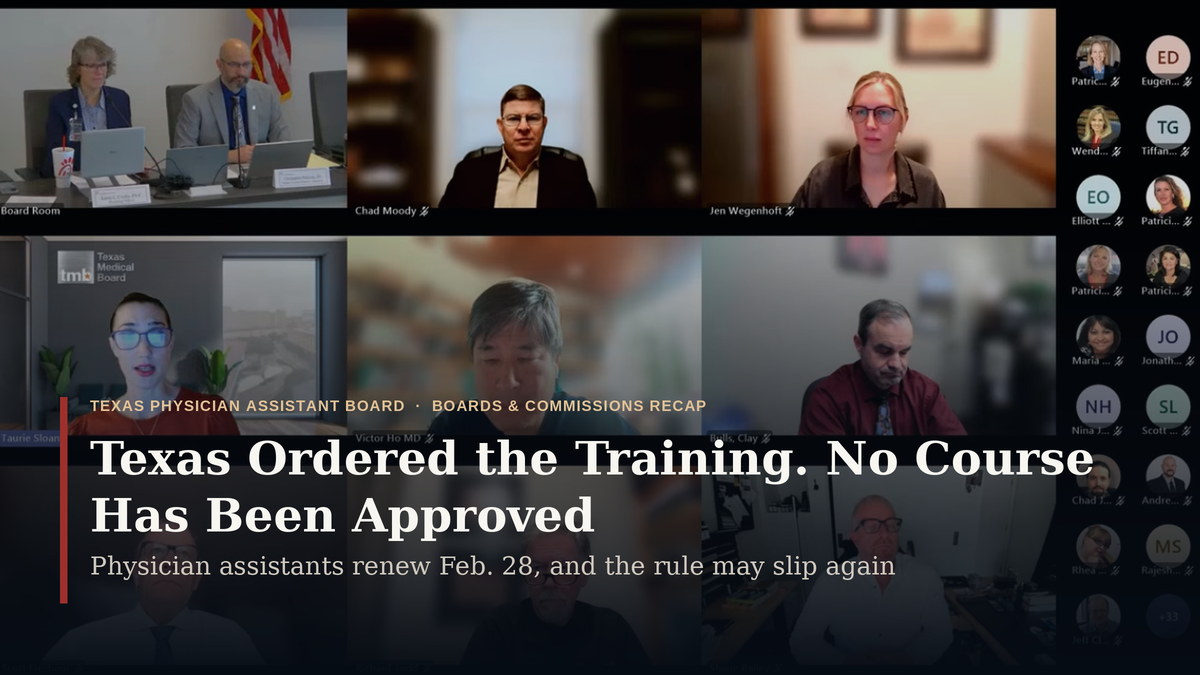
Texas physician assistants who treat patients in emergency rooms or urgent care centers are supposed to document two hours of training in collecting sexual-assault evidence when their licenses come up for renewal at the end of February. No approved course exists.
Agency staff told the Texas Physician Assistant Board on Nov. 6 that unless a free one appears by Dec. 1, the requirement will move again — to whichever group of physician assistants renews after February. Texas counted about 15,400 physician assistant licensees in September and publishes no count of how many work in emergency or urgent care. Renewal notices for the February group start reaching inboxes around the beginning of December.
The training matters well outside a licensing file: a sexual-assault prosecution can turn on whether the clinician who examined the survivor knew how to collect the evidence and pass it on without breaking the chain of custody. The Legislature ordered it in 2025 in House Bill 47, built on recommendations the governor’s own Sexual Assault Survivors’ Task Force made in November 2024, and the law has applied to physician assistant renewals filed since Sept. 1, 2026 — as the Dispatch reported in September, when the same deadline caught emergency room physicians.
The bottleneck is not the Legislature’s. House Bill 47 requires only that the training match the evidence collection protocol the attorney general distributes; it mentions the task force once, and nothing about coursework. It was the medical board, in the rule that carries the requirement, that decided it would “recognize any course found acceptable to the Governor’s Sexual Assault Survivors’ Task Force”. The task force’s own page for health care professionals claims the bill as its own, names no approved course, and sends clinicians back to the board’s pages. Those pages say: “Currently, there is no approved coursework available for continuing education in forensic evidence collection.”
A course is being written. Texas Medicine, the state medical association’s publication, reported in August that the Texas College of Emergency Physicians was preparing one and that the board had settled an approval process with the task force, and that the board’s timeline was “predicated on the CME being available by Dec. 1, when the renewal period begins for those with licenses expiring at the end of February 2027.”
Staff made the agency’s defense plainly: it will not enforce a rule nobody can satisfy. Taurie Sloan, the medical board’s director of government affairs, said the same reasoning had already been applied to the physicians whose licenses expire Nov. 30 — almost 12,000 of whom, she said, were emailed to say the training is not required of them, no free course having existed when their window opened Sept. 1.
“If by December 1, we do not have at least one free course available, we’ll push it to the next renewal cohort.”
Andrew Sauer, a member of the board who is a physician assistant in Amarillo and said he works emergency shifts and renews in February, asked what happens if the course never comes. “And so we’re anticipating them to get something ready, but if they do not get ready, then do we have a plan for that?” Karrie Lynn Crosby, the presiding officer, asked how licensees would be told, and said the agency had not chosen this: it is, she said, “a legislative mandate.”
Underneath the missing course sits the machinery. Licensees who need continuing education to renew must now log it through CE Broker, the private platform the medical board has partnered with, and February’s physician assistants are the first of their license type to renew under it. Clay P. Bulls, a board member and physician assistant in Abilene, said he had finished his national certification requirements, uploaded the hours and been shown as short: “I just checked mine and it’s saying that I’ve got two hours lacking, but it won’t tell me exactly what those are.” Seeing which two, he said, meant buying an upgrade.
The board’s published position is that a free account suffices — “Paid plans are optional … they are not required for compliance” — and the free account does show whether a licensee is complete. The same guidance concedes that an itemized view of “any remaining requirements” comes with an upgrade. Physician assistants, Bulls said, are being told “you have to do this or else”, and if they cannot establish compliance, “that’s going to come up when it comes to the disciplinary action of that”.
Physician assistants who never see an emergency patient can take themselves out of the forensic requirement now, by attesting on the platform that they are “Not Working in an ER Setting”. For the rest, the notices go out days after the date the whole timeline turns on.
The rule item the meeting was billed on produced nothing. Item 28 on the posted agenda was a review of, and adoption of proposed amendments to, the medical board’s physician assistant chapter — the thing the Dispatch’s Nov. 5 preview named to watch, noting no such proposal had reached the Texas Register. None had. The chair disposed of it and of a separate, unspecified rule-review item in one sentence: “there’s nothing to discuss under number 27 or 28”. A nutrition and metabolic health hour, added by the same rule, binds physician assistants whose licenses expire on or after May 30, 2027. Licensure staff reported 287 licenses issued so far this fiscal quarter at an average of eight days, against 339 at four days a year earlier. The board worked a long disciplinary slate and spent about 64 minutes in closed session on a single appeal.