
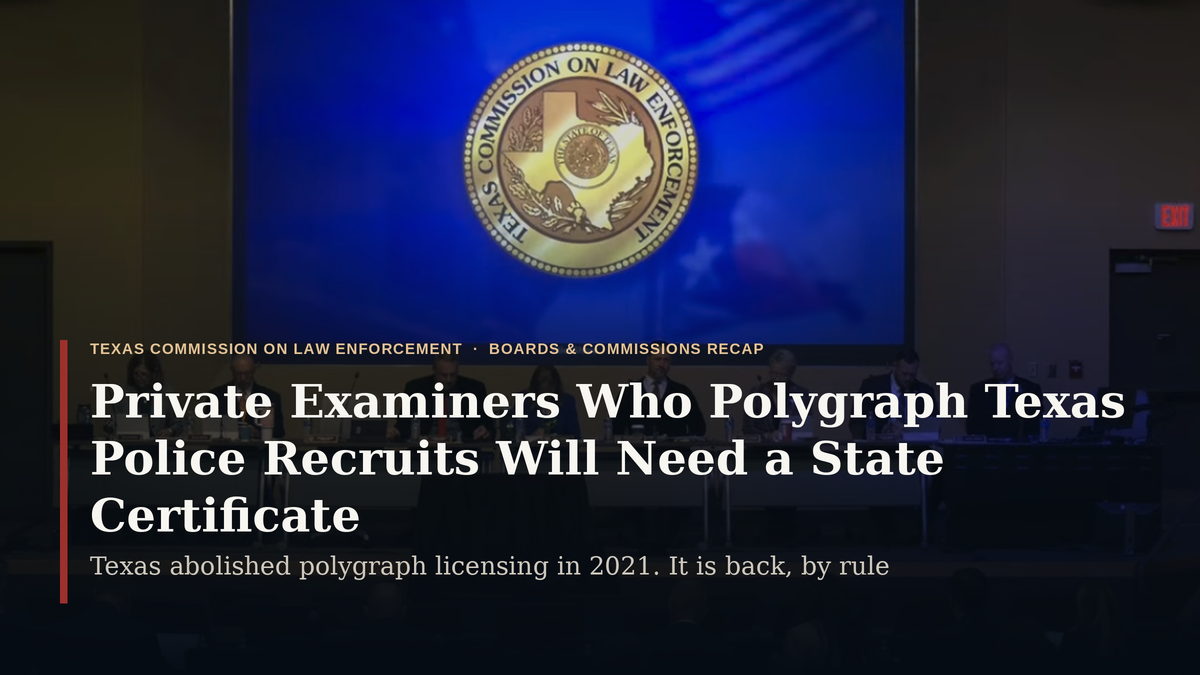
Private examiners who give lie-detector tests to Texas police recruits will need a state certificate from Jan. 1. The requirement survived a polygraph firm’s objection and a round of changes the governor’s office asked for, but it ended up in a rule whose public notice never mentioned polygraphs and said the rule changed nothing about who was covered.
The Texas Commission on Law Enforcement adopted the package Nov. 19. By the agency’s published count, Texas had 83,428 currently appointed peace officer licenses at 2,775 active agencies as of May 29, 2026, and the certificate will be needed by anyone who polygraphs a candidate for a job it licenses, badge or no badge.
Texas does not license polygraph examiners. It stopped on Sept. 1, 2021, when House Bill 1560 repealed the Polygraph Examiners Act and expired every license under it the same day. Five years on, a credential is going back on private examiners who work for police, by rule rather than by statute.
Senate Bill 2180, which passed the Senate 31-0 and the House 136-9 in 2025, reaches peace officers and nobody else. It lets the commission set “minimum requirements for the training, testing, and certification of peace officers to conduct polygraph examinations” and requires it to bar an uncertified officer from giving one. The commission’s position is that a police hiring polygraph is its business whoever administers it, and that its authority rests on the broader statutes governing how departments vet recruits rather than on the polygraph law, Aaron Heath, an assistant general counsel, told commissioners.
The commission went wider than the bill. Two of the rules it published for comment Oct. 16 reached private examiners, and said so. One required the certificate of a person “regardless of their status as a peace officer”; the other barred a chief administrator from letting “a person who does not hold a law enforcement polygraph certificate” test an applicant. Both notices flagged the expansion. One said the rule “does expand an existing regulation by requiring certification of individuals who are not peace officers.”
That was the design from the start. The advisory committee that drafted the rules distinguished pre-employment polygraphs, where staff said “any person” conducting one for a law enforcement agency would need the certificate, from criminal-investigation polygraphs, where only a peace officer would. The certificate carries 30 hours of continuing education, at least 16 of them at a commission-approved conference. The commission has issued a certificate to non-licensees before: in June it opened its public information officer certificate to people it does not license.
Richardson Polygraph filed two comments arguing the requirement “exceeds the scope” of the statute, staff said. The governor’s office weighed in too. The provision came out of both rules, and reappeared in a third.
Heath told the commissioners that “after discussions with the governor’s office and these public comments, we decided to relocate these provisions to proposed rule 217.5,” a new rule on what a department must do before hiring. TJ Vineyard, a deputy chief, said the provision had been carried across to where staff thought it “more appropriately” belonged: pre-employment polygraphs must be done only by examiners the commission has certified.
Nothing in the published version of that rule mentions polygraphs. As published Oct. 16 it lists seventeen things a chief administrator must obtain before hiring, among them fingerprints, a driving record, references, and medical and psychological declarations, and a polygraph is not among them or anywhere else in it. Its notice advertised three new requirements, none about polygraphs. It said the rule “does not increase or decrease the number of individuals subject to the rule’s applicability,” which is true of the people the rule binds, police chiefs, and silent about the examiners the new condition reaches. Anyone who read the notices and commented was commenting on wording that did not survive to the vote.
That matters under the state’s Administrative Procedure Act, which requires public notice of a proposed rule and, as Texas courts have applied it, does not let an agency adopt a rule that differs substantially from the one it noticed without proposing it again. Whether moving a provision from two rules that announced it into one that did not crosses that line is the question any objector could raise. A commissioner put the agency’s answer on the record, asking whether anything in the final version reached people or conduct that “was previously not covered in the proposed version.” Heath said no: “So these were already before you,” in the September package, if not in that rule.
The agency has “an obligation to protect the integrity of the pre-appointment process,” Heath said, and must do so “while also allowing chief administrators to have reliable tools to make well-informed hiring decisions.” The commission has not published the adopted text of 217.5, its responses to the comments, or what the governor’s office asked it to change.
The polygraph trade divided over the law behind all this. At a Senate committee in April 2025, two men testified against Senate Bill 2180: Michael Mitchell, a polygraph examiner from Austin, and J. Patrick O’Burke of Floresville. Testifying for it was Constable Bobby Rachel, for the Texas Association of Law Enforcement Polygraph Investigators; three police associations registered in support. Rachel and O’Burke both went on to sit on the advisory committee that drafted these rules. Rachel was the first of two speakers at the microphone Nov. 19, and his worry pointed elsewhere, to voice-stress testing: “There will be a push to allow those kind of assessments into this,” he said, and they are “not as credible as the polygraph examinations that we’re using.” No one at the meeting commented on the relocation.
Commissioners also took up a rule obliging every Texas agency to adopt a written polygraph policy, and approved a model one departments may use instead; the broadcast dropped during comment on the first and resumed after the vote, though staff later spoke of it as adopted. The rules take effect Jan. 1. The adopted wording and the agency’s answers to commenters go to the Texas Register, which carried neither as of Nov. 20.
A definition fixed after complaints, a penalty sent back to staff without a vote, and a warning to police chiefs about the agency’s own records system. Commissioners sent out for comment a change to the definition of a part-time peace officer, striking the requirement that the officer be entitled to benefits; it came, staff said, from “feedback received during the pay status update roll out”, and one speaker on the dais allowed that “sometimes we miss something and sometimes we just don’t get it right”. On the disciplinary docket, after the police chief of Elgin came to the microphone, commissioners split his agency’s agreed administrative penalty from another, accepted the other, and sent the Elgin waiver back to staff by the chair’s direction rather than by vote — counsel having advised that no motion was needed. The chair then told chief administrators generally that the agency’s records tools are not a substitute for vetting a recruit: “It is a tool. It is not the background investigation.”