

Most of the electricity Texas data centers have asked for will never flow. The grid operator’s first screen has already set aside three of every five gigawatts it sorted, and what remains in the group it plans around lands close to what an independent researcher predicted will actually be built. That matters to anyone with a power bill, because the wires to serve a data center go up before anyone knows whether it will show up, and Texas pools much of that cost across every ratepayer.
The audit Gov. Greg Abbott ordered on Aug. 3 was sold on a frightening number: “approximately over 474 gigawatts” of requests, more than five times the most power the state has ever used at once. Three months in, the audit is showing that the queue’s problem is less a shortage of power than a shortage of proof. Proof of land, of equipment, of money is the right guardrail for ratepayers, but it answers none of the questions the people living next door are asking.
The queue was mostly paper from the start
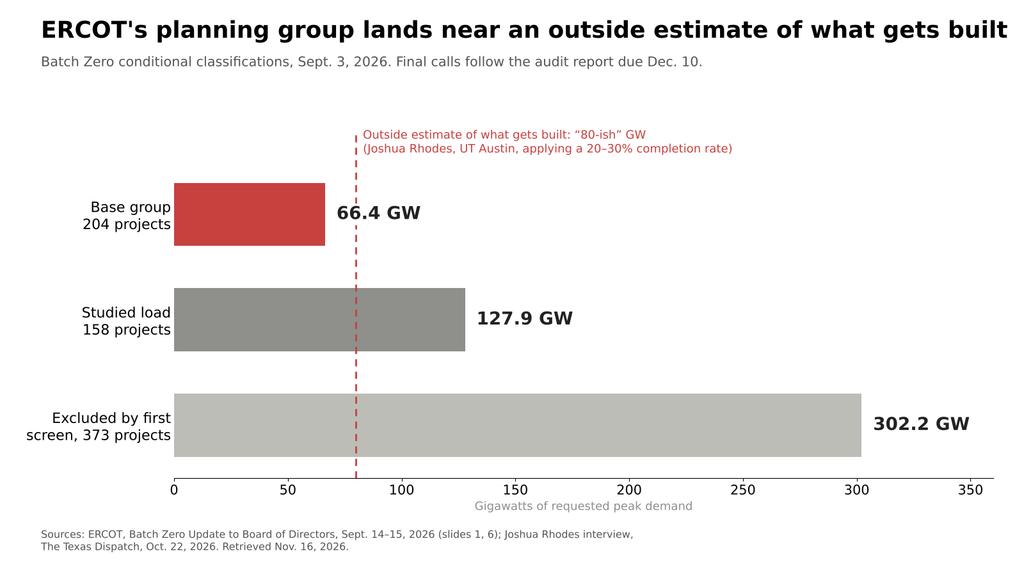
The Electric Reliability Council of Texas, the nonprofit that runs the grid for most of the state, sorted every large request into its one-time Batch Zero study on Sept. 3. It excluded 302.2 gigawatts from 373 projects outright. It kept 127.9 gigawatts as “studied” load, which it will test to see how much the grid can serve. And it put 66.4 gigawatts from 204 projects in its base group, the load that feeds its forecasts and reliability planning and the only group allowed into the stability study a project must pass before it can switch on.
That base group is still enormous. It equals 73% of the grid’s record demand of 91,134 megawatts, set July 22, and by ERCOT’s rule of thumb that one megawatt serves about 250 homes at peak, it is enough electricity for some 16.6 million homes. But it is a number someone has begun to check, which the 474 never was.
It is also close to an outside estimate made with no access to ERCOT’s files. Joshua Rhodes, a University of Texas at Austin research scientist who studies the grid, applied the historical completion rate for power plants in the queue, 20% to 30%, to the 400-plus gigawatts then on the books. “Maybe you’re looking at 80-ish,” he told the Dispatch in October, still a doubling of the grid in a few years. ERCOT’s paperwork and Rhodes’ arithmetic arrived at roughly the same place by different roads, which is the best evidence yet that the real figure is in the tens of gigawatts, not the hundreds.
The audit is a test most applicants are not passing on the first try
ERCOT’s lawyers, outside counsel, finance staff, engineers and weatherization inspectors have now read first-round answers from 257 developers, about 5,140 questions in all, and the grid operator expects to send follow-up letters to four in five of them, with five business days to explain the gaps. The problems it is finding are not exotic: developers who cannot document who owns them, who cannot show they control the land, who cannot show they have ordered equipment that takes 18 months or more to arrive, and whose posted financial security cannot be confirmed.
An earlier check pointed the same way. Of 290 computer models developers submitted to show how their equipment would behave when the grid wobbles, about 18% were acceptable on first review. Loads that fail verification or do not answer “will be disqualified.”
The money test is the one with teeth. Since Oct. 8, a Public Utility Commission rule has required $50,000 in security for each requested megawatt, plus a $100,000 study fee. For a 1,000-megawatt campus, that is $50 million posted before the first study begins, which is a fair working definition of a serious request. A draft standard contract would go further, requiring a letter of credit for five years of minimum bills and letting the utility keep part of the security when a project slips.
In Archer County, a request is real the day it is filed
About 1,200 feet from Heather Peysen’s house on Three Way Road, outside Wichita Falls, a developer wants a data center that would draw 1,000 megawatts, more than 1% of the state’s record demand and, by ERCOT’s rule of thumb, as much power as 250,000 homes. On Sept. 14 she asked state regulators to audit it. “The 1000 MW request sits 1200 ft from my home,” her filing in the commission’s large-load docket reads. Fifteen other comments from area residents arrived the same day, several following a template from a neighbor-run group, Texoma Data Center Watch, the Dispatch reported.
The project, called Project Raptor in the filings, already has numbers attached. A question-and-answer sheet prepared for the Archer County Commissioners Court names Google as the company, puts maximum water use at 32,000 gallons a day with air-cooled chillers, and says the developer would spend $3.5 million to $4.5 million rebuilding a pump station and about 9.5 miles of pipeline for the local water supply corporation. It also says the project is not planning to generate any of its own power. Google has not publicly confirmed the site.
The county’s one lever was money. On June 22 commissioners unanimously rejected a tax-abatement application from the developer’s entity, and Assistant County Attorney Tyler Sales told the court, according to its minutes, that “by not agreeing to a tax abatement, the county has no way to hold them accountable.” Nothing in ERCOT’s audit changes that. The grid operator’s separate community-impact survey, which asks about water, noise and setbacks, produces a report for policymakers; only the verification of land, equipment and money decides who gets connected.
Proof protects ratepayers. It does not answer the neighbors
The state’s case rests on the fact that the grid is everyone’s, and the Dispatch’s view is that guarding it is the state’s proper job. The cost of wires is shared, and a county-by-county process cannot decide how much load a statewide system can carry. Requiring every applicant to prove land, equipment and money before ratepayers start building for it protects the broader interest of all Texans against paying for lines to projects that never arrive. The hard part is time. Seventeen data centers and crypto-mining sites totaling 6,608 megawatts, enough for about 1.65 million homes, had finished every ERCOT step except approval to switch on when the pause began, and ERCOT says it is still determining whether the April 9, 2027, study deadline holds.
The developers’ case is that delay is the cost. A megawatt online is worth hundreds of thousands of dollars a year to its operator, Rhodes noted, and the industry’s trade group asked regulators “to move swiftly in order to distinguish between speculative projects and serious, committed investors,” as the Dispatch reported Aug. 3. Google, in the same docket as Peysen, has filed comments urging faster connections and told ERCOT’s board it has committed $40 billion to Texas through 2027. Where that case gets hard is the evidence itself: four in five developers needing follow-up letters is hard to square with a screen that is too fine.
The neighbors’ case is that proof of money is not proof of fit. A project can pass every ERCOT test and still sit 1,200 feet from a house, and counties have few tools to say no. Hays County Commissioner Walt Smith told KUT that a local moratorium would bring a lawsuit and “we’re gonna lose,” the Dispatch reported. The hard part of that case is that a local veto over grid-scale load would leave the state’s planning hostage to 254 separate decisions, which is why the better answer is a state standard for siting rather than a local one.
The audit will tell lawmakers which projects are real. It will not tell them where a real one should go, and every month spent deciding that keeps 6.6 gigawatts of finished projects idle while every shortcut risks wires that ratepayers keep paying for after a speculative project walks away.
What to watch
- Nov. 19, 2026: ERCOT’s Large Load Working Group meets; watch for any update on second-round verification responses.
- Dec. 10, 2026: ERCOT files its Batch Zero Eligibility Verification Report and Community Impact Review Report with the Public Utility Commission (Nov. 5 update). The final base, studied and excluded totals replace the Sept. 3 figures, and the report should say whether the April 9, 2027, study deadline moves.
- Dec. 14, 2026: Comments and hearing requests are due on the commission’s draft standard large-load interconnection agreement, including how much security a developer forfeits when a project slips.
- Dec. 17, 2026: The commission takes up both ERCOT reports at its open meeting (ERCOT timeline); filings post in Project 59142.
- December 2026: ERCOT’s Capacity, Demand and Reserves report, which ERCOT said could be delayed until base-load classifications are final.
Sources
Primary documents
- Office of the Governor, “Governor Abbott Directs Comprehensive Data Center Audit,” Aug. 3, 2026.
- ERCOT, Market Notice M-A080326-01, Update Regarding Batch Zero Timelines and Processes, Aug. 3, 2026.
- ERCOT, ERCOT Updates: PUC Open Meeting (Batch Zero verification and audit; community impact review), Aug. 20, 2026.
- ERCOT, Item 14: Batch Zero Update, Board of Directors, Sept. 14–15, 2026.
- ERCOT, Batch Zero Eligibility Verification Process Update, PUC Open Meeting, Nov. 5, 2026.
- Public Utility Commission of Texas, Project No. 59142 filings, retrieved Nov. 16, 2026.
- ERCOT, Large Load Working Group, retrieved Nov. 16, 2026.
Data
- ERCOT, Monthly Operational Overview, July 2026 (record demand of 91,134 MW).
- ERCOT, Fact Sheet, October 2026 (1 MW serves about 250 homes at peak).
Research and interest groups
- Joshua Rhodes, University of Texas at Austin research scientist, interviewed in The Texas Dispatch, Oct. 22, 2026.
- Data Center Coalition (trade association of data-center developers and operators), statement in The Texas Dispatch, Aug. 3, 2026.
- Texoma Data Center Watch (neighbor-run group opposing the Archer County project), template described in The Texas Dispatch, Sept. 16, 2026.
News reporting
- The Texas Dispatch, Texas Data Centers Must Answer Water Questions Under Oath by Oct. 12, and Refusing Is a Crime, Sept. 16, 2026.
- The Texas Dispatch, Texas Data Centers Seeking 75 Megawatts or More Now Owe $100,000 Up Front and $50,000 a Megawatt in Security, Oct. 9, 2026.
- The Texas Dispatch, Texas Draft Contract Would Make Data Centers Post Cash Guarantees and Report Their Water Use, Oct. 30, 2026.
- The Texas Dispatch, Will Texas Give Communities More Say Over Data Centers?, Oct. 27, 2026 (citing KUT).