
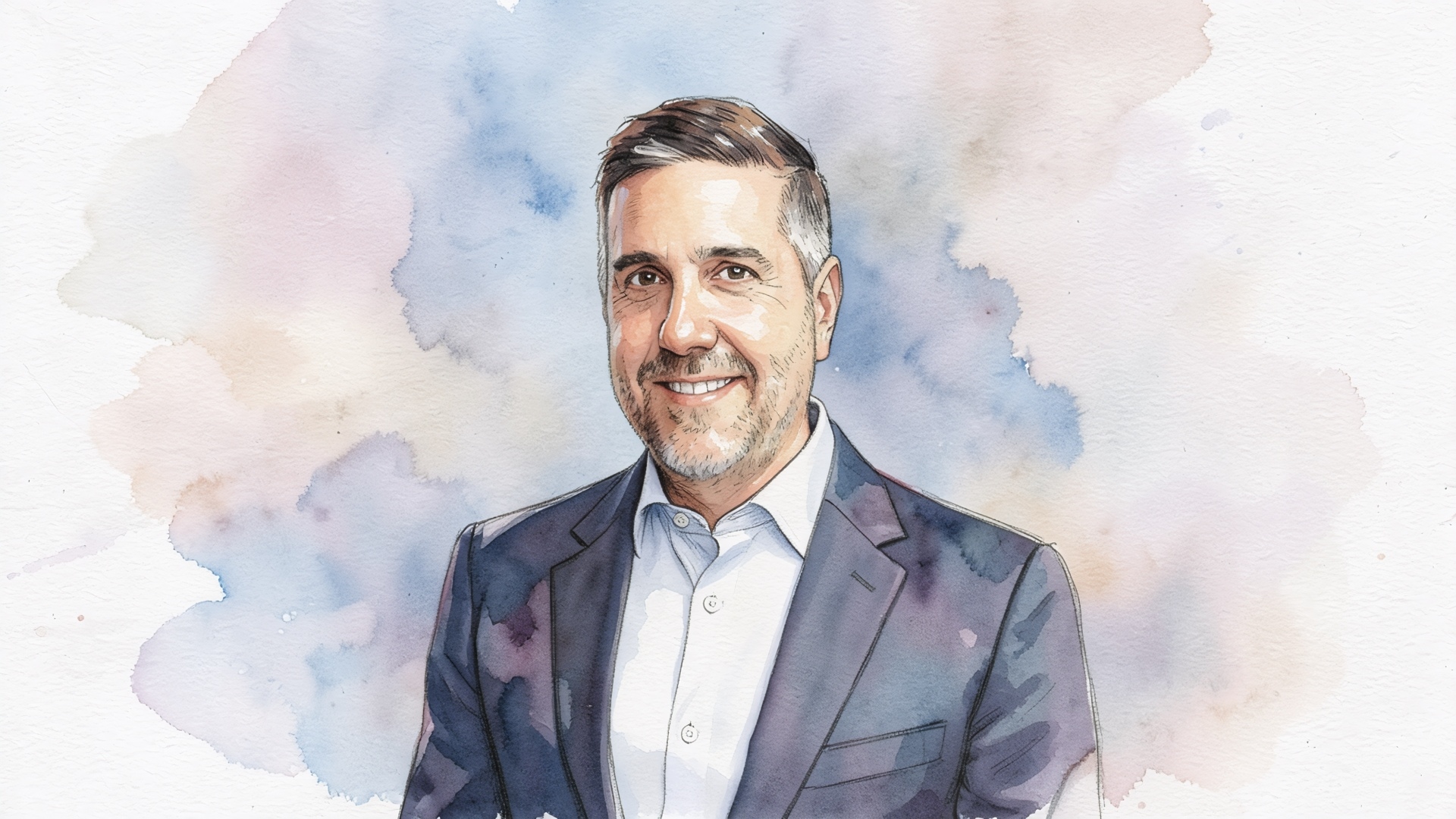
On March 1, 2003, Ted Delisi went to work in a spare bedroom.
He had an old Apple laptop, a Nokia cell phone, a domain name that took more effort to register than it would today, and a business checkbook the size of a three-ring binder. He remembers writing an early check — $23.16 — and wincing. Do I really need that?
His goal was modest. “Is this going to make it 90 days?”
It made it. Twenty-three years later, Delisi and his wife, Deirdre, run Delisi Communications, an Austin government relations and public affairs firm, and he has spent most of his adult life inside Texas campaigns and the Capitol. The spare-bedroom stretch is the part he still describes most vividly.
“If you’ve ever seen an airplane take off from an aircraft carrier,” he says, “that catapult just shoots that jet off, and then the first thing it does is it drops, and you can’t see it for one-one-thousand, two-one-thousand. Then it starts to rise.” Every entrepreneur, he says, is “trying to shoot themselves out of a catapult, and they’re just wondering, how long does it take the jet engines to fire?”
Temple
Delisi grew up in Temple, the town on I-35 between Austin and Dallas where, as he puts it, travelers used to stop when they had car trouble and now stop for Buc-ee’s. It was a one-high-school town “where Friday Night Lights is not a slogan. It was a real thing.”
He wasn’t a star football player. He was a news junkie, which he traces to his mother’s interest in politics and a ninth-grade U.S. history teacher who sent him to Time magazine. “Maybe I wasn’t the coolest kid at Temple High School,” he says. “But I kind of had my group and did what I wanted to do,” and he kept asking why things were the way they were.
Austin, an hour south, was the big city. Driving down Sixth Street counted as cool. There were no cell phones and nobody texting to ask when you’d be home — the Dazed and Confused era, he says, with less trouble to get into than the movie suggests.
A doctor running for the Senate
Like a lot of curious kids, Delisi assumed he’d be a doctor. He went to Vanderbilt University in Nashville and worked nights in the emergency room — “so low they wouldn’t trust me to do much of anything.”
In 1994, someone at the hospital told him one of the doctors was running for the U.S. Senate. That was Bill Frist, a heart surgeon who won the seat and later became Senate majority leader. Delisi was struck that a physician had made the leap he was drawn to himself.
He went to work in Tennessee politics, then on the 1996 presidential campaign of former Tennessee Gov. Lamar Alexander, where he met Deirdre. He assumed politics was something you did once or twice before getting a real job. “This is not a real way to make a living,” he remembers thinking. Law school seemed like the sensible next step.
Instead he moved back to Texas in 1996, two years into George W. Bush’s governorship, and got connected to Karl Rove, Bush’s political consultant. Delisi managed campaigns on which Rove consulted, several of them close. In 1999, when Rove went full-time to Bush’s presidential campaign, Delisi and a partner bought Rove’s direct-mail consulting business. He scraped together the money. Austin, in 2000, was buzzing.
When Bush won, Washington was the obvious next stop. The Delisis chose not to go. “Where do you want to raise a family? Where do you really want to call home?” he says. “I loved Austin, still love Austin.”
The race that made it a career
The moment Delisi decided politics would be his profession came in 2002. He had served as press secretary and communications director to John Cornyn when Cornyn was Texas attorney general, and that year he was general consultant and chief strategist for Cornyn’s successful run for the U.S. Senate. Deirdre was working for Gov. Rick Perry, whom she later served as chief of staff; the 2002 Republican ticket, Delisi says, worked unusually well together.
“That’s maybe the first time when I really understood that this was going to be something that I was going to make a profession out of,” he says.
Campaigns, he notes, are a strange business model. “You build a campaign, you spend all the money and you go out of business, all in about 14, 15 months.” He liked that Election Day was a final reckoning for months of work. “Good campaigns gain two to three inches a day on their opponents,” he says — invisible day to day, decisive over a year.
He also learned something about himself. “I was always one of these people that hate to lose, rather than love to win.”
Doing it his way
A few months after the Cornyn win, Delisi went out on his own with 100 percent ownership. Partnerships, he’d seen, could go sideways — the best friend from childhood you no longer speak to after a real estate deal. “If you’re going to risk your capital, do it in such a way that your work and your abilities and your decisions will determine the outcome,” he says.
He started with campaigns because that’s what he knew, but planned all along to move toward helping businesses navigate government. That’s now most of the firm’s work.
He explains it in market terms. “Great businesses exist where there are market inefficiencies,” he says. “And there is a permanent market inefficiency between the public sector and the private sector. That’s where my business exists.”
Texas government is inherently complicated, he says: 181 legislators, a governor, dozens of agencies, and a session that runs 140 days every other spring. Part of his job is translating it — how a decision affects the state’s 5.5 million schoolchildren, or how the sales tax that supplies the bulk of state tax revenue ties the budget to consumer spending.
He also pushes back on the old image of lobbying as dinners with senators. “There is so much complexity now,” he says. “If you’re going to be successful being an advocate in the Capitol, you’ve got to have gobs and gobs of truth” — data, subject-matter experts and the facts at hand when they matter. Relationships still count, he says, but he describes the firm as closer to a boutique law firm, with specialists in each issue area. One colleague calls transportation policy “not an onion with layers, but a field of onions with layers.”
The distance swimmer
Delisi has thought hard about whom to hire. Two rules stand out.
First, don’t hire your twin. He once listened to a peer describe hiring a childhood friend he’d worked with for years. “What if you hired someone that really had a whole different type of skill set than you did?” Delisi asked. He wants a Venn diagram, not a mirror.
Second, he looks for people who understand competition — ideally in a sport nobody watches. He points to a colleague who was a distance swimmer. “Nobody shows up to cheer for distance swimming,” he says. “That’s someone who is used to competition and is used to almost nobody cheering for you.”
It doesn’t have to be athletics. Chess, math contests, music competitions, trivia: “The less clapping that happened for you, and the more you were into it, the more I’m interested in how your mind works.”
Integrity and intelligence come first, he says. But in a small firm — “a small speedboat group of people,” not a 60,000-person company — everyone represents everyone else.
He applies the same thinking at home. He and Deirdre have 19-year-old twin sons and a 16-year-old daughter. “In a world where your kids can push A on the controller and start the game over again,” he says, “maybe the role of youth sports is to teach them that you can work really hard, you can practice hard, you can have a sound strategy and you can still lose.”
When the world shut down
The scariest moment in the firm’s history, Delisi says, was COVID. Standing in his kitchen in 2020, he figured clients would cut consultants first.
The opposite happened. Every business suddenly needed to know what government would allow. He worked with an ambulance company that had to treat every patient as COVID-positive and needed answers on protective equipment and protocols. “What I thought was going to be like my small business, my journey was over,” he says. “Then I quickly learned that in certain instances we were really needed.”
Four conditions
Delisi spoke six days before the Nov. 3 election, and because he follows everything from the governor’s race to state House seats, he offered a framework he says he has used for years.
Texas Democrats, he noted, had the longest losing streak of any state party in the country: no U.S. Senate win since 1988 and no statewide win since 1994. For that to end, he argued, four conditions had to line up: a Republican president, an economy showing weakness, a Democrat able to reach beyond Democrats, and a Republican nominee carrying significant negatives.
He thought most of the conditions were in place. His one question mark was whether James Talarico, the Democratic Senate nominee, could make the third one happen.
Six days later, the question was answered. Talarico defeated Republican Ken Paxton — who had ousted Cornyn, Delisi’s old candidate, in the primary runoff — by roughly 12 points, and Democrat Gina Hinojosa unseated Gov. Greg Abbott by about seven. Both are the first wins of their kind for Texas Democrats in more than three decades.
The results will shape Delisi’s next two years: a new governor, a reshuffled Capitol, and clients who need to understand both.
What’s next
Delisi says what energizes him is learning new subjects as clients bring them in. Lately that’s data centers, whose politics he has watched swing “from rah-rah, let’s do this economic development, to hold on a second.” He tests every policy the same way he once tested campaign messages: “If you can’t explain what you’re doing to the Rotary Club Wednesday at noon, then you should be worried.”
He sees large language models as a real tool for a memo-heavy business — getting a draft “80 percent” of the way, with his team’s expertise supplying the last 20 and checking every fact. He is also asking a harder question: what happens when someone at the Capitol pastes a bill into an AI chatbot and asks whether it’s good or bad? “I think it’s already happened,” he says. Understanding “by what standards” people now judge policy is part of the job.
His advice to young people in politics hasn’t changed since he was one. Be a sponge, and learn the job next to yours, not just your own. “If you want to know baseball, you want to know pitching and you want to know catching, and you want to understand what the first baseman does,” he says.
And keep the drama outside the office. “Life has enough drama,” he says. “In a high-stress environment like a campaign, you want people that are steady in the foxhole.”