
A $29.4 million request to staff a permanent defense against screwworm and fever ticks now tops the Texas Animal Health Commission’s budget wish list. House lawmakers spent more than three hours of an Oct. 2 hearing asking whether the state’s other invasive-species spending is buying enough for the money.
“Today marks day 121 of the New World Screwworm response in Texas,” Louis “Bud” Dinges told the House Committee on Agriculture & Livestock. Dinges, testifying for the Texas Animal Health Commission, said “49 New World Screwworm cases have been detected on 41 premises across 19 counties” since the first case surfaced in Zavala County on June 3. Those cases produced 21 infested zones. Seven have met the criteria for release and two more have shrunk. Federal crews have dropped “more than 1.39 billion sterile flies” over Texas since Feb. 1, he said.
The danger has not passed. Dinges said that in the week ending Sept. 25, surveillance caught a wild fly in a baited trap in Brewster County, which The Texas Dispatch reported at the time. He said 79,731 suspect flies have been collected statewide and sent for diagnosis.
Paying to keep watch is the next fight. A member asked whether the agency had put its needs in its legislative appropriations request. A TAHC official said it was. The package is “our number one exceptional item,” the official said, describing “an ectoparasite, preparedness and defense” package of “about $29.4 million, 118 FTEs” meant for fever ticks, screwworm and a possible Asian longhorned tick threat. The official said the money would not build a permanent bureaucracy. “The intent on that is not to build our agency to make it where it’s sustained at that,” the official said, but “to put the resources in place to deal with the long term threat of new world Screwworm.”
Rep. Stan Kitzman, R-Pattison, pressed on how seriously Texans should take a threat that, so far, has been smaller than feared. He asked what to tell people who say, “oh, well, we made it through this summer and it wasn’t any big deal.” He also asked, “What do you tell people about our due diligence going forward and how serious this is or is not?” A panelist answered plainly. “As long as the fly is present in Mexico, it’ll be a threat to Texas and the United States.”
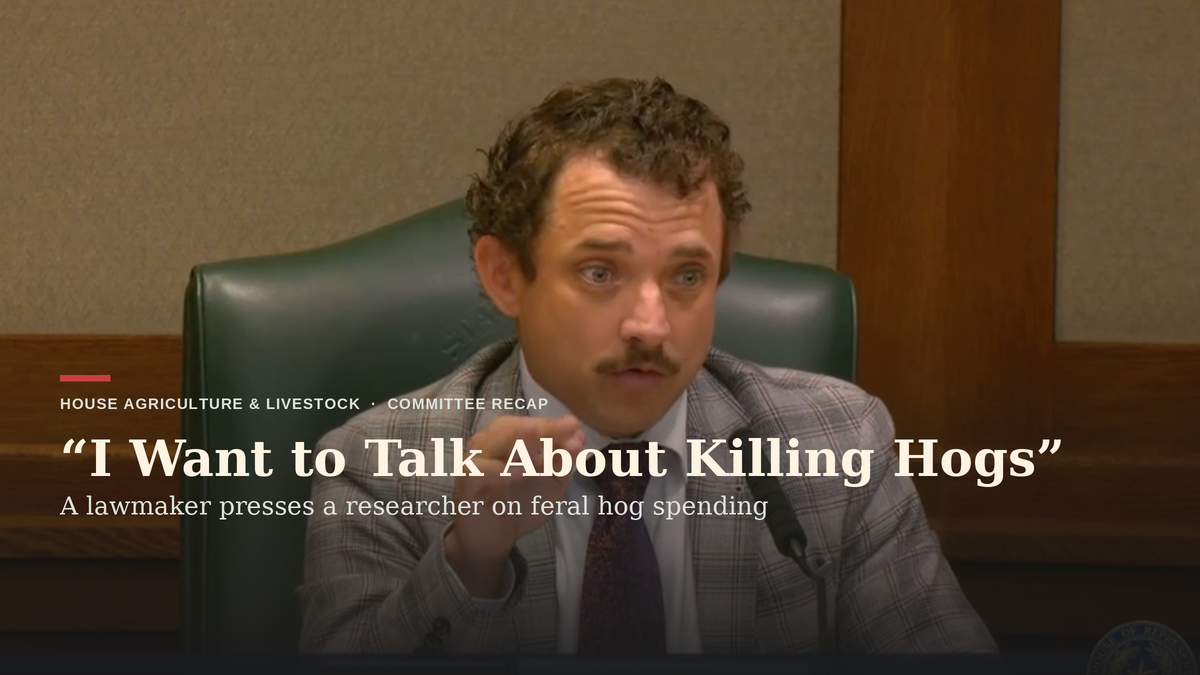
The sharper questioning came earlier, on feral hogs. Rep. Briscoe Cain, R-Deer Park, quizzed Dr. John Tomashek of Texas A&M AgriLife about a rider in the state budget, Senate Bill 1. The rider required a report to the Legislative Budget Board and the governor by Oct. 1 on how feral swine money was spent. “Do you know anything about that report?” Cain asked. “No, I do not, sir,” Tomashek said.
Cain then asked what Tomashek actually does. “Okay, so you’re just there to do research. I want to talk about killing hogs.” Tomashek replied, “We also kill hogs. But my work is primarily on research.” Cain said he doubted the results. “I’m not sure we’re getting the bang for their buck,” he said, adding that other places “seem to be eradicating invasive species better than us.”
Rep. Don McLaughlin, R-Uvalde, asked the question the committee could not answer. He asked whether anyone knew “how much we’re spending on feral hogs” across what he called “a whole bunch of different pots.” “Is there a compiled list somewhere?” he asked. “To my knowledge, no, but we could compile such a list,” Tomashek answered, covering state, federal and private support. A member asked that it be shared with the committee.
Cain’s later questions went to a private-sector proposal. Henry Foray of Inversa pitched an approach built on his company’s work in Florida, and Cain asked about the incentives it creates. “How do we ensure that the ultimate goal of this, which recognizes human nature, there’s incentives to financial incentivize it, but at the same time, to ensure that we’re incentivizing the total eradication of the animal as well,” he said. Foray said he was “hyper obsessive” about avoiding “perverse incentives” and “Cobra effect” outcomes. He also conceded the limits. “Feral Hog is not one of those species that I think anyone will tell you you can successfully eradicate,” he said, citing “400 years” of establishment. Foray said the safeguards end with technology, including drones and “audit bots,” and a final human review.
Kitzman offered a historical frame. “It sounds an awful lot like buffalo hunting,” he said, though he added that the hog is not “near on the level of the noble beast of the American bison.”
No vote was taken. The hearing fed the committee’s interim report, and the budget request, the hog spending list and any bills will take shape when the 90th Legislature convenes in January 2027. The Dispatch previewed the hearing before it began.
The committee spent about two and a half hours on the state’s Texas-grown marketing programs, where GO TEXAN supporters defended the program and Gulf shrimpers warned their industry is near collapse. It also heard about 40 minutes of agency-oversight testimony, including from the Texas A&M Forest Service.
Fact box
- Issue
- Invasive species: New World screwworm, feral hogs, mealybugs and fever ticks (approx. 215 minutes, about 53 percent of the hearing)
- What happened
- TAHC reported on the screwworm response and said its top budget request is a $29.4 million, 118-position ectoparasite program. Members questioned feral-hog spending and an overdue budget-rider report and asked for a compiled list of state hog spending. No vote — interim hearing.
- When
- Friday, Oct. 2, 2026 · run time 6:46:08
- Where
- Room E2.012, Capitol Extension, Austin
- Chair
- Rep. Ryan Guillen, R–Rio Grande City (HD-31); Vice Chair Rep. R.D. “Bobby” Guerra, D–Mission (HD-41)
- Key witnesses
- Louis “Bud” Dinges and Thomas Lansford, Texas Animal Health Commission; Dr. John Tomashek, Texas A&M AgriLife; Henry Foray, Inversa; Dr. Philip Kaufman, AgriLife; Allen Cain, Texas Parks and Wildlife (verify)
- Archived video
- house.texas.gov video 22880