
From Nov. 30, the most medically fragile children in Texas can get Medicaid nursing care at home without first entering a nursing facility, and without waiting their turn on a list 7,491 children long in September.
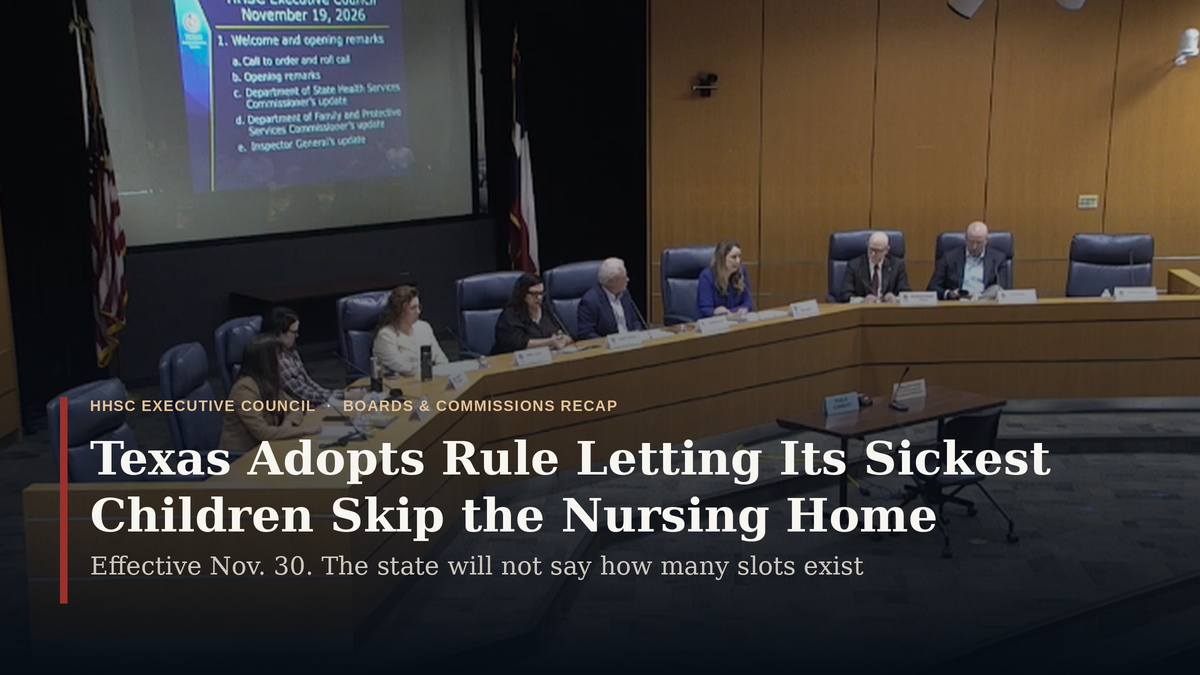
The Texas Health and Human Services Commission’s executive commissioner adopted the rule creating those openings — the agency calls them diversion slots — on Nov. 9, and it published Nov. 20. Staff walked the agency’s Executive Council through it Nov. 19 and said slots would be offered from Dec. 1.
Until now there were two ways into the Medically Dependent Children Program, a Medicaid waiver that pays for nursing care at home instead of in a nursing home: join the state’s interest list, its term for a waiting list, or be admitted to a nursing facility first. Families have described checking a child into a nursing home purely to unlock care at home, as the Dispatch reported in August.
Reaching the top of the list has never meant getting in. Of the program’s interest-list closures from Sept. 1, 2025 to Sept. 30, the commission counted 928 as enrollments — 19.8 percent, its own figure. The largest category, at 27.6 percent, was no response.
Its chief Medicaid and CHIP services officer, Emily Zalkovsky, wrote in the filing that the slots would let such children reach services “without having to go through the interest list process or enter a nursing facility”.
What changed between the draft the public commented on and the adopted rule is the medical gate. Seventy-seven people and organizations wrote in, among them Disability Rights Texas, the Texas Pediatric Society and The Arc of Texas, and 36 commented at an October hearing, mostly the same groups. Many objected that the criteria were too narrow.
The commission loosened the gate in several places and narrowed it in two. A child must still be “too medically fragile to complete a stay in a nursing facility,” but the two-condition requirement now applies only “typically,” and the stipulation that a slot be available is struck. The seizure tests eased: three hospital trips now count without an admission, and daily seizures need treatment most days of a month, not every one. The narrowings are quieter: comfort feeds no longer count toward the feeding-tube test, and the agency’s physician must now find a child too fragile for any stay, not an extended one.
The added condition is congenital T-cell or neutrophil disorders, the commission’s answer to Glen Medellin, a UT Health San Antonio pediatrics professor who heads its division of complex and palliative care. He called the idea “long overdue” in March, then told the commission its checklist, eight conditions long then, had dropped something:
“I am concerned that we drop some criteria such as immunosuppression,” he said. “Because these include our children with cancer, stem cell transplant, that really are quite sick and should not be going into a nursing home and often can’t be waiting long periods of time.”
It is not what he asked for: it covers children born with inherited defects of the immune system, not children immunosuppressed by cancer treatment. The word immunosuppression appears nowhere in the rule.
His other objection fared better. He had warned that doctors were losing the ability to flag a child as fragile without matching the checklist: “I’m worried that the way these rules are written is taking that away.” The rule keeps that route: an agency physician may find a child too fragile “even if the person does not meet at least two of the criteria”.
The Arc of Texas, a statewide disability advocacy organization, got half of what it asked. Its deputy director of public policy and advocacy argued in March that requiring two of the most severe conditions was the wrong test:
“Medically fragile children often have complex overlapping needs that do not fit neatly into rigid categories.”
He asked it to weigh a family’s circumstances too — a caregiver who cannot keep going, private-duty nursing lost. It softened the two-condition test but kept the list clinical: thirteen conditions, devices and treatments, no family circumstance. It “disagrees with removing the clinical criteria from rule or relying solely on physician judgment”.
What it still will not say is how many openings exist. Commenters asked, and said there were not enough. The commission answered that the number “is not addressed in this rule” and that worries about there being enough are “outside the scope of this rule project”, noting the Legislature funded new slots, and that it administers them “in accordance with available program resources”. The Dispatch has now put the question twice.
Staff told the council that families seeking a slot should start by calling the interest-list line, that the child’s treating physician completes an attestation form, and that slots open Dec. 1.
The audit expansion nobody came to argue about, a ten-year backlog nearly cleared, and 300 staff moved onto Medicaid applications. Two rule proposals extending the state’s recovery audit contractor program into Medicaid managed care — a private firm reviewing claims private health plans have already paid, under House Bill 142 of the 89th Legislature — were summarized in a few sentences each and drew no question from the council. Two people had preregistered to comment and neither joined, and nobody signed up in the room, so no provider or health plan said anything at all. Staff reported the long-term care survey and complaint backlog, which has run roughly a decade, on course to clear by the end of December, with a few abuse cases held for an attorney general investigation. The eligibility chief said more than 300 additional staff and more than 60 state office staff have been shifted onto Medicaid applications, and that retirees are being recruited back. Both this agency and the family protective services department are under Sunset review at once; the hearings are Dec. 2 and Dec. 3.