
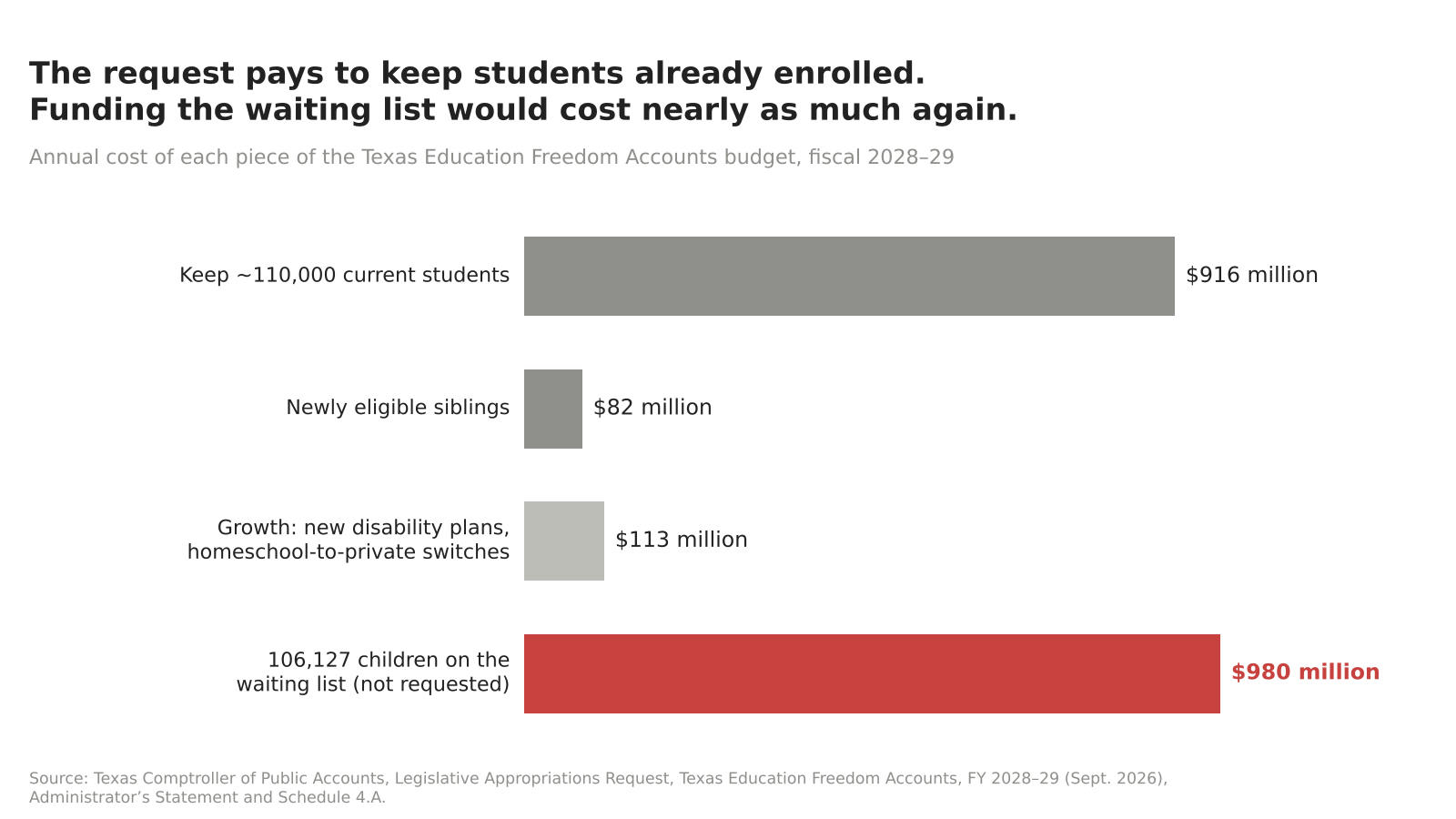
The request to double Texas’ education savings account budget would not pay for any of the children on the program’s waiting list. The comptroller’s office is asking for $2.08 billion over two years to keep the roughly 110,000 students already enrolled, plus their newly eligible brothers and sisters, while the 106,127 children still waiting would take another $980 million a year that the request leaves out. For a family that applied last spring and lost the lottery, the figure that decides the next school year is not the headline $2 billion but whatever lawmakers add on top of it.
That changes what the 2027 debate over Texas Education Freedom Accounts is actually about. The $1 billion ceiling in the 2025 law expires Sept. 1, 2027, and after that the program is whatever size the Legislature appropriates. “Doubling” is the price of standing still. Growth is a second, separate $2 billion decision, and the repeal bills already filed are a decision about families who are already inside.
Two Billion Dollars Buys the Same Program for Two More School Years
The first $1 billion paid for one school year, 2026-27, because the program launched in the second year of the state’s two-year budget. The next budget covers two school years, 2027-28 and 2028-29, which means the base request of about $1.04 billion a year funds the program at roughly the size it is today. Students already in it stay in automatically; their families only confirm they want to continue.
Inside that base, $916 million a year continues current students and $82 million funds siblings who become eligible for the first time. The enrolled group, as the comptroller describes it, is more than 60,000 private school students at $10,474 each, 7,300 students with documented disabilities who average more than $5,000 on top of that, and over 42,000 homeschoolers at $2,000. That works out to about $8,300 per student per year, roughly two-thirds of the $12,322 average that the law’s 85 percent formula implies the state and local districts spend on a public school student.
A separate $113 million-a-year exceptional item covers growth inside the existing group: nearly 15,000 participants expected to get new special education plans that raise their awards, and up to 4,200 homeschoolers expected to move into private schools, each adding at least $8,474 a year. All told, the request comes to about $2.3 billion.
What it does not buy is new seats for new families. When applications exceed money, the law fills open spots by lottery, siblings of current participants first and then new applicants by income and disability tier. The comptroller’s office counted more than 44,000 children on the 2027-28 interest list when it filed the request, and program officials told senators in October the list had reached 65,000.
For the Families Already In, the Budget Line Is a Tuition Bill
Alex Narvaez, a Houston-area father of three whose family earns less than $66,000 a year, moved his sons to St. Anne’s Catholic School in Tomball after bullying and safety worries at their public school. The accounts now cover more than $30,000 in annual tuition for the three boys, and he told KERA that without them “there’s no chance of me being able to afford tuition for three kids at private school.”
Graciela Gonzalez of Austin made the opposite move first. Money was tight, so she and her husband pulled their three daughters out of a Catholic school and enrolled them in a nearby public school, a choice she said they knew “wasn’t the best choice academically.” Then the program was announced. “We cried together,” she told the Senate Education Committee on Oct. 7.
In Pflugerville, just north of Austin, parent Stacy Harrell sees the same dollars from the district’s side. She told reporters the same day that 149 students who would otherwise attend Pflugerville ISD took accounts, an estimated $1.2 million loss, about $8,000 per student, in a district already closing four elementary schools. The estimate comes from two groups that oppose the program, the Texas Center for Voucher Transparency and Every Texan.
Most of a Waiting-List Expansion Would Be New Spending, Not Money Moved From Public Schools
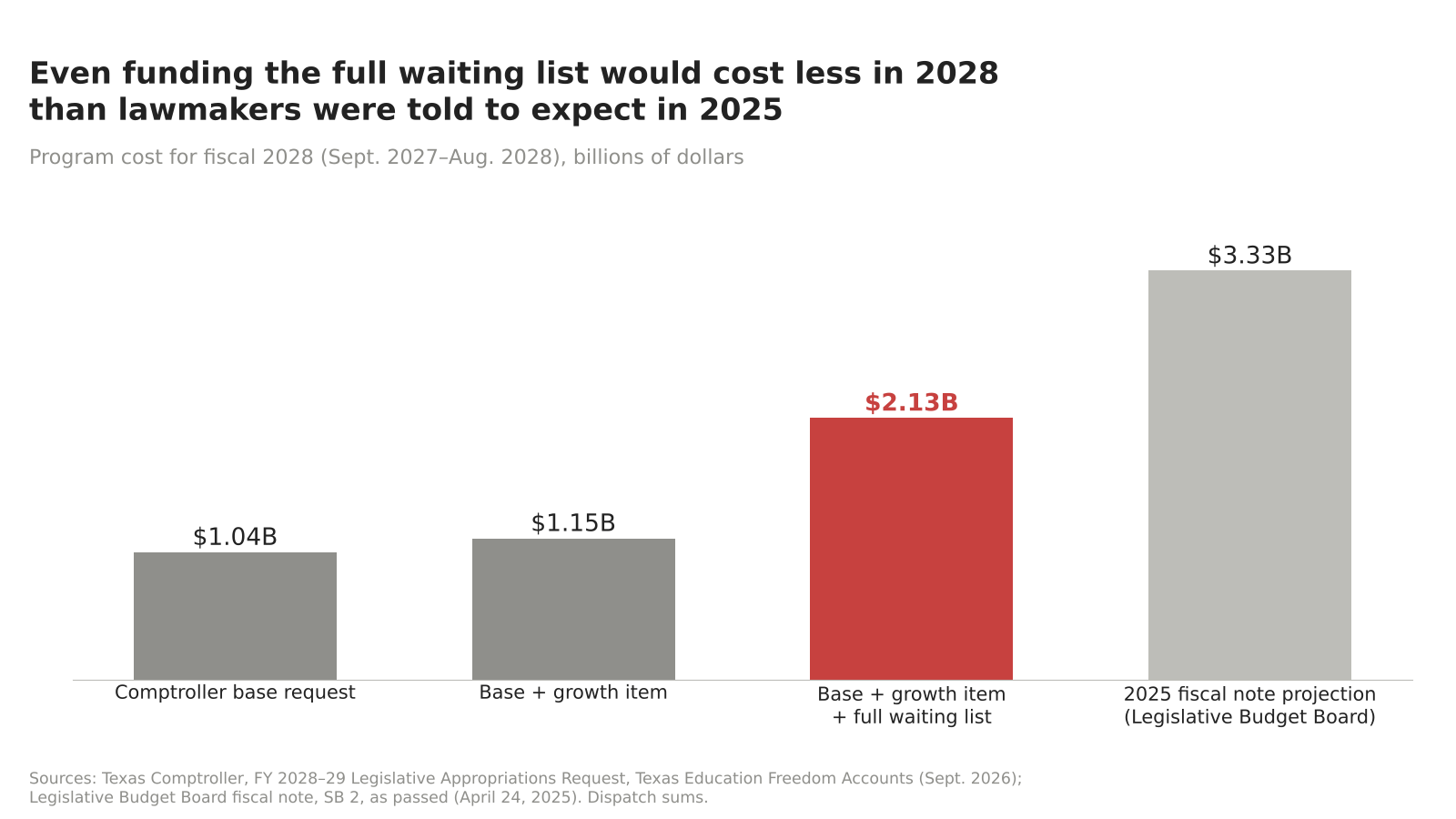
Funding the waiting list would cost about $9,200 per child per year and bring the two-year total to roughly $4.3 billion. That is less than lawmakers were warned to expect: the Legislative Budget Board’s 2025 fiscal note projected $3.33 billion in general revenue for fiscal 2028 alone, against about $2.13 billion for the base, the growth item and the full waiting list combined.
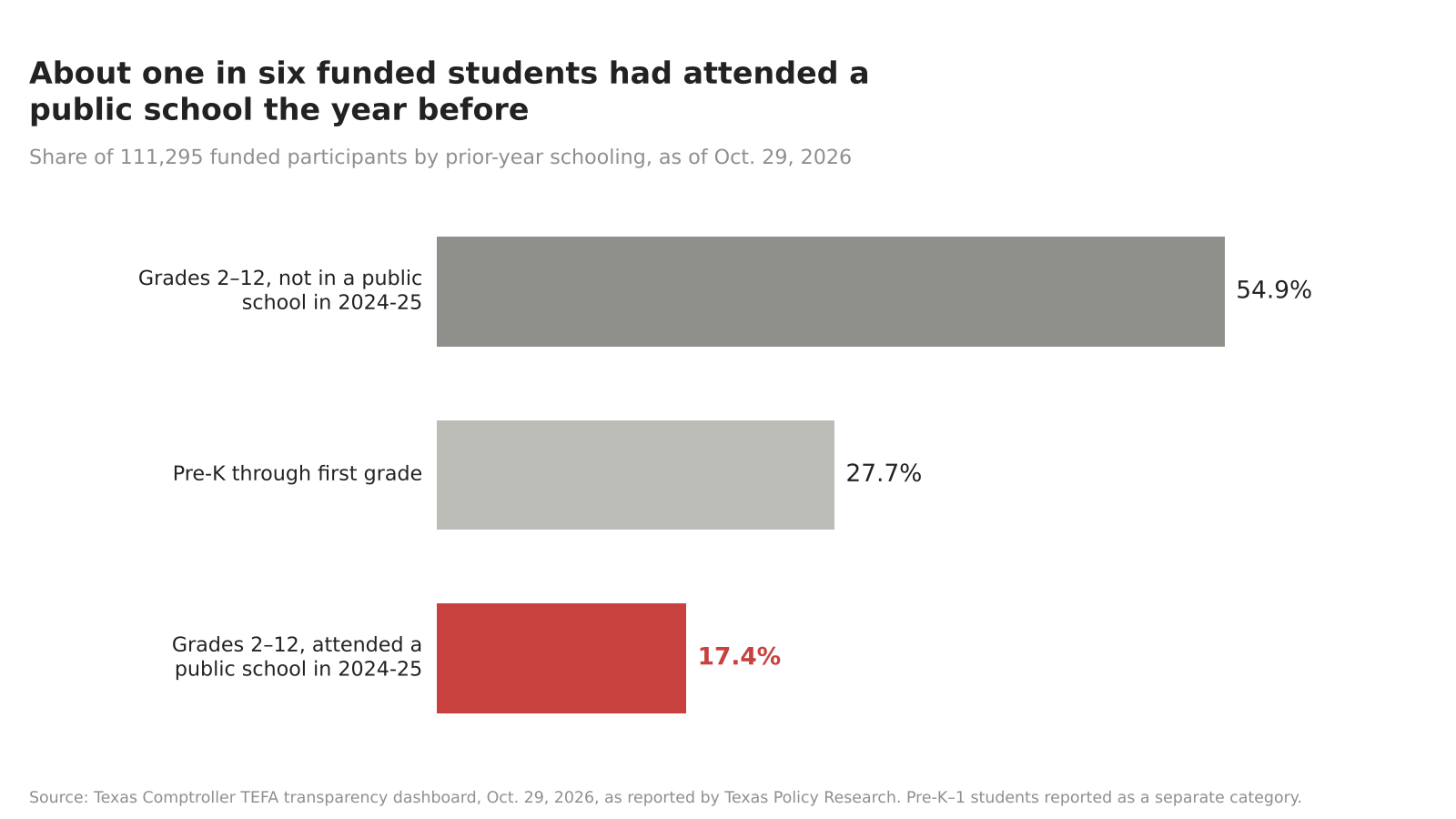
The catch is where the students come from. That fiscal note assumed 70 percent of new private school seats would be filled by public school students, whose departures would trim what the state spends on school formulas. The comptroller’s new dashboard shows 17.4 percent of 111,295 funded students were public school students in grades 2 through 12 the year before, with another 27.7 percent in pre-K through first grade. Texas Policy Research, which favors making the accounts available to every family, concedes that when a student already in private school gets an account, “the state does not save the cost of a public school seat.” The Texas Center for Voucher Transparency, which opposes the program, says 80 percent of the students on the waiting list were not previously in public school.
Each Side’s Case Holds Until It Reaches the Families on the Other Side
Supporters start from demand and from who has been served. The program drew 274,144 applications, 60 percent of funded students come from households at or below twice the poverty line, and 20 of 67,002 eligible high-income applicants got an account. Families already paying for private school or homeschooling pay the same taxes as everyone else, they argue, and the comptroller’s request says “the state has a moral imperative to serve these children.” Where that case gets hard is the second billion: most of it would pay for schooling families were already buying, without the formula savings the 2025 estimate counted on, and private schools must have operated two years and be accredited before they can take a new student’s account.
Opponents start from evidence. “Good policy requires great information,” Dee Carney of the Texas Center for Voucher Transparency told budget officials Sept. 9, arguing the Legislature needs participant outcomes before it expands. Only private school students in grades 3 through 12 take the required tests, and homeschool participants are not tested at all, so the first results will not answer the question for 42,000 of the 110,000. The administrative share also scales with the appropriation: the law lets the comptroller keep up to 3 percent and the outside administrator up to 5 percent, which Our Schools Our Democracy, a group that opposes the program, puts at up to $184 million on a $2.3 billion budget. Where that case gets hard is the families already enrolled. Nine filed bills would repeal the program; Senate Bill 106 lets 2026-27 money be spent but ends the accounts Sept. 1, 2027, which would send families like Narvaez’s back to choosing between tuition they cannot pay and a school they left. And district losses arrive on top of a 76,000-student enrollment drop that began before the first account was funded.
The real choice in the budget is between keeping about 110,000 families whole for roughly $1 billion a year and opening the program to the 106,000 who are waiting for roughly $2 billion a year, knowing that most of the added billion would be new state spending on children who were not in public schools, decided before the first test results arrive.
What to watch
- Jan. 1, 2027: The date SB 2 uses to count the waiting list the comptroller must price for lawmakers (Senate Bill 2, enrolled).
- Jan. 12, 2027: The 90th Legislature convenes (Texas Legislative Council). Watch the introduced House and Senate budget bills for whether the program line is about $1 billion or about $2 billion a year (Texas Legislature Online).
- Feb. 1, 2027: The final 50 percent installment goes to private school participants for 2026-27 (Texas Education Freedom Accounts).
- Early 2027: The comptroller announces the 2027-28 application window. Last year’s ran Feb. 4 to March 31; a repeat would put families’ applications in while lawmakers are still writing the budget that pays for them (Texas Education Freedom Accounts).
- May 31, 2027: The 140th and last day of the regular session (Texas Constitution, Article 3).
Sources
Primary documents
- Texas Comptroller of Public Accounts, Legislative Appropriations Request, Texas Education Freedom Accounts (Agency 910), Fiscal Years 2028–29, September 2026 — Administrator’s Statement (pp. 1–2), Schedule 2.A (base request by strategy), Schedule 4.A (exceptional item). Copy opened as posted by Texas Scorecard: https://texasscorecard.com/wp-content/uploads/2026/09/DocDisplay.aspx_.pdf
- Senate Bill 2, 89th Legislature, enrolled version (Education Code Secs. 29.3521, 29.356, 29.361, 29.362): https://capitol.texas.gov/tlodocs/89R/billtext/html/SB00002F.htm
- Legislative Budget Board, fiscal note, SB 2 as passed 2nd House, April 24, 2025: https://capitol.texas.gov/tlodocs/89R/fiscalnotes/html/SB00002F.htm
- Texas Constitution, Article 3, Sec. 24 (140-day regular session): https://statutes.capitol.texas.gov/Docs/CN/htm/CN.3.htm
- Texas Legislative Council, Dates of Interest: https://tlc.texas.gov/docs/legref/Dates-of-Interest.pdf
- Texas Comptroller, news release on transparency tools and independent audit, Oct. 26, 2026: https://content.govdelivery.com/accounts/TXCOMPT/bulletins/43086ab
Data
- Texas Education Freedom Accounts program site (award amounts, FAQ on continuing participation and year-two priority, 2026-27 payment calendar): https://educationfreedom.texas.gov/
- Texas Comptroller TEFA transparency dashboard, Oct. 29, 2026, figures as reported by Texas Policy Research (see below)
Research and interest groups
- Texas Policy Research (Austin group that favors making education savings accounts available to every family), “New Texas School Choice Dashboard Shows Demand Ahead of Session”: https://www.texaspolicyresearch.com/new-texas-school-choice-dashboard-shows-demand-ahead-of-session/
- Our Schools Our Democracy / Texas Center for Voucher Transparency (groups that oppose the program), Sept. 9, 2026 release: https://osod.org/3050-2/
- Every Texan (research group that favors more state spending on public services), co-author of the district-loss estimate as reported by Community Impact
News reporting
- The Texas Dispatch, “Analysis: The Most Important Number in Texas’ First School Choice Report Is ‘Fewer Than 30,’” Aug. 6, 2026: https://thetexasdispatch.com/texas-education-freedom-accounts-2026-analysis/
- The Texas Dispatch, “Thirteen Filed Bills Would Repeal, Add Conditions to or Shield Texas Education Savings Accounts,” Nov. 16, 2026: https://thetexasdispatch.com/tefa-repeal-bills-sb-106-hb-580-hjr-47-education-savings-accounts/
- The Texas Dispatch, Senate Education Committee recap, Oct. 8, 2026: https://thetexasdispatch.com/texas-senate-education-school-choice-child-care-pre-k-recap-october-7/
- The Texas Dispatch, Tier 3 awards, Aug. 19, 2026: https://thetexasdispatch.com/texas-education-freedom-accounts-tier-3-middle-income/
- The Texas Dispatch, transparency tools and audit, Oct. 28, 2026: https://thetexasdispatch.com/comptroller-huffines-transparency-tools-audit-education-freedom-accounts/
- The Texas Tribune, “Texas’ school voucher program would double under $2 billion request,” Sept. 3, 2026: https://www.texastribune.org/2026/09/03/texas-school-voucher-program-2-billion-expansion-budget-comptroller/
- Community Impact, “Comptroller asks lawmakers to double Texas Education Freedom Account funding to $2B,” Sept. 8, 2026 (updated Oct. 7): https://communityimpact.com/central-austin/texas-legislature/comptroller-asks-lawmakers-to-double-texas-education-freedom-account-funding-to-2b/
- Community Impact, “As lawmakers consider expanding TEFA funding, some public schools say they’re losing money,” Oct. 7, 2026: https://communityimpact.com/central-austin/texas-legislature/as-lawmakers-consider-expanding-tefa-funding-some-public-schools-say-they-re-losing-money/
- KERA via Houston Public Media, “Three families explain what’s at stake,” Nov. 12, 2026: https://www.houstonpublicmedia.org/articles/education/2026/11/12/566932/texas-democrats-want-to-repeal-school-vouchers-three-families-explain-whats-at-stake/
- KERA via Texas Public Radio, comptroller and the program fund, Oct. 29, 2026: https://www.tpr.org/government-politics/2026-10-29/texas-next-comptroller-will-control-1-billion-school-voucher-fund-and-it-could-double
- The Texan, “The Road to Expansion: School Choice in the 90th Legislative Session,” Oct. 20, 2026: https://thetexan.news/issues/education/the-road-to-expansion-school-choice-in-the-90th-legislative-session/article_f6220bb9-0028-4120-b329-f48726635dd9.html
- CBS Austin, “Texas Comptroller seeks more school voucher funding as skeptics question who benefits,” Sept. 8, 2026: https://cbsaustin.com/news/local/texas-comptroller-seeks-more-school-voucher-funding-as-skeptics-question-who-benefits
- Axios Austin, “Most Texas voucher recipients were already enrolled in private school,” Sept. 3, 2026 (consulted; summary only): https://www.axios.com/local/austin/2026/09/03/texas-vouchers-private-school