
The organization that polices reliability standards on the ERCOT grid grades its own metrics on a traffic-light system. Trend improving is good. Stable is fine. One bad year gets watched. Two or more consecutive years of decline gets a metric labelled actionable.
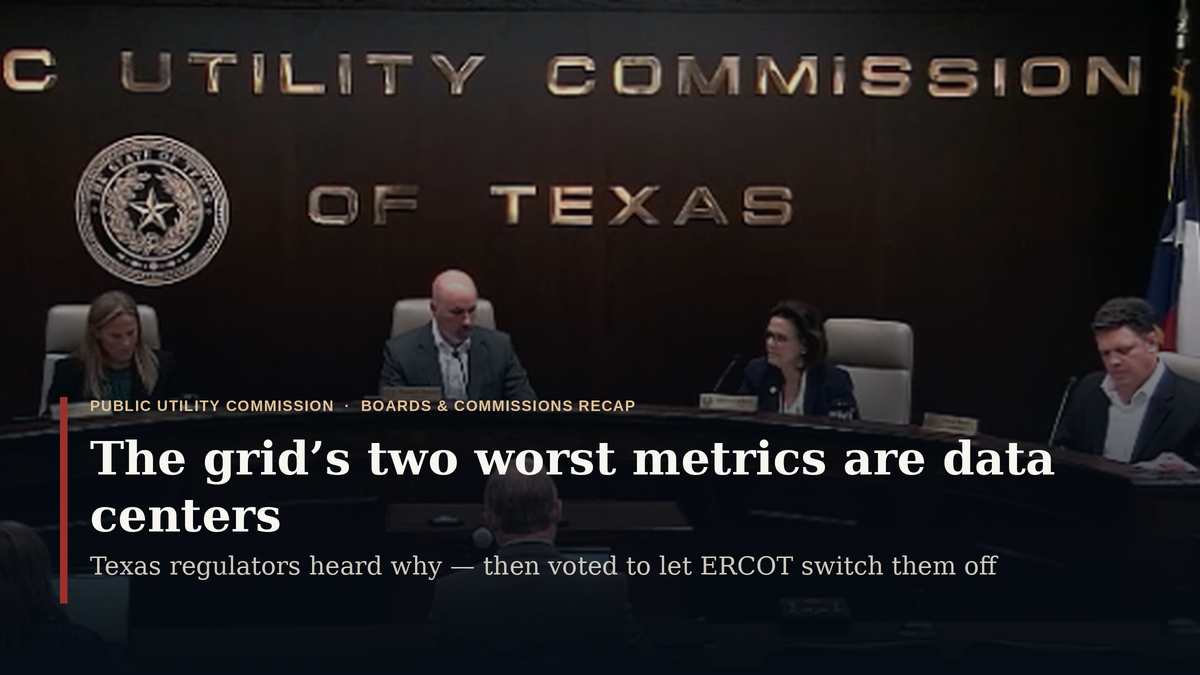
At the Public Utility Commission’s July 30 open meeting, Texas Reliability Entity (RE) told commissioners that two metrics had gone actionable in its latest assessment — and that they were the same problem wearing two hats.
“Two of the metrics that we look at fell into that actional category,” David Penney, the entity’s director of reliability services, told the commission, “and both of those are tied at the hip to the large load integration issues.”
The first is future reserve margins, where the uncertainty comes from not knowing what in the enormous queue of proposed large loads is real. The second is operational: whether these loads stay connected when the voltage dips.
Penney said Texas RE has been seeing voltage ride-through events in ERCOT “as far back as 2022” — well before the incidents that drew national press. What has changed is the scale. He pointed the commission to an event the week before the meeting, in the Northern Virginia data-center corridor: “There was a 230 KV line fault that tripped off 3,000 plus megawatts of data center load in that area. That event was more than double the size of those previous events.”
Although that didn’t happen in Texas, the number is worth holding next to a Texas one Penney gave a few minutes later. Asked what the risk actually consists of, he explained that ERCOT has already set a ceiling on how much load may drop off the system in a single contingency: “That number is about 3,200 megawatts right now.” The Virginia event came in just under the largest single loss the Texas grid is designed to absorb.
The mechanism is not only about load disappearing. Penney listed ramping as the other hazard — “especially AI generator loads can ramp very quickly and that can create frequency disturbances” — and noted that because data-center loads cluster geographically, one voltage event can take all of them at once. Drop that much load that fast, he said, and “you’re going risking over frequency and losing generation and other stability issues.”
Regulators are moving, slowly, toward being able to compel these facilities to adhere. Penney said NERC is working out a definition that would make large loads registered entities, subject to enforceable reliability standards rather than voluntary ones. “The preliminary discussions are around 50 megawatt load levels,” he said, though that has to clear the stakeholder approval process. The performance standards themselves, he said, are already written and waiting: “that set of standards has already been developed. It’s just waiting on the registration process to evolve.”
Twenty minutes later the commission took its own step, and it was a blunter instrument: a rule to switch large loads off.
Item 29 was staff’s proposal for publication implementing the large load demand management service created by Senate Bill 6 of the last session. Lucy Considine, appearing for commission staff, laid it out. The rule requires ERCOT to ensure that every electric cooperative, transmission and distribution utility and municipally owned utility “develop a protocol to allow transmission voltage customers to be curtailed during firm load shed events.” And it creates a new reliability service that “allows ERCOT to curtail demand from qualifying large loads when there is a significant risk of an energy emergency alert resulting from extreme weather conditions.”
Staff proposed an annual budget of $54 million, with offer prices capped at $5,000 per megawatt hour, and put out questions for stakeholders on scope, procurement and budget.
The one substantive question from the dais went to a gap in the design. Commissioner Courtney Hjaltman asked what happens to a large load that is not really one load — a campus, or a facility that could divide itself. “It’s one gigawatt, but 500 megawatts are this type of load and 500 are something else, and they could split up. Is that something we’ve thought about even being possible?”
Staff’s answer was a principle rather than a rule. “I think as long as the same megawatt isn’t being sold twice, we’re good to go,” Considine said, “but the details of how that split works, I think we might need to talk a little bit more about.” She added that staff had deliberately tracked the statute closely — “We tried to mirror the language in the law” — and that as drafted it would be easy to read the proposal as barring a load from selling half its megawatts into one service and half into another.
Staff treated the ambiguity as the point of publishing rather than a flaw in it. “So I think asking that question, or at least out loud, folks will hear that you’re interested in seeing if that might be possible, if it’s worthwhile, if it’s reasonable, if it’s a good thing to do or not.”
Chairman Thomas Gleeson closed the item by tying it to the Legislature: “in the Senate B&C hearing yesterday, Senate Bill 6 was discussed a lot, and I’m glad to see we continue to diligently work to get all of those statutory provisions implemented in our rules.”
The proposal was approved for publication on a voice vote — after the chairman had moved on and had to be called back by staff to take it. “Excuse me, Chairman. I think we need a motion to approve that’s a proposal.” “Yep.”
The meeting at a glance
Issue
Large computational loads — data centres — as the central reliability problem on the ERCOT grid, across two agenda items: Texas Reliability Entity’s annual assessment of reliability performance (item 28, Project 56022) and the commission’s proposal for publication of the large load demand management service required by Senate Bill 6 (item 29, Project 58482).
What happened
Texas reported that two reliability metrics have gone “actionable” — future reserve margins and voltage ride-through performance — and that both trace to large load integration. The commission then approved for publication a rule letting ERCOT curtail qualifying large loads when extreme weather creates a significant risk of an energy emergency alert, and requiring cooperatives, TDUs and municipal utilities to build protocols for curtailing transmission-voltage customers during firm load shed. Annual budget $54 million; offers capped at $5,000/MWh. Carried on a voice vote; comment period follows publication.
When
Thursday, July 30, 2026. Broadcast runs 49 minutes 16 seconds. Closed session 9:33–9:56 a.m.
Where
William B. Travis Building, 1701 N. Congress Ave., 7th floor, Austin — per AdminMonitor’s listing for PUC open meetings, not stated on the recording.
Governing body
Public Utility Commission of Texas — five commissioners appointed by the Governor with Senate confirmation.
Archived video
adminmonitor.com/tx/puct/open_meeting/20260730/