
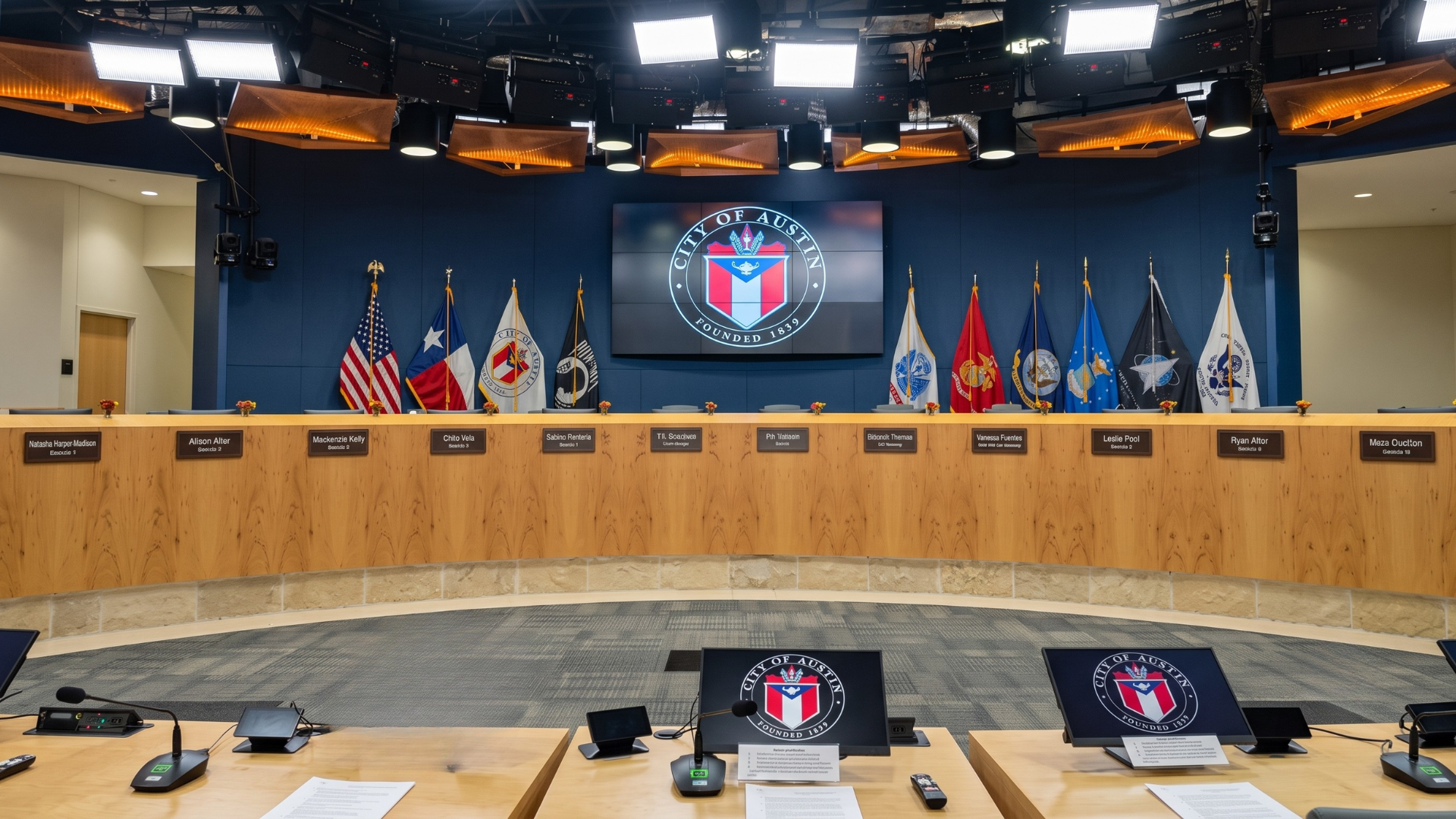
The Austin City Council will meet Sept. 24 with four contract amendments on its consent agenda that would add $854,872 to the city’s payments to two nonprofits that provide immigration legal services, including what the city’s own contract history calls “deportation defense.”
The vote comes four days after a federal immigration agent shot a 28-year-old Venezuelan delivery driver in North Austin, an incident that has produced two sharply different accounts of what happened, a federal investigation, calls from the mayor and most of the council for an independent inquiry, and a habeas corpus petition in federal court.
The two threads are separate on paper. The contracts were posted to the agenda on Sept. 18, two days before the shooting, and they continue programs the city has funded since 2016 and 2018. But critics have tied them together, and the timing has put a routine renewal in front of a much larger audience than it would ordinarily draw.
Wilber Rafael Garces Perez was shot shortly before 1 p.m. on Sept. 20 near Research Boulevard and Anderson Square, according to Austin-Travis County EMS. Austin Police Chief Lisa Davis told reporters that preliminary information pointed to a “small foot pursuit” before the shooting, the Texas Tribune reported. Sheridan Nolen, a spokesperson for the Texas Department of Public Safety, said troopers got a call at about 12:50 p.m. from ICE asking for help pursuing a blue Toyota Corolla, and that the agent had already fired by the time troopers arrived.
The Department of Homeland Security, in a statement posted to X the night of Sept. 20, did not name Garces Perez but said he “illegally entered our country under the Biden Administration,” had a final order of removal, and is “in federal custody pending removal.” DHS said Homeland Security Investigations, with FBI support, is leading the investigation. The department did not respond to the Austin American-Statesman’s questions about the agents’ identities, body cameras or what led to the shooting.
Garces Perez, speaking by phone through a translator from the South Texas ICE Processing Center in Pearsall at a Sept. 21 news conference, gave a different account, according to the Statesman and Courthouse News. He said he was delivering for DoorDash when an unmarked vehicle struck his car without activating lights, that he made a U-turn, was struck again, and was shot while sitting in the driver’s seat. He said there was no foot pursuit. His attorney, Kate Lincoln-Goldfinch, said he entered the United States in 2024 through the CBP One appointment system, received a work permit and applied for asylum, and that his removal order resulted from a hearing notice sent to a previous address. She said he has no criminal record and that a bullet remains lodged near his spine. The Statesman said it could not independently verify those claims. A bystander video the newspaper verified shows Garces Perez in the driver’s seat after the shooting with a wound in his upper back.
Lincoln-Goldfinch said she has filed a habeas corpus petition in federal court to keep Garces Perez in the country while the shooting is investigated. Austin police and the Texas Rangers are conducting their own investigations, Davis said. A protest at the scene the evening of Sept. 20 ended with three arrests after some demonstrators threw rocks and bottles at officers, FOX 7 Austin reported.
Mayor Kirk Watson said at a Sept. 20 news conference that he was “angry” but “not surprised” by the shooting. “With the nature of ICE and the way ICE is doing its business these days, there’s no reason for us to be surprised by it,” he said, according to KXAN. Watson said Austin police “would be in a position to offer clear third-party eyes” and that “the credibility of ICE doing some form of investigation just by itself and excluding others would not be appropriate.”
Council members Vanessa Fuentes, José Velásquez and Mayor Pro Tem José “Chito” Vela said in a joint statement that “the people of Austin deserve answers, and we demand full transparency and accountability,” adding that “no federal agency is above scrutiny when the safety and right of our community are at stake.” Council Member Zo Qadri called for the release of dash and body camera footage and said he was “disgusted by what I’ve heard.” Council Member Mike Siegel said “our top demand needs to be that the city can investigate this crime.” Council Member Krista Laine said she stands “with those demanding a full independent investigation and immediate release of body cam footage.” Council Member Marc Duchen said ICE “has a clear obligation to cooperate with the Austin Police Department and other officials as the investigation move forward.”
The Travis County District Attorney’s Office asked to be a “co-equal” partner with Austin police in the investigation and said “it is possible that this incident included violations of state law.” U.S. Rep. Greg Casar, D-Austin, has asked DHS for a congressional briefing by Sept. 28.
The four items, numbered 51, 52, 57 and 59 on the Sept. 24 agenda, sit in the consent section, where items are approved in a single vote unless a council member pulls one for separate discussion. All four are amendments to existing social-service agreements administered by Austin Public Health, and each adds a 12-month extension through Sept. 30, 2027.
Item 57 adds $378,000 to the city’s main agreement with American Gateways, an Austin nonprofit that provides immigration legal services, raising the contract’s ceiling to $3,414,505. The city’s backup document describes the program’s purpose as “to stabilize the immigration status of detained and non-detained immigrants by providing screenings, consultations, group information sessions, workshops, pro se assistance and legal representation.” It states that the council first approved the agreement on March 22, 2018, “to provide immigration legal services and deportation defense,” for $135,000. The document lists the program’s City Business Plan goal as “for clients to obtain and maintain public benefits as a result of receiving services.”
Item 52 adds $161,280 to a separate American Gateways agreement “to provide legal pro se assistance for individuals representing themselves in court,” raising that ceiling to $628,780. Item 51 adds $188,872 to a Catholic Charities of Central Texas agreement “to expand legal and counseling services,” which the backup says “helps immigrants stabilize their immigration status, re-uniting them with family members and providing them with work authorization,” for a ceiling of $2,060,036. Item 59 adds $126,720 to a second Catholic Charities agreement under which “the agency covers application filing fees for eligible immigrants unable to pay,” for a ceiling of $579,920.
The four increases total $854,872, all from Austin Public Health’s Fiscal Year 2026-27 operating budget. The four contract ceilings total $6,683,241, a figure that spans the life of each agreement, the oldest of which dates to 2016. Each of the four new amounts is 10 percent lower than the amount the council approved for the same contract in August 2025, according to the amendment tables in the city’s backup documents; the council trimmed two of the contracts by smaller amounts in a separate amendment last year. The claim circulating online that Austin has “already paid” American Gateways $3.4 million overstates the record: the main agreement’s authorized total before Sept. 24 is $2,979,505, with a ceiling of $3,036,505, and the $3.4 million figure is the ceiling the council would set with this vote.
Prior renewals have drawn little opposition. The August 2025 amendments passed 10-0 with Qadri absent, a one-time $150,000 addition passed 9-0 in October 2025, and a November 2024 addition to the pro se contract passed 10-1, according to the vote records in the backup documents.
Immigration court is a civil proceeding, and federal law provides that a person facing removal may have counsel “at no expense to the Government,” which means no lawyer is appointed for those who cannot afford one, under 8 U.S.C. §1362. City-funded legal aid programs like Austin’s exist to fill that gap; whether local governments should fund them is the point of dispute.
A Sept. 22 Breitbart Texas article and social media posts circulating in Austin describe the items as spending on “deportation defense” that is being passed “quietly” on the consent agenda while attention is on the shooting. The consent agenda is the council’s standard mechanism for contract renewals of this kind, and the backup documents show the same agreements were amended on consent in August and October 2025. The Texas Dispatch found no public response from the council or Austin Public Health to the criticism as of Sept. 22, and none of the council statements on the shooting mentioned the contracts.
The criticism points to Harris County, where Attorney General Ken Paxton sued over a county Immigrant Legal Services Fund created in 2020, arguing that directing more than $1.3 million to deportation defense violated the Texas Constitution’s prohibition on gifts of public money. After a district court and the 15th Court of Appeals declined to halt the program, the Texas Supreme Court on June 26 ordered Harris County to stop disbursing the funds while the case proceeds, saying it had significant questions about the county’s authority to run the program and that money once spent could not be recovered, KBTX reported. Three justices dissented from the pause without taking a position on the merits. The court said its order was not a final ruling. Paxton called it “a major win for protecting taxpayer dollars” in a June 27 release. No comparable lawsuit against Austin’s contracts has been reported.
The council votes Sept. 24. If no member pulls the four items, they will pass with the rest of the consent agenda; if one does, the city’s immigration legal services program will get a separate floor discussion in the same week the city is demanding answers from ICE.