
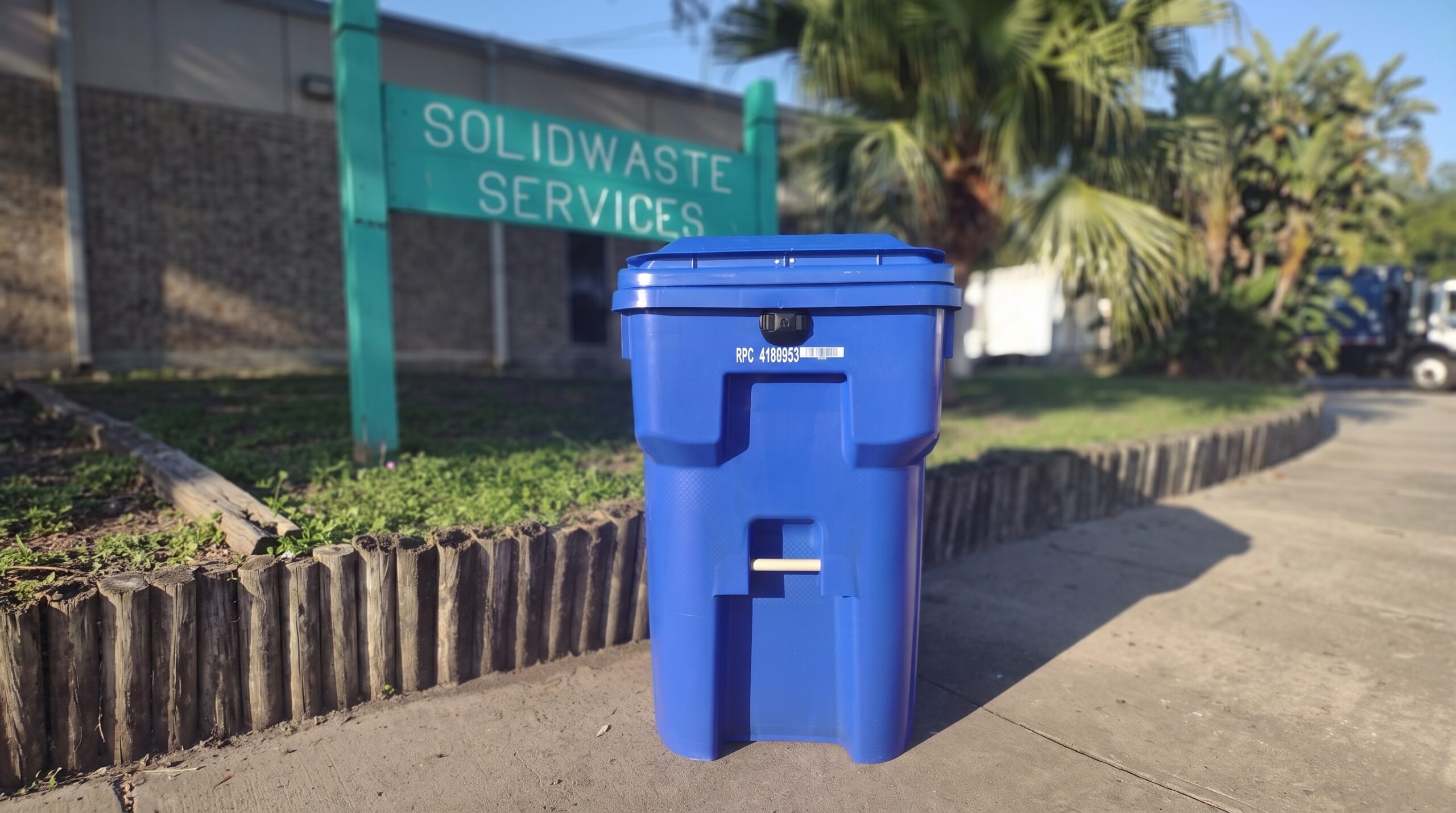
The blue cart that Corpus Christi rolls out to a new recycling customer costs the city $48.72 this year. Last year it cost $44.57. The reason, city staff told the council in a memo posted Sept. 4, is the price of plastic: “Due to fluctuation in the cost of plastic resin, the purchase price for the carts increased.”
That 9 percent increase is a small number on its own. It is also one of four decisions Texas cities are making this month about what it costs to keep recycling running — and, in three of the four, the cost is landing somewhere other than on the household bill.
Corpus Christi’s council votes Sept. 15 on buying 13,092 carts, 9,252 brown ones for garbage and 3,840 blue ones for recycling, at a total of $645,138. The memo, from Solid Waste Operations Director Philip Aldridge and Finance and Procurement Director Sergio Villasana to City Manager Peter Zanoni, splits the bill between two accounts: $450,757.44 charged to refuse collection and $194,761.64 charged to recycling collection. That separate recycling line is what makes the cost visible at all. Corpus Christi serves about 92,000 curbside customers, and staff wrote that the alternative purchasing cooperative they compared prices against would have run “approximately up to 18.2% higher.”
Laredo is dealing with an older problem. Its council takes up an item Sept. 8 authorizing $116,600.15 for replacement parts the agenda describes as “sorely needed” at the city’s own materials recovery facility — the plant where mixed recyclables are sorted into bales that can be sold. The city has to buy from Machinex Technologies of High Point, North Carolina, as the sole source. “The recycling facility has been in operations since 2013,” the agenda item reads. “The replacement of these parts is vital for the operations of the City-owned Recycling Materials Recovery Facility.”
On the same agenda, Laredo’s environmental and solid waste department, run by Director Bishop P. Wagener, is recommending the council throw out the only bid it received to handle used tires — $446,000 from UTW Collection Services of Donna. Staff wrote that “the provided rate is not competitive with market estimates” and that the department wants to rebid “to weigh any other possible options up to and including the City managing these materials ourselves.”
Fort Worth is going the other direction, and its rate structure shows why the cost of recycling is hard for a resident to see. The council votes Sept. 15 on the city’s first residential solid waste increase in 19 years, about 20 percent across the board: the 96-gallon cart rises from $25.75 to $30.90 a month, the 64-gallon from $19.50 to $23.40, the 32-gallon from $13.75 to $16.50, and a separate environmental protection fee from $2.25 to $2.50. The city’s own rate presentation runs 22 pages and breaks the charge out only by cart size. Recycling appears on one page, as a bullet in a list of services. Staff wrote that “residential rates do not fully recover operational program expenses” — a statement about the whole solid waste program, with no way to tell from the document how much of the gap is recycling.
Longview, meanwhile, is proposing to spend less. The city’s budget for the year beginning Oct. 1 cuts its recycling line from $250,000 to $160,000, a reduction of $90,000, while adding $12,000 for what the line item calls increased public engagement on recycling. Residential garbage service goes from $19.36 to $19.82 a month. The council votes on the budget Sept. 17 and on the tax rate Sept. 18. The Texas Dispatch reported this month that participation in Longview’s curbside program has fallen from about half the city to roughly one household in eight since a fire destroyed the plant that processed the material.
Put together, the four cities are answering the same question four ways. Corpus Christi is absorbing a commodity price increase into its general fund and keeping the recycling line visible. Laredo owns its sorting plant outright and is paying sole-source prices to keep 13-year-old equipment running, while openly weighing whether to bring another waste stream in house rather than pay above-market rates for it. Fort Worth is raising what households pay by a fifth without telling them how much of it is recycling. Longview is cutting.
Only one of the four is a rate fight, which is what makes them worth reading together. Laredo votes Sept. 8, Corpus Christi and Fort Worth on Sept. 15, Longview on Sept. 17.