
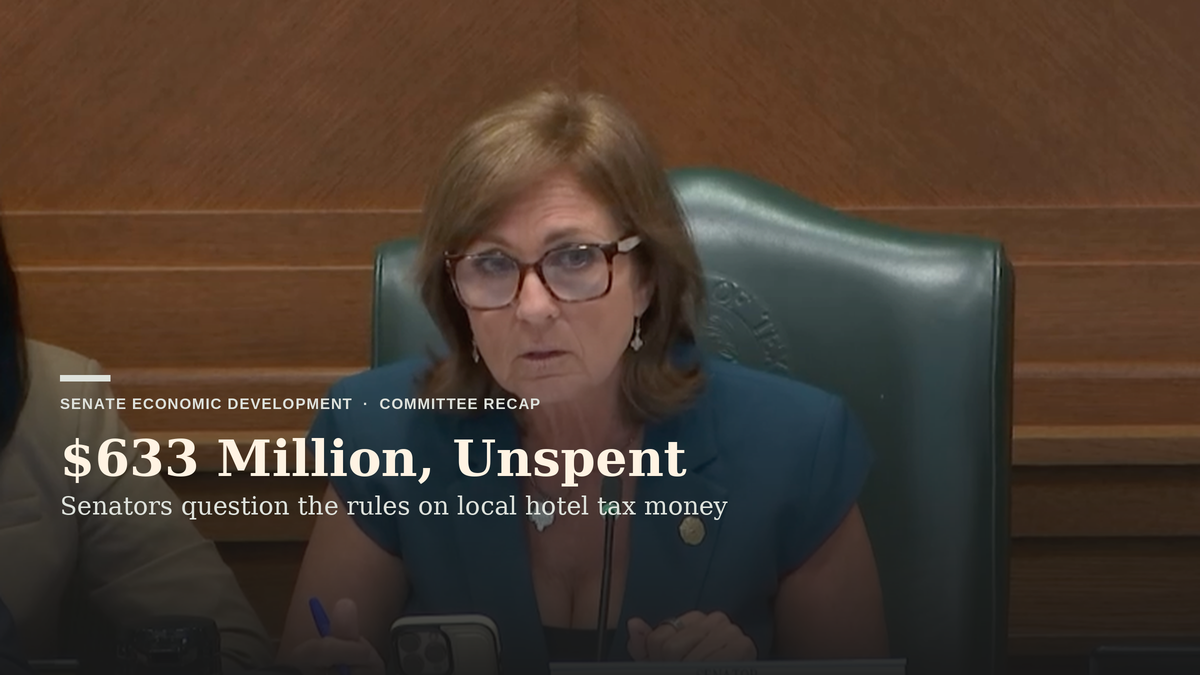
Texas cities are holding $633 million in local hotel tax money they have collected but not spent, a comptroller’s official told the Senate Committee on Economic Development Sept. 22. State law bars them from spending it on anything but tourism, and senators from both parties signaled that the rules, the reporting and the collection system are all headed for another look next session.
“There’s $633 million sitting in banks,” said Russell Gallahan, who supervises local government and transparency work at the comptroller’s office. Local governments are “collecting a billion and spending a billion” each year, he said, and the unspent balance is local money only.
Sen. Royce West, D–Dallas, went straight at the double standard. Gallahan confirmed that the state spends most of its own 6 percent hotel tax as general revenue, while cities cannot. “That makes a lot of sense, doesn’t it? The state can use it for general revenue,” West said. “Madam Chair, we should look at that.”
The hotel tax charge filled about two hours and 10 minutes of a nearly six-hour hearing, the first of three interim charges the Dispatch outlined in its preview of the hearing. Cities levy the tax under Chapter 351 of the Tax Code, and House Bill 3727 and Senate Bill 1420 of 2023 require them to report rates, collections, spending by category and unspent balances to the comptroller, which posts them in its local hotel occupancy tax overview.
Compliance remains partial. Gallahan said 507 cities and 47 counties reported in 2025, out of 1,299 entities the agency believes can levy the tax. Most nonfilers are likely small towns with no hotels, he said, but the agency must take their word for it. “We don’t know what we don’t know,” he said.
Chair Angela Paxton, R–McKinney, contrasted that with sales tax, which the state collects in full and sends back to local governments. “It doesn’t sound like we go at collecting this one the same way we do,” she said. Gallahan agreed. The state does not police local misuse at all, he said; enforcement falls to residents, hotels and the courts.
Short-term rentals are the widest gap. The comptroller has agreements with most major platforms to collect the state’s share, Gallahan said, but those platforms generally do not collect city or county hotel taxes. Asked by West how much goes uncollected, he said, “No, sir, I’m not in the guessing business.” Vice Chair Kevin Sparks, R–Midland, asked whether lawmakers should put “the onus” on the rentals rather than on state auditors “trying to be all over the state.”
Sen. Carol Alvarado, D–Houston, said a bill she carried to have the comptroller collect local taxes on rental bookings died in the House, as did last session’s Senate Bill 1592 by Sen. César Blanco, D–El Paso. She then turned on Justin Bragiel, general counsel for the Texas Hotel & Lodging Association, who had praised the idea: “Come on, let’s come clean. You testified not just submitted a card, but you testified against our bill.”
Bragiel said the association supports automatic collection of local taxes on rental bookings. Its objections, he said, were to provisions covering online travel agencies and which fees are taxable. Since the 2025 session, he said, the association and those companies “have come to an agreement” on how to handle the issue next time.
Erika Boyd, president and CEO of the Texas Travel Alliance, urged the committee to finish that work. She cited a November 2025 El Paso audit that found more than $2.4 million in delinquent hotel taxes owed by 23 hotels. She also asked lawmakers to standardize spending categories and give reporting “teeth,” such as “making a jurisdiction ineligible for any new statutory carve out or rate increase” until missing reports are filed.
Sparks pushed the other way on spending. Oilfield crews fill hotels across his West Texas district, he said, but “people aren’t going to Wink or to Monahans or to Kermit or anything within a hundred miles, probably to vacation.” Those towns pile up money they cannot use on roads or ambulances. “I just wonder whether or not we’re disadvantaging those rural communities,” he said, and suggested “potential carve outs by population.”
Rick Thompson of the County Judges and Commissioners Association of Texas backed him. The 47 counties with the tax collected $85.1 million last year, he said, but 46 of them collected $28 million and Harris County took in the rest. He asked lawmakers to let counties spend a share on emergency services and law enforcement, and to make any state collection program optional, noting that Denton County has already spent $25,000 on collection software and pays a $15,000 annual subscription.
Bragiel said the first answer for towns with idle balances is a lower rate. He asks local officials, he said, “why are you still collecting the hotel tax rate at such a high rate if you don’t have a use for that hotel tax revenue?” He added: “Just because we’re taxing people who don’t live here doesn’t mean it’s still not a tax.” He floated a small administrative penalty for cities that repeatedly fail to report.
Paxton pressed every witness on return on investment. “Like, is there a formula?” she asked. There is not one, Bragiel said. “When we say economic impact, it’s sort of this blob, amorphous blob of an idea,” Paxton said, asking for “apples to apples” measures across programs. “That’s what a business does,” she said. “Our taxpayers deserve that.”
No votes were taken. The committee’s interim report will shape bills for the 90th Legislature, which convenes in January 2027.
In about 47 minutes on project finance zones, comptroller staff said four zones are active, in Fort Worth, Dallas, Houston and Austin, capturing growth in state hotel, sales and mixed-beverage taxes for 30 years, and that the agency neither measures their return nor can claw money back. The longest block, nearly three hours on preparing Texas workers for artificial intelligence, is covered in the companion recap, “Texas Can’t Track Whether AI Is Costing Graduates Jobs, Senators Told.”
Fact box
- Issue
- Hotel occupancy tax accountability — collection, reporting and use of state and local HOT revenue (approx. 2 hours 11 minutes, about 37 percent of the hearing)
- What happened
- Comptroller staff reported $633 million in unspent local hotel tax balances and partial compliance with 2023 reporting laws; senators questioned why cities cannot use the money for general purposes, how short-term rental taxes go uncollected, and whether rules disadvantage rural towns; industry and county witnesses offered competing fixes. No vote — interim hearing.
- When
- Tuesday, Sept. 22, 2026, 9:00 AM CT · run time approx. 5:50:00
- Where
- Room E1.016 (Hearing Room), Capitol Extension, Austin
- Chair
- Sen. Angela Paxton, R–McKinney (SD-8); Vice Chair Sen. Kevin Sparks, R–Midland (SD-31)
- Key witnesses
- Russell Gallahan, Texas Comptroller of Public Accounts; Justin Bragiel, Texas Hotel & Lodging Association; Erika Boyd, Texas Travel Alliance; Christopher Kiley, Texans for the Arts; Rick Thompson, County Judges and Commissioners Association of Texas
- Archived video
- senate.texas.gov video 22834