
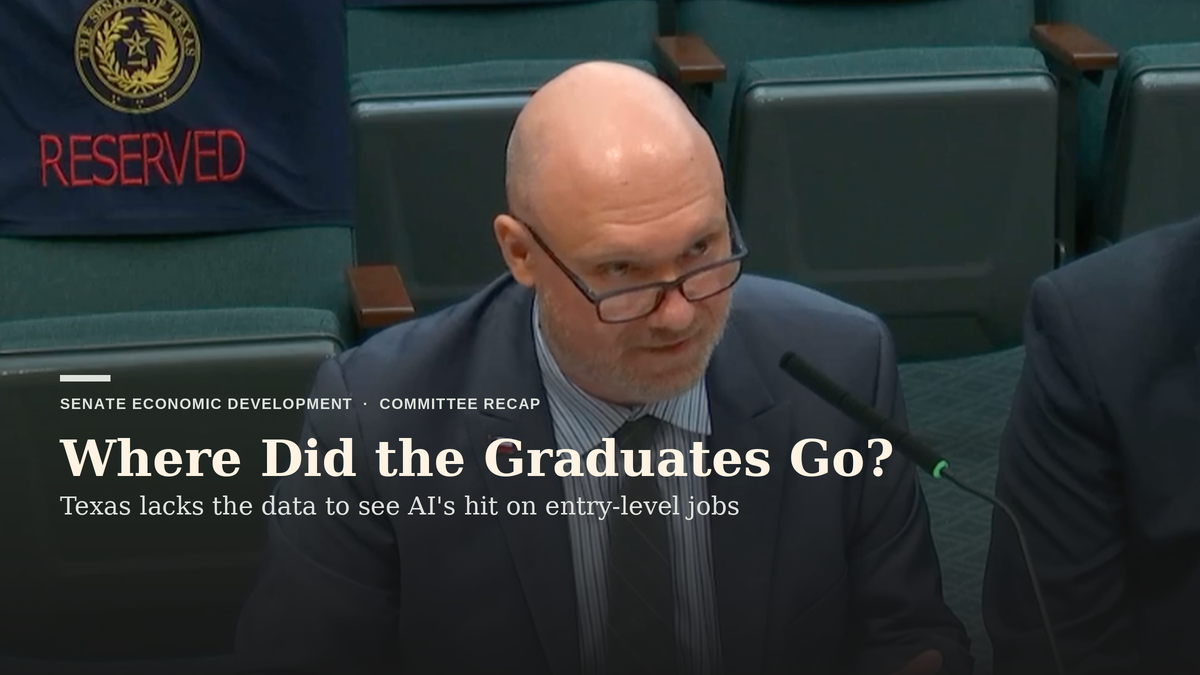
Texas cannot yet tell whether this spring’s college graduates found work, let alone whether artificial intelligence is shrinking the jobs they trained for, witnesses told the Senate Committee on Economic Development Sept. 22. Chair Angela Paxton, R–McKinney, said she already has AI bills drafted for the session that opens in January.
“We don’t know if the college graduates from this year, from May 2026 have jobs, much less what they’re doing,” said Renzo Soto, deputy director of education and workforce policy at Texas 2036. The Higher Education Coordinating Board knows who graduated and the Texas Workforce Commission knows who is working, he said, but the records are not connected or published in time to matter.
The AI charge ran nearly three hours across four panels, the longest block of a six-hour hearing. The Dispatch’s preview noted the state’s own June 2026 Texas Workforce Investment Council report on AI’s workforce effects. Witnesses said the damage so far is quiet.
“AI’s effect on the workforce so far is concentrated in early career hiring, not broad job loss,” said Michelle Singh, vice president for strategic educational alliances at the University of North Texas. “Companies are not laying off young workers already in AI exposed roles. They are simply hiring far fewer new ones into them.”
Soto urged lawmakers to carry out Senate Bill 1786 “with fidelity.” The 2025 law requires enhanced employer wage filings that include occupation, county of employment and remote-work status. He also backed the Sunset Commission staff’s call for a unified workforce database, a recommendation the Dispatch tracked as the Workforce Commission took up its sunset review.
Sen. Royce West, D–Dallas, said the state has waited too long. “For too long, we haven’t connected the dots,” he said, and asked for a model state. Soto pointed to Kentucky, which has linked agency data since about 2011.
Workforce Commission Chairman Joe Esparza said the new wage data will need “about four quarters” of collection before it yields a usable product. He said Texas ranks second nationally in AI-related job postings, with about 116,000 openings. The agency recently reported that Texas added 159,400 jobs over the year.
Paxton, a former math teacher, spent much of the afternoon on a harder question: what happens to human judgment. Dr. Miha Vindis, director of the Texas Certified Public Manager program at Texas State University, warned that “cognitive offloading can become cognitive surrender,” with workers outsourcing “not simply the task, but the judgment and critical thinking behind it.” A human who only approves a finished AI product at the end, he said, is “just human as a glorified, you know, clicker.”
Paxton read from what she described as a 1979 IBM training manual: “A computer can never be held accountable. Therefore a computer must never make a management decision.” She added, “I don’t think any of us want to cede accountability to AI. And if we’re not careful, we could end up doing that.”
Sen. Carol Alvarado, D–Houston, pressed employers on layoffs. Rob Cohan, who leads public sector strategy work at Accenture, said AI is changing jobs more than eliminating them. “Can you name any corporations?” Alvarado asked. “Not off the top of my head,” he said. She asked whether workers should get advance notice or retraining when AI reshapes their jobs. Cohan said Accenture is retraining all 800,000 employees: “we spent 3 billion and it wasn’t enough.”
Meg Stevens of IKEA said the retailer adopted an AI ethics policy before deploying any tools. “We have not laid off any employees because of AI,” she said, and the company retrained more than 8,000 customer service workers worldwide as virtual design consultants after launching a chatbot. She asked for a state incentive for companies that reskill first. When Alvarado asked whether a human should review any AI decision on discipline, scheduling, pay, hiring or firing, Stevens said IKEA already requires it. “Well, I hope other corporations will do the same,” Alvarado said.
Vice Chair Kevin Sparks, R–Midland, worried that schools will fall behind. “How do we not look up five years from now? And, and we’re just light years behind,” he asked. Soto said a Texas 2036 voter poll released that day found “safety comes first” across every demographic. He said 2025 laws on AI governance and training, Senate Bill 1964 and House Bill 3512, were never translated into classroom guidance. West said the Coordinating Board and the Texas Education Agency should be charged with setting policy, adding, “that needs to be happening right now.”
Manufacturers are further along but not ready. Wroe Jackson, executive vice president and general counsel of the Texas Association of Manufacturers, said 98 percent of manufacturers nationally are exploring or piloting AI automation but only about 20 percent feel prepared to deploy it at scale. He pointed members to the task force created by Senate Bill 2925, whose report on modernizing manufacturing is due Oct. 1.
The session ahead came up early. Paxton told West she expects the State Affairs and Education committees to hear AI legislation, “because I have bills drafted for both of those committees.” West said he has bills drafted as well.
No votes were taken. Paxton said the testimony will guide recommendations for the 90th Legislature, which convenes in January 2027.
The hearing opened with more than two hours on hotel occupancy taxes, where the comptroller reported $633 million in unspent local balances and senators questioned the spending limits — the subject of the companion recap, “Cities Sit on $633 Million in Unspent Hotel Taxes As Senators Eye a Rewrite.” In about 47 minutes on project finance zones, comptroller staff said the agency neither measures the zones’ return nor can claw back rebates.
Fact box
- Issue
- Preparing the Texas workforce for artificial intelligence (approx. 2 hours 49 minutes, about 48 percent of the hearing; longest block)
- What happened
- Four invited panels — researchers, employers, universities and state agencies — told senators the state lacks timely data on graduates’ job outcomes, that AI is cutting entry-level hiring more than existing jobs, and that human judgment must stay in charge; Chair Paxton said she has AI bills drafted for the 90th Legislature. No vote — interim hearing.
- When
- Tuesday, Sept. 22, 2026, 9:00 AM CT · run time approx. 5:50:00
- Where
- Room E1.016 (Hearing Room), Capitol Extension, Austin
- Chair
- Sen. Angela Paxton, R–McKinney (SD-8); Vice Chair Sen. Kevin Sparks, R–Midland (SD-31)
- Key witnesses
- Dr. Miha Vindis, Texas State University; Rob Cohan, Accenture; Renzo Soto, Texas 2036; Wroe Jackson, Texas Association of Manufacturers; Meg Stevens, IKEA; Dr. Heather Shipley, UT San Antonio; Dr. Michelle Singh, University of North Texas; TxDOT chief information officer; Joe Esparza, Texas Workforce Commission
- Archived video
- senate.texas.gov video 22834