
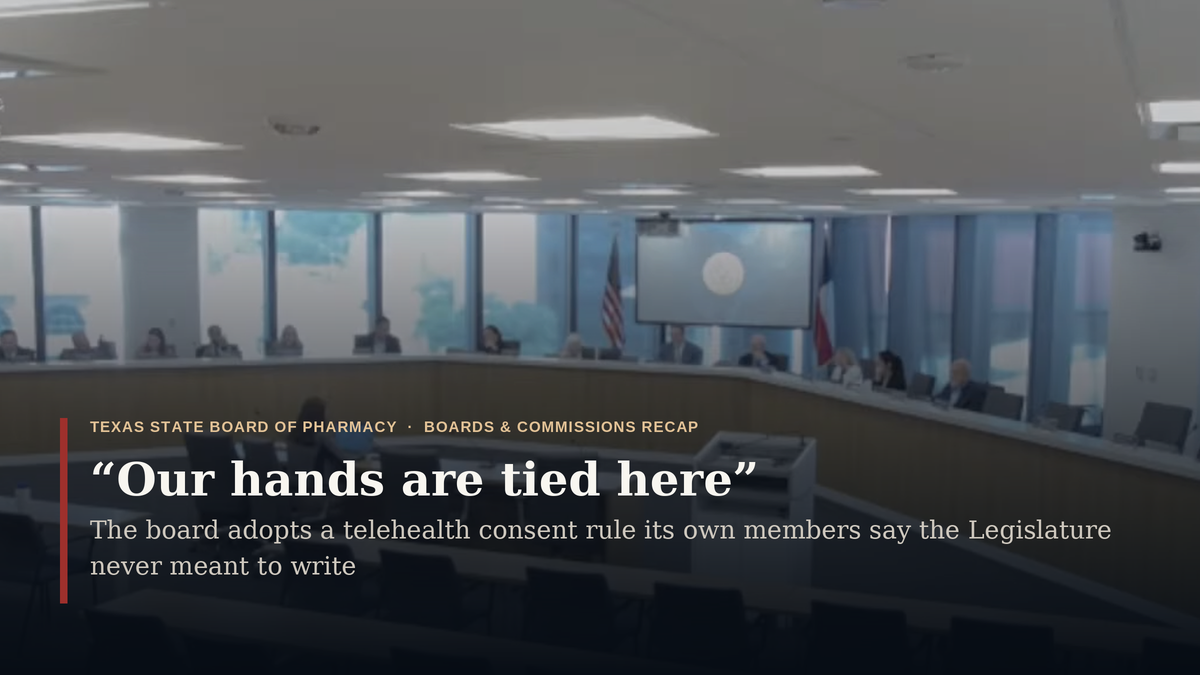
Every other motion the Texas State Board of Pharmacy took up on Tuesday morning passed without a single audible objection — the jurisprudence exam rule, the disaster-closure rules, the records rule, the rule review, the officer elections. Then it reached the telehealth item, and three members voted no.
What they were voting on is four paragraphs of paperwork. What they spent twenty-three minutes arguing about is whether an ordinary phone call to a Texas pharmacy is a telehealth service — and whether the board has any power to say it is not.
The answer from board staff was flat. “The board cannot narrow the applicability of a statute,” the presenting staff attorney told members. “The legislature laid out the informed consent requirement for telehealth services and the definition of a telehealth service and the board does not have the authority to override limit or narrow what the legislature put into statute as the definition and requirement.”
The new rule, §291.13, does one narrow thing: it says how a pharmacist documents that a patient consented. HB 1700, passed in the 89th Legislature’s 2025 regular session, amended Chapter 111 of the Occupations Code to require every agency regulating a health professional to write rules standardizing the format and retention of records of a patient’s consent to treatment, to data collection and to data sharing. Under the rule the board adopted, consent may be written or verbal; if verbal, it must be logged with the initials or identification code of the pharmacist or agent who took it; the documentation must be kept two years and produced within 72 hours if a board agent asks.
Staff walked members through the statutory definition of a telehealth service — a health service delivered by a licensed professional “to a patient at a different physical [location] than the health professional using telecommunications or information technology” — and then made the point that reframed the whole item. That definition, staff said, “has existed in statute in section 1110013 of chapter 111 since 2017.” The consent requirement itself “comes from section 111002A of chapter 111 and that requirement has existed in statute since 2005.”
“What is new is the documentation,” staff said.
In other words: on the board’s reading, Texas pharmacists have owed patients informed consent for phone and video encounters for years. HB 1700 did not create the obligation. It created the paper trail — and the paper trail is what made everybody look at the obligation.
Staff read three sets of comments into the record. Doug Read of H-E-B — captioned “Doug Reid with HB Pharmacy” — argued the rule “fails to distinguish between true telealth encounters and patient counseling communications already required as part of dispensing,” that its economic impact is understated, and that “stopping to obtain and document telehealth consent for every question from a patient would create substantial workflow issues and delay patient access to medication.”
The Texas Federation of Drug Stores said the rule “creates two different standards of care for the same professional service.” Ronald Richardson, a Houston compounding pharmacist, asked that one consent stay good for recurring services until the patient revokes it.
A representative of CVS Health asked the board to consider “the different pathways that they may have in order to… not prevent access to pharmacy care by the patient… by requiring additional consents that… aren’t routinely done today.” He also made the observation that hangs over the rest of the item: if the requirement really has been law since 2017, “there doesn’t seem to have been a precedence set for how this was being enforced.”
The second speaker put the practical stake plainly. “If all of a sudden you have to… jump through a number of hoops just to counsel a patient, the question is will that counseling actually occur?” He argued nothing in HB 1700 requires the board to classify routine counseling as telehealth, and that telehealth services are ordinarily paid services while counseling at dispensing is not: “when a pharmacist is counseling as part of the dispensing process there is no payment associated with that.”
Then the board talked, and what came out was a body adopting a rule it did not want.
“I just want to go on record to say that our hands are tied here,” said Vice President of the board Donna Montemayor. “I don’t know what the intent was of this bill and what the author intended. I think that they didn’t… foresee the consequences that they would have of making those statements in the way that they did. Um, and if we could change them, I think that we would.” She finished: “But I do not agree with the actual bill itself.”
Board Member Rick Fernandez agreed. “Not being able to specify a consultation as not necessarily being the target of the telehealth is really the concern,” he said. “When we add administrative burden to our pharmacies, that’s where the concern is for all of us… The documentation portion is burdensome.” He asked whether there was “any wiggle room on the consultation” — any standard-of-care line the board could draw. Staff: “anything that meets the statutory definition of telehealth service the board could not narrow out… unfortunately the statutory definition of telehealth service is not tied to payment… it is pretty broad… the board does not have the power to to limit or narrow that.”
Someone asked the question the whole industry was waiting on: what will inspectors actually look for? “How would they distinguish between what’s normal counseling and what’s telehealth?” Staff’s answer is the single most consequential sentence in the meeting for any Texas pharmacy, and it is not a legal standard. “What the inspectors look for when they go out on inspections is dictated to them,” staff said. “So if they’re inspecting for it, it’s because they’ve been told to inspect for it.”
A member closed the loop out loud: “So I guess in the end we will be relying on the discretion of enforcement.”
Not everyone at the table was sympathetic to the pharmacies. Treasurer Donnie Lewis brought the board back to the informal conference docket. “We’re here about patient safety. That’s our job… I know that adds… layers of extra work and I get that. But if you remember we had some cases where telehealth was involved, patients got drugs, no counseling, no anything and then we saw the aftermath of that. So definitely our patients were injured by the lack of communication between the… pharmacies and the patients.”
His prescription was not for the board. “We don’t have any control over this. We really don’t. So my suggestion is that… the people that need this changes maybe we need to go back to the source, go to the legislature, go to your legislators and explain what your concerns are.”
Before the vote the chair asked whether the board had to act at all. Staff said yes. “This is in statute. It is in effect… I would not advise just ignoring a statute. We’ve received no directive from the legislature or the governor’s office to not enact the statute and do rulemaking. And my understanding is that all the other health boards have enacted their rules subject to this bill.”
The board had two texts in front of it: the original, which restates the statutory definition and the consent requirement inside the rule, and a revised version that would drop the restatements and simply cross-reference §111.004. Staff said the revised version “would not change the requirements because those still exist in statute” and called it “less intuitive for the reader.” The chair put it more bluntly: “the only difference with the revised is that… it references it rather than stating it.”
The board took the original. “So we do have a motion and a second to go with the first version or the original version,” the chair said. Then the vote. “So that’s six for and three opposed. Motion does carry though.”
The meeting at a glance
Issue
Final adoption of new rule 22 TAC §291.13, “Telehealth Services Provided by a Pharmacist” — the board’s implementation of HB 1700 (89th Leg., R.S., 2025), which amended Occupations Code §111.004 to require every agency regulating a health professional to standardize the format and retention of records of a patient’s consent to treatment, data collection and data sharing.What happenedBoard staff told members the rule adds only documentation: the statutory definition of a telehealth service has been in Occupations Code §111.0013 since 2017 and the informed-consent requirement in §111.002(a) since 2005, and “the board cannot narrow the applicability of a statute.” H-E-B, the Texas Federation of Drug Stores, a Houston compounding pharmacist, CVS Health and a second in-person speaker all asked that routine counseling and refill calls be excluded. Members said they agreed and could not act — “our hands are tied here… I do not agree with the actual bill itself” — and were told enforcement would turn on what inspectors are “told to inspect for.” The board adopted the original text over a revised cross-reference version. .
What it requires
Informed consent to treatment, data collection and data sharing before a telehealth service, in a video or audio-only format. Written or verbal. If verbal, documented with the initials or identification code of the pharmacist or agent who obtained it, in the pharmacy’s data-processing system, an electronic log book or a hard-copy log. Retained two years; produced within 72 hours on request of a board agent.
Where it stands
Adopted. An adoption notice and preamble go to the Texas Register; the effective date and the adopted text should be taken from that filing. The board’s legislative tracker recorded HB 1700 as its last pending implementation item from the 89th session.
When
Tuesday, August 4, 2026, gavel at 9:47 on the morning stream. The telehealth item runs 18:56–41:40 — 22 minutes 44 seconds. Recess at 10:46 a.m.; afternoon session adjourned 11:50 a.m.
Where
Room 4.300, George H.W. Bush State Office Building, 1801 Congress Ave., Austin.
Governing body
Texas State Board of Pharmacy — 11 members appointed by the Governor under the Pharmacy Act.
Archived video
Morning session (2:36:31) and afternoon session (20:40), TXPharmacyBoard channel, streamed live August 4, 2026.