
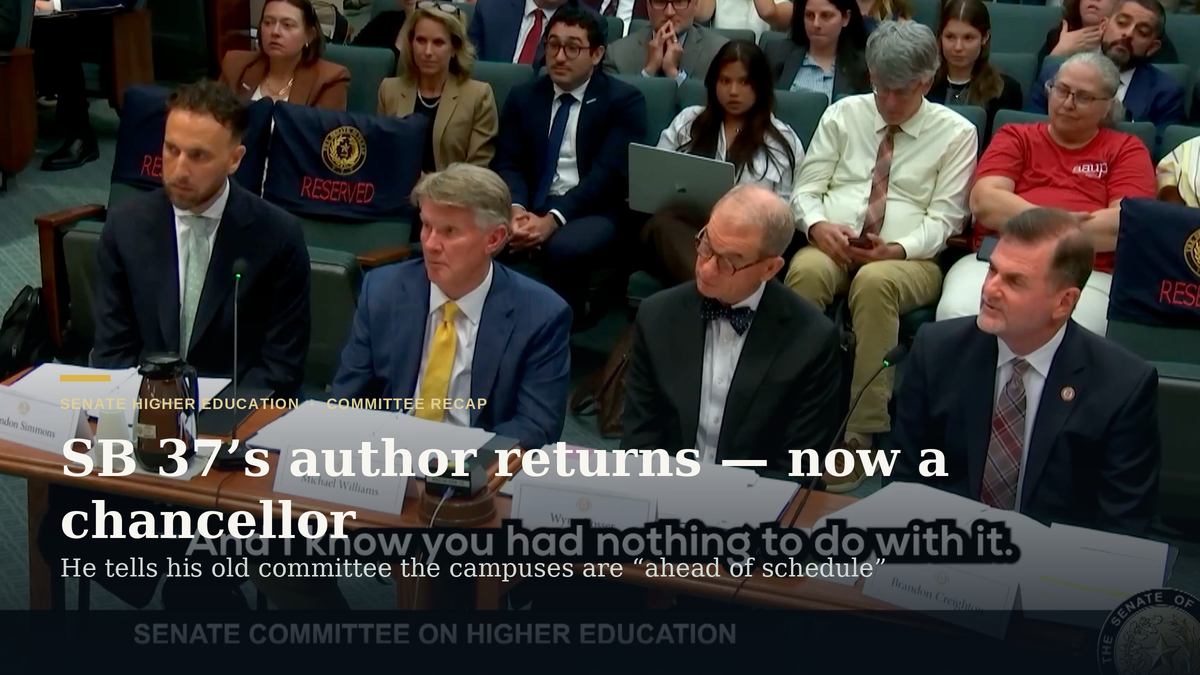
The man who wrote Texas’ sweeping higher-education governance law came back to the committee that produced it Tuesday — this time as a witness, not a senator — to report that the campuses he now helps run are moving faster than the statute requires.
In one of the more unusual role reversals of the interim, former Sen. Brandon Creighton, now chancellor of the Texas Tech University System, testified before the Senate Committee on Higher Education on the rollout of Senate Bill 37, the 2025 law he authored to reshape curriculum review and board governance across public universities. Chair Paul Bettencourt, R-Houston, introduced him with a grin.
Creighton said the law was a response to a changing economy and responsible stewardship of Texas. Higher education, he said, “has to keep pace with the changes in the private sector and the economic landscape in this world as it exists in 2026.” He also said,”the commitment to academic integrity and accountability and student success was at the heart of Senate Bill 37 when I carried that legislation. As chairman of the Senate Committee on Education and now as chancellor, I have a responsibility of putting those principles into practice.”
He reported that “each of our institutions within the Texas Tech system are ahead of schedule.” Asked later how the transition was going, he called it “the most deliberative process” he had seen.
The stakes behind that progress report are a hard deadline. Under SB 37, every institution’s governing board must complete an initial review of its general-education curriculum and certify compliance to the Texas Higher Education Coordinating Board by Jan. 1, 2027.
Commissioner Wynn Rosser laid out the machinery. A statewide advisory committee “began meeting in September of 2025,” he said, with a report due to the coordinating board “in October of 2026” and a final report to the Legislature “on December 1st, 2026.” The curriculum reviews themselves, Rosser stressed, happen “at each institution,” with the board certifying compliance campus by campus.
The law also reaches board members personally. Rosser told members the coordinating board is now required “to adopt by rule a training program for members of governing boards,” and that trustees “must now sign and submit a notarized sworn statement to the coordinating board upon completion” of the training. On the most contentious piece of SB 37 — its restructuring of faculty senates and councils — Rosser drew a sharp line: “The coordinating board has no oversight authority over their establishment nor their operations,” he said. “That responsibility rests with the governing board of each” institution.
The hearing doubled as the public debut of the law’s new watchdog. “My name is Brandon Simmons, and I’m honored to serve at the pleasure of the governor as … your ombudsman for higher education,” Simmons told the committee, thanking coordinating-board chair Stacy Hock and Rosser “for their support in launching the office.”
Simmons described a two-track shop — one side focused on “oversight and handling of the investigative process,” the other on “policy and best practices” — staffed heavily from the attorney general’s office, including a deputy director who had served on Attorney General Ken Paxton’s executive leadership team as deputy attorney general for legal strategy.
System general counsels then walked members through the compliance grind. “My name is Donna Cornell … general counsel for 24 years at the University of Houston System,” she said, adding that the system intends “to go to our board in August” to file its core curriculum for the 2026-27 catalog “in an abundance of caution.”
Brooks Moore of the Texas A&M University System said his board’s “review and its certification to the coordinating board and legislature will happen before the January 1st, 2027 deadline.” Nelly Herrera of the Texas State University System and Archie Holmes of the University of Texas System rounded out the panel, alongside University of North Texas System Chancellor Michael Williams.
Members largely welcomed the pace while probing the edges. Vice Chair Brent Hagenbuch, R-Denton, told Creighton he “had the chance to watch you as you put this bill together.” Sen. Royce West, D-Dallas — whom Bettencourt joked had served on higher-education committees “33 years” — pressed the coordinating board to keep driving down duplicative coursework, saying he wanted “to make certain that … we continue to see a reduction … in the number of repeat courses” students take when they transfer. Sen. Tan Parker, R-Flower Mound, thanked the panel “for the great discussions.”
Because the committee met in the interim, it took no vote; the only recorded vote of the day was the 6-0 adoption of committee rules at the gavel. The testimony pointed toward the 90th Legislature, which convenes in January 2027 — weeks before the certification deadline lands. If the campuses are, as Creighton insists, ahead of schedule, the next session’s work on SB 37 may be less about rescue than refinement. But with the ombudsman’s office barely operational and faculty-governance changes still settling, the committee left itself ample reason to keep watching.
Also heardThe committee’s monitoring charge also covered House Bill 127, the 2025 campus research-security law aimed at foreign-adversary risk. Research security officers from the Texas A&M University System (Kevin Gámez), UT MD Anderson Cancer Center (Trey Atchley) and Rice University (Tam Dao, a former FBI agent) described how due-diligence reviews, travel monitoring and researcher screening are working in practice. The hearing’s second interim charge — the community college finance model under House Bill 8 — is the subject of the companion story.
The hearing at a glance
Issue
Monitoring SB 37 implementation — general-education curriculum review, governing-board training and certification, the new higher-education ombudsman, and faculty-governance changes. The largest single issue by time, roughly 1 hour 55 minutes.
What happened
Invited testimony from the SB 37 author (now a system chancellor), the Commissioner of Higher Education, the new ombudsman and four university-system general counsels on progress toward the Jan. 1, 2027 certification deadline. Interim hearing — no vote on legislation.
When
12:00 PM CT, Tuesday, July 28, 2026 · hearing ran about 4 hours 39 minutes (all issues)WhereRoom E1.028 (Hearing Room), Capitol Extension, Austin
Chair
Sen. Paul Bettencourt, R–Houston (SD-7)
Archived video
senate.texas.gov · vid 22695