
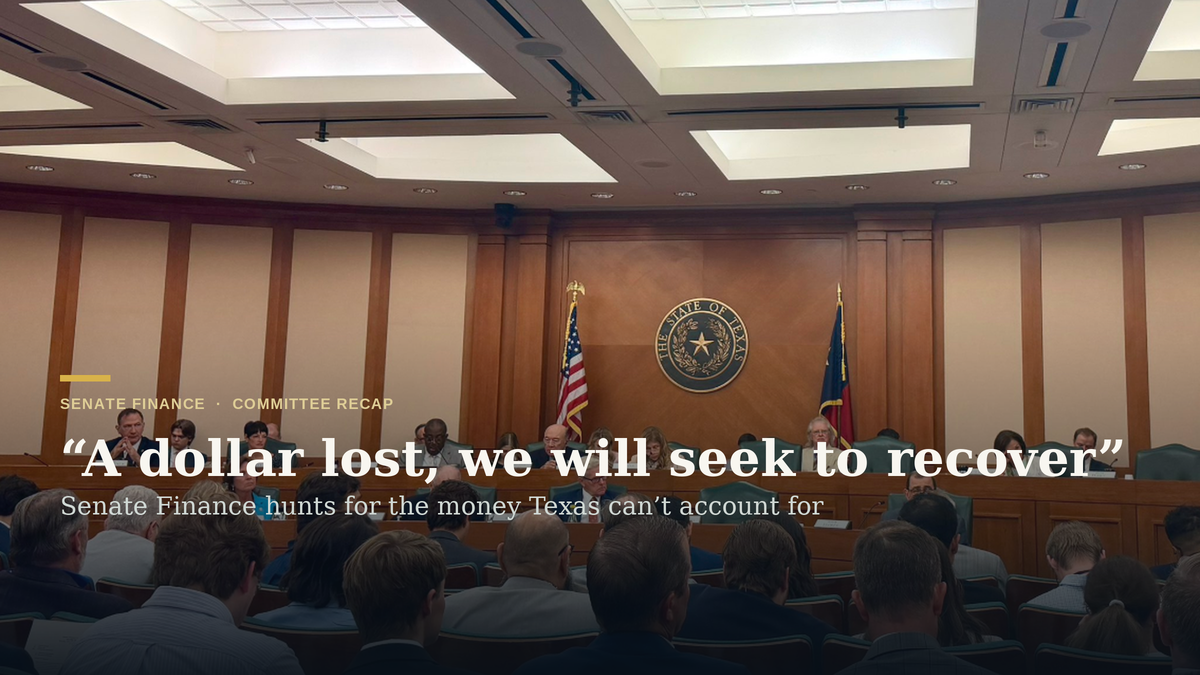
For nearly five hours Tuesday, the Senate’s budget-writing committee tried to answer a question that grows harder the bigger the state budget gets: how much of it disappears to fraud, waste and abuse, and who is supposed to catch it. The Senate Committee on Finance devoted the larger share of its second interim hearing in as many days to the charge, and the agencies that police the state’s money delivered a blunt message — they can recover dollars after the fact, but stopping the loss up front is a different problem, and one the Legislature has not fully funded.
Chair Joan Huffman, R-Houston, told members the panel was directed “to detect and mitigate fraud, waste and abuse, quantify the fiscal impact” across the budget and “make recommendations to strengthen oversight and better protect public funds.” Then she turned to Sen. Lois Kolkhorst, R-Brenham: “I know you’re deep in it.”
The Legislative Budget Board set the terms. Julie Lindsay told members that only four state agencies operate a dedicated office of inspector general — the Health and Human Services Commission, the Department of Criminal Justice, the Juvenile Justice Department and the Department of Public Safety — and that “the funding for these offices total $234.1 million in all funds for the biennium.”
The state’s core financial-watchdog functions at the Comptroller of Public Accounts and the State Auditor’s Office carry a combined “296.1 million for the biennium,” she said, while a separate line pays for the contract-oversight team that reviews every state contract “over $1 million.” The picture Lindsay drew was of a system built to audit and recover, not to prevent.
Nowhere was that clearer than at Health and Human Services, which runs the state’s largest benefit programs and its largest recovery operation. Raymond Winter, the agency’s inspector general, appeared with principal deputy Susan Biles and described a mandate with almost no give in it. “Our work focuses on identifying dollars at risk, dollars that have been wrongfully diverted from the system,” Winter said.
“Our mission is to recover those funds where appropriate … and to hold the bad actors accountable.” The standard he laid out was absolute: “A dollar lost, even if innocent, we will seek to recover.” Winter told members the office’s authority runs through the Government Code and the Human Resources Code, the latter allowing the state to recover up to three times the amount lost to knowing misconduct.
Prevention has a scoreboard too, and it is smaller. Molly Regan, HHS’s chief of family resources and eligibility services, told members the agency “serves more than 7.5 million people every month across nearly 200 different programs,” processes “6 million applications annually” and regulates “188,000 providers.”
A front-end unit built to stop improper payments before they leave the treasury has produced “more than $216 million in cost avoidance … since this unit was stood up in 2017,” she said — a real number, but a fraction of what flows through Medicaid and food assistance each year. The inspector general’s office, Regan noted, sits on the back end, chasing money after the payment is made; her staff sits on the front end, “looking at prevention of even making a payment if it’s an inappropriate one to make.”
Kolkhorst, whom Huffman had flagged at the outset, kept returning to a theme she had pressed during the morning’s higher-education charge: how much of the state’s eligibility spending rests on people’s word. “We’ve talked a lot about self-attestation with our community colleges and with our general academic institutions,” she said. “So how much in SNAP is self-attestation?” The exchange exposed the soft edge in fraud prevention — a system that takes applicants at their word is fast and cheap to run, but, as Kolkhorst put it earlier in the day, “you gotta trust them.”
The afternoon’s most consequential numbers were not about fraud at all, but about a coming hole in the food-stamp budget. HHS witnesses walked members through federal changes to the Supplemental Nutrition Assistance Program enacted in Washington last summer, which shift more of both administrative and benefit costs onto the states. In Texas, the witnesses said, “the combination of the cost share changes … is a need for an additional 1.7 to 2.1 billion in GR to continue SNAP in the next biennium.”
The state currently issues “about $7.6 billion in benefits annually” to 3.2 million people through more than 21,000 retailers, at an administrative cost of “about $468 million per year,” most of it paying the roughly 6,600 eligibility workers across the state. Driving down the program’s payment-error rate, one witness said, is now “our number one priority,” because a persistent error rate under the new federal formula could cost the state hundreds of millions in general revenue.
Members pushed the agencies on whether they actually talk to one another. The State Auditor’s Office, which fielded the charge through general counsel Kathleen Day, said its most formal partnership is with the HHS inspector general, with “formal meetings at least once a quarter.” Day described the auditor’s reach as broad but its teeth as limited — the office runs a fraud hotline and refers matters to law enforcement, but has no enforcement power of its own, a distinction more than one senator seemed to find unsatisfying.
Because the committee met in the interim, it took no vote; its findings become recommendations to the 90th Legislature, which convenes in January 2027. The direction was audible. Agency after agency told the committee it could recover money and prosecute bad actors, but that the tools to prevent losses — data analytics, front-end verification, tighter self-attestation checks — are thinner than the recovery machinery behind them.
Whether the next Legislature funds prevention as aggressively as it funds clawbacks is the question the committee left on the table. Huffman adjourned the marathon session with a lighter note about what comes next: the committee reconvenes September 2 “to discuss property tax relief. Very exciting subject.”
Also heard: The same hearing opened with the committee’s other interim charge, higher-education transparency — how public universities account for state appropriations, tuition and designated funds, and what the Texas Southern University audit revealed about gaps in that reporting. The State Auditor’s Office, the Legislative Budget Board and a Dallas college-completion nonprofit testified.
The hearing at a glance
Issue
Preventing Fraud, Waste, and Abuse — quantifying the fiscal impact across the budget and assessing prevention and recovery tools. Roughly 5 hours, the larger share of the hearing (about three-quarters of the run time).
What happened
Invited testimony from the Legislative Budget Board, the State Auditor’s Office, the HHS Office of Inspector General, HHS eligibility services and the Texas Workforce Commission on how the state detects, prevents and recovers improper spending — and on a looming Snap cost shift. Interim hearing — no vote taken.
When
9:00 AM CT, Tuesday, July 28, 2026 · hearing ran about 6 hours 53 minutes (both charges)
Where
Room E1.036 (Finance Room), Capitol Extension, Austin
Chair
Sen. Joan Huffman, R–Houston (SD-17)
Archived video
senate.texas.gov · vid 22656