
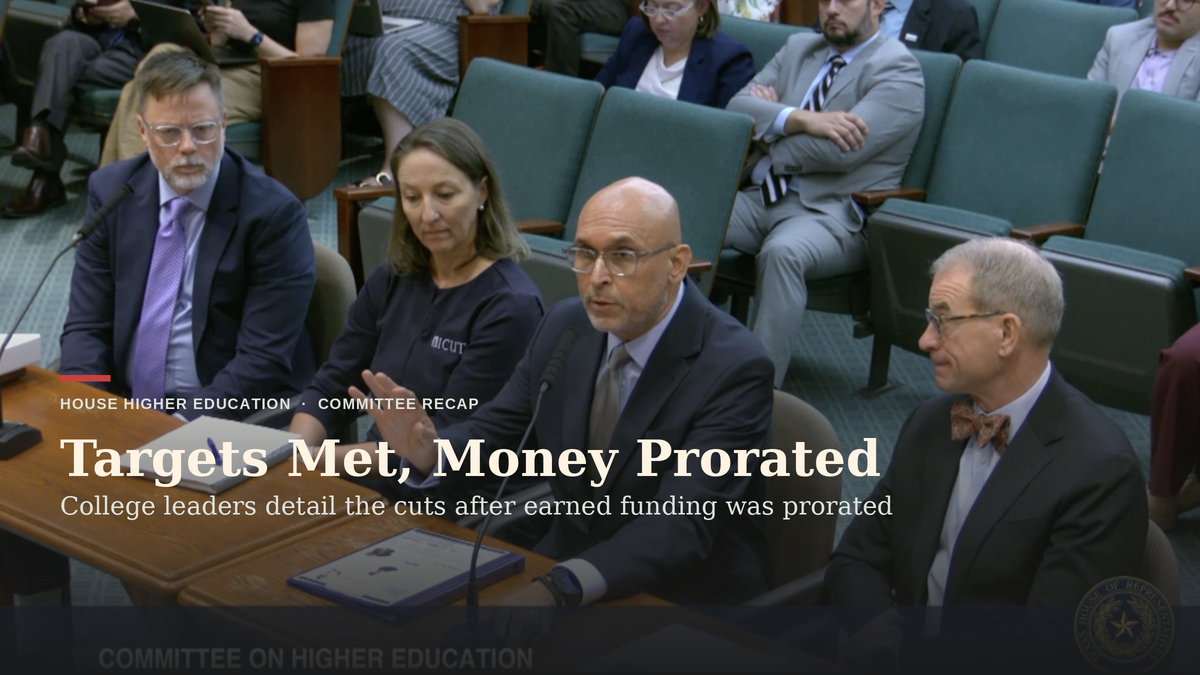
Texas community colleges hit the performance targets lawmakers set for them, and the state paid out less than the formula promised. Four college leaders came to the House Higher Education Committee Aug. 17 to describe what that shortfall bought: canceled construction, frozen workforce expansion, a deficit budget and, in one district, a $10 million hole in a year when performance went up.
“The biennial appropriation was capped based on lower initial forecast. Earned outcome. Fundings were prorated,” Austin Community College Chancellor Russell Lowry-Hart told members. “As a direct result, ACC lost approximately $6 million in expected state funding and a year where our performance actually increased. Colleges shouldn’t be faced with financial penalties or instability for exceeding the performance goals you set before us.”
Pressed by Vice Chair Donna Howard on the operational effect, he put the number higher: “We’re really down $10 million from what we earned. We budgeted for 6 million of that. And that’s what we ended up having to make cuts, in personnel, in execution of programs, and in raises for employees.” Asked whether the district can keep clearing the metrics, he said the cuts will “delay them. And, probably limit the scope of them from what it could have been.”
The committee spent nearly three hours — the single largest block of an eight-hour hearing — on implementation of Senate Bill 1786 and the outcomes-based funding model it refines, the model created in 2023 by House Bill 8. Sarah Keaton, deputy commissioner for administration at the Texas Higher Education Coordinating Board, walked members through rules the board adopted for fiscal 2027 that tighten the formula: a cap limiting funding to one credential from each of six categories over any five-year period, a reduction in the weight for academically and economically disadvantaged students “from 25% to 20,” a cut in the adult-learner weight “from 50% to 40,” and a switch in forecasting “from a three year average to a two year average.” The changes, she said, “are intended to improve the model’s predictability.”
Predictability is the word the sector kept returning to, and it is not the same as more money. Ray Martinez, president and CEO of the Texas Association of Community Colleges, defended the design without defending the payout. “Texas is the first state in the country to condition 95% of its community college funding upon outcomes,” he said. “We are less than three full fiscal years into this transformative funding model… The adjustments that we’re making are not to change the fundamental formula that you all decided upon because you got it right. The adjustments that we’re making are to ensure that we can sustain this funding model moving forward.”
Rep. Gary VanDeaver, a co-author of HB 8, put the problem in one line earlier in the hearing: “I think sometimes maybe we’re a victim of our own success.” He asked witnesses what the legislature should do “to keep our commitment as a legislature,” and returned to it after the agency’s answer: “I just want to be sure that we keep our commitment to the community colleges knowing there’s going to have to be adjustments and knowing that it was always a work in progress and will continue to be.”
Howard was sharper, and she named the remedy. “Those metrics were met and surpassed. And yet we’re now saying, I’m sorry, there was a cap on the amount that we were going to make available. We wanted you to achieve more, but only to this level. Are we going to pay for that?” she said. Her answer: “Let’s honor our commitments for this biennium, find some money within the budget, because that’s possible. If we want to do it, we can find it.”
The position is consistent with the one Howard laid out in a Dispatch profile in July, in which she argued Texas should fund what it promises. A coordinating board witness offered the counterweight: even after proration, community college state funding “is up 38% relative to FY 23, the baseline year before House Bill eight’s methodology was first used.”
Rep. Vincent Perez pushed on who absorbed the cut, and said he is still waiting on the data. “When I met with Dr. Rosser, the one thing I had asked for was if, you know, we could be provided with all 50 colleges and the reductions in funding and we’ve yet to receive that,” Perez said. He rejected the framing that the reduction landed evenly: “Proportional cuts don’t necessarily result in proportional outcomes throughout the 50 colleges.
The community college and border colleges and the rural colleges had the largest cuts. It wasn’t just proportional across the board.” Keaton confirmed his statewide figure — “the statewide average was 6.5% overall” for fiscal 2026 to 2027 — but said she did not have the institution-level run in front of her. Perez then drew the line to next year: “I think what we’re trying to solve an appropriations problem, you know, with a policy instrument here. And I think that’s something that the legislature is just going to really have to consider… so that we can be clear about that as we’re considering legislative options for the next session.”
The colleges supplied the ledger. Texarkana College President Jason Smith reported a three-year completion rate that “has grown from 8.6% in 2012 to 61.8% in 2025, the highest in Texas,” workforce enrollment up 71% over three years, and dual credit workforce enrollment that “increased from approximately 180 students to 1094 students” since 2018. The reward, he said, was a budget rewrite: “We had to shift the fundings. It’s moving away from expanding workforce programs, moved away from capital projects that we were hoping hopefully were going to be able to anticipate, building or renovating. And then the last one was expanding our academic coaches for dual credit.”
Panola College President Jessica Pace said her college grew occupational skill awards “from 7 to 244” between 2022 and 2024 while “facing a reduction of approximately $1 million in performance funding for outcomes already earned.” San Jacinto College Chancellor Brenda Hellyer said her board “approved a deficit budget last week” after every budget manager cut 4% to fund a 3.1% raise pool.
Rep. Charlene Ward Johnson asked the question that separates the two possible fixes: “I know you’re asking for a supplemental payment or funding, but are you also asking us to go back and tweak the funding model? Or the bigger issue is that supplemental.” The panel’s answer was the supplemental. Rep. Aicha Davis asked what the colleges had invested to exceed the forecast in the first place, and heard about dual credit staffing that tripled at one college as enrollment climbed.
Because the hearing was an interim proceeding, the committee took no votes; two working groups off the coordinating board’s standing advisory committee — one chaired by Hellyer — are already drafting changes to the outcomes definitions and the structure of the model itself for the 90th Legislature, which convenes in January 2027.
Also heard
The same charge covered two other new laws. Senate Bill 2231 produced the state’s first Free College Application Week, which coordinating board officials said drew more than 260,000 applications — 495% above the same week a year earlier — while the University of Houston told members it processed more than 7,500 transcripts in one week and expects to lose more than $600,000 a year in application revenue. Under Senate Bill 2314, beginning with the class of 2027 every Texas high school student must either participate in direct admissions through My Texas Future or formally opt out — a new graduation requirement the State Board of Education adopted rules for in June. The committee closed with nearly two hours on college and career advising, where an LBJ School researcher told members Texas averages roughly 400 students per counselor against a recommended 250.
Fact box
Issue
Interim charge monitoring implementation and rulemaking for SB 1786, SB 2231 and SB 2314, dominated by community college outcomes funding (~174 minutes, ~36% of hearing — the largest charge)
What happened
Four community college leaders told members their institutions exceeded HB 8 performance forecasts and had earned funding prorated against a capped appropriation, forcing budget cuts; Vice Chair Donna Howard called for a supplemental appropriation this biennium; Rep. Vincent Perez said rural and border colleges took the largest cuts and is still awaiting institution-level data; no vote (interim hearing)
When
Monday, Aug. 17, 2026, 9:00 AM CT
Where
Room E2.036, Capitol Extension, AustinChairRep. Terry M. Wilson, R–Georgetown (HD-20)
Key witnesses
Sarah Keaton (deputy commissioner for administration, THECB); Ray Martinez (president and CEO, Texas Association of Community Colleges); Russell Lowry-Hart (chancellor, Austin Community College District); Jessica Pace (president, Panola College); Brenda Hellyer (chancellor, San Jacinto College); Jason Smith (president, Texarkana College)
Archived video
house.texas.gov, video 22751