
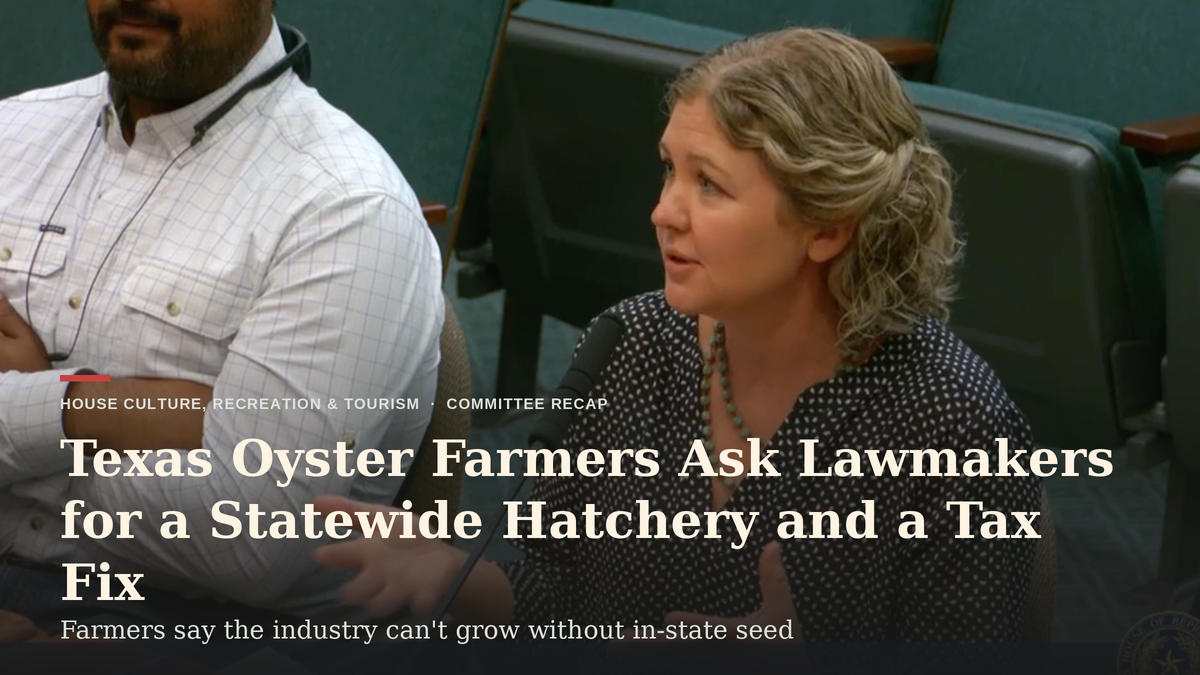
Texas oyster farmers told a House panel Sept. 30 that their young industry cannot grow without a hatchery in the state, insurance it can afford and a sales tax break that has so far delivered pennies. They asked lawmakers to act in the 90th Legislature.
“80% of the oyster reefs that existed in Texas waters in 1950 are gone,” Brad Lomax told the House Committee on Culture, Recreation and Tourism. Lomax, who has owned the Water Street Oyster Bar in Corpus Christi since 1983, testified for the Commercial Oyster Mariculture Advisory Board. “This is a catastrophic loss of habitat,” he said.
Farming is the alternative to dredging public reefs. Lomax put the industry at “somewhere between around 15 to 17 farms” that are operating or being permitted, on “somewhere north of 150 acres,” and he said the figures are not precise. Amy Bellaire, who owns Bigtree Oyster Company in Rockport, said Texas farmers are “now harvesting over 3 million oysters a year.”
The first obstacle is seed. “Texas farmers don’t have a reliable source of high quality seed in Texas right now,” Bellaire said. “We do rely almost solely on out-of-state hatcheries and nurseries.” Those suppliers favor their own states. “They will prioritize their farms in their own state when they run short on seed,” she said. Lomax laid out his priority list in a sentence: “First of all, we need a statewide hatchery.”
The price of one is the question. Chris Hollenbeck, director of the Texas A&M center for Marine Aquaculture, said large hatcheries run “on the scale of, 5 to $20 million.” He cited an LSU hatchery built 15 years ago at about $5 million and a Virginia Institute of Marine Science facility that cost about $20 million. A&M’s small hatchery, he said, could supply only “a few percent of what the industry needs,” though its newest breeding lines grow about 40 percent faster than wild oysters.
Lomax said the request will come through the university systems next session. “Hatcheries don’t make a lot of money,” he said. “So they need to be part of a university system if at all possible.”
The second obstacle is a tax break that did not work as written. Lawmakers passed House Bill 3486 and House Bill 3487 in 2025 to give restaurants sales tax relief for serving Texas-farmed oysters. Lomax said a 100-count sack costs $85 to $100 and the law was meant to save $5 per sack. “Instead of a $5 sales tax savings for us as a restaurant operator, it was something like $0.16,” he said, blaming “the math mistakes that were made in the comptroller’s office.”
A member asked whether the statute or the agency needed correcting. “It’s my understanding that it’s the math,” Lomax answered. “The math got messed up.” Another member said the committee would have a chance to address it during the legislative session.
Farmers also described a permitting maze and a coverage gap. “There are six different agencies that we work with as part of our permitting process,” Bellaire said, and “we can’t get insurance for any of the gear on the water.” Peers in other states, she said, have a designated agriculture department contact who connects farmers to grants, loans and insurance. In a survey she ran, “nine out of the nine farmers responding rated that as very important.” Members floated an interagency point of contact and a working group that would put the governor’s office, the Department of Agriculture, A&M and Texas Parks and Wildlife at one table.
Marketing is the third ask. Lomax recalled shopping at a Whole Foods in August, where the seafood manager told him Texas did not allow oyster farming. He pointed to the Texas Department of Agriculture’s $4.5 million wild-caught shrimp campaign as a model. “If we could get a couple million bucks from the legislature, I think we could dig up another couple million,” he said. Rep. Trey Martinez Fischer, who said he looks for Gulf shrimp by name at the store, asked what it would take to put Texas oysters at that level. “I would love to see the background on the promotional program for shrimp from the ag department,” he said.
The hearing was invited testimony only. No vote was taken, and the committee’s interim report will shape bills for the 90th Legislature, which convenes in January 2027. The Dispatch outlined the oyster charges in its preview of the hearing.
Fact box
- Issue
- Cultivated oyster mariculture — hatchery, insurance, capital and market access (approx. 60 minutes, about 47 percent of the hearing)
- What happened
- Oyster farmers and a Texas A&M aquaculture director asked for a statewide hatchery, a fix to a 2025 sales tax relief law, an agriculture department point of contact and a marketing program; members floated an interagency working group. No vote — interim hearing.
- When
- Wednesday, Sept. 30, 2026 · run time 2:07:17
- Where
- Room E2.012, Capitol Extension, Austin
- Chair
- Rep. Will Metcalf, R–Conroe; Vice Chair Rep. Lulu Flores, D–Austin
- Key witnesses
- Brad Lomax, Commercial Oyster Mariculture Advisory Board; Jacob Aparicio, Oyster Bros; Amy Bellaire, Bigtree Oyster Company; Chris Hollenbeck, Texas A&M Center for Marine Aquaculture
- Archived video
- house.texas.gov video 22870