
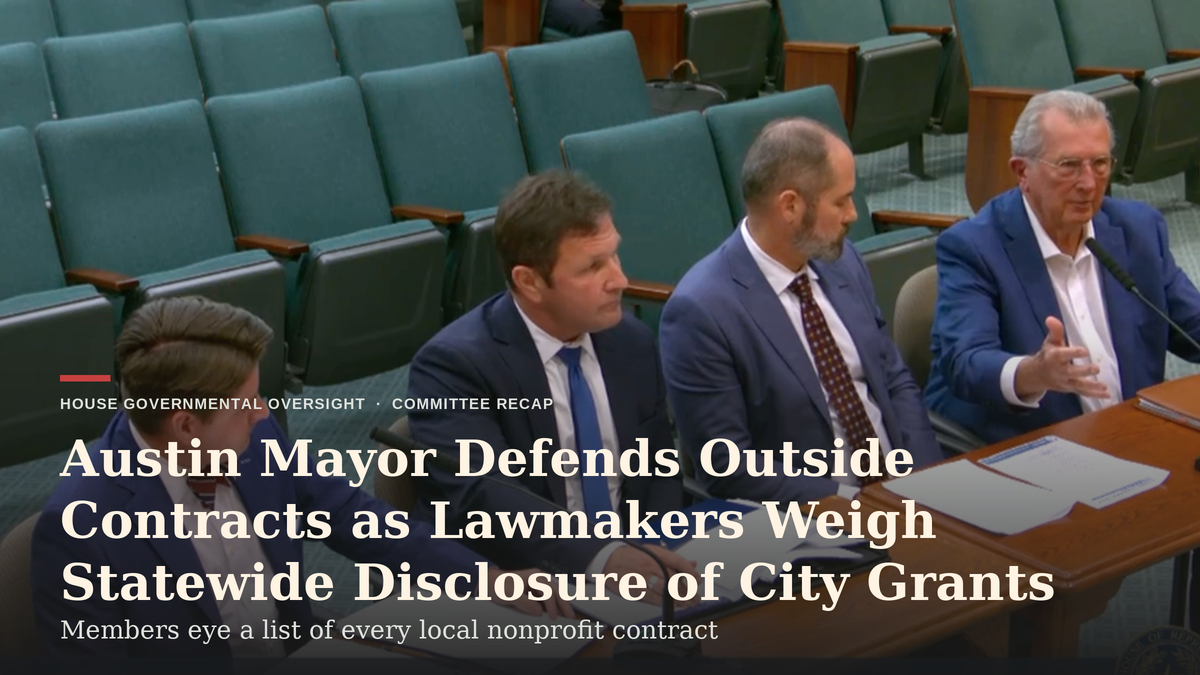
Austin Mayor Kirk Watson told a House committee Sept. 30 that the city spends about $100 million a year on outside consultants and nonprofits and is auditing it. Lawmakers left the hearing talking about a statewide list of every local nonprofit contract and new ways to sue cities over grants.
“When government spends taxpayer money through a nonprofit or an outside consultant, we ought to know why we’re spending it,” Watson told the House Select Committee on Governmental Oversight. “We ought to know whether we’re getting the results we were promised.” He added, “Contracting something out doesn’t contract out our responsibility.”
Ed Van Eenoo, the city’s chief financial officer, put numbers on it. The city spends “about $100 million annually” on the two categories, he said, roughly 1.4% of a $6.6 billion budget. Information technology consulting accounts for about $22.8 million a year, he said, which he estimated equals about 125 full-time technology staff.
Rep. Ellen Troxclair pressed Watson on past spending. She cited city audits and budget records that she said show more than $1.5 billion between 2015 and 2022 that “either fell outside core services, missed the targets that the city itself set for themselves or was never measured at all.” Watson said the city is addressing it, pointing to a February ordinance, passed unanimously, for an efficiency review.
Rep. Richard Peña Raymond turned the discussion statewide. “Maybe we should be asking, Chairman, every city and every county in this state… to give this committee a list of all the NGO contracts they have so we can look at them,” he said. The Dispatch reported on the committee’s last hearing, on school district foundation money, in its Aug. 26 recap.
Critics said Austin’s system rewards allies. Bill Aleshire, a former Travis County judge, called it “a grifter cycle where billions, not millions of tax dollars” go to nonprofits that “become part of the Council members political base for reelection.” He cited a July 2, 2025, city audit that he said found $1.9 billion in nonprofit spending between October 2019 and June 2025, 60 percent of it to three groups, including the Austin Transit Partnership.
Ben Crockett of the Texas Public Policy Foundation said the city paid the People’s Institute for Survival and Beyond roughly $880,000 for “undoing racism training.”
Cara Mendelsohn, a Dallas City Council member testifying for the city, argued transparency is the gap. “When taxpayer dollars are passed through to a nonprofit, that transparency can disappear,” she said. “If an organization is performing government function with taxpayer dollars, I believe the public should have substantially the same ability, the same right to information, as if the government was performing it itself.” She also said she has seen “coalition staff become campaign managers and workers in city council races.”
Paul Webster of the Cicero Institute turned to homelessness. He said an analysis of 61 Texas homeless service providers found pay up 150 percent from 2013 to 2024, and that communities received $1.3 billion in federal homelessness awards since 2014. “Total homelessness has decreased by 2%, but unsheltered homelessness has increased by 5% and chronic homelessness by 20%,” he said. Sonia Burns, a public witness, argued state and federal policy on mental health and state hospital beds drives the problem as much as city contracts.
The legal discussion was the most concrete. Rep. Mitch Little asked William Farrell of the Office of the Attorney General whether he works on litigation against municipalities over unauthorized gifts. Farrell said he successfully prosecuted two cases against Harris County. “I need you to use your lawyer brain and reverse engineer for us how we solve this problem legislatively,” Little said. “I would say that you have to do it by statute,” Farrell answered.
Little said none of the grants discussed “involves any retention of government control over those funds,” whether to the Fellowship of Christian Athletes or a journalists’ association; in his view, “it’s just a pure gift in violation of the Constitution.” He proposed requiring every municipality to notify the attorney general of any grant it issues. “You could assign a lawyer to do that, right? And if it doesn’t comply, you could sue them, right?” he asked. “Yes, sir,” Farrell said.
The hearing was interim; no vote was taken. The Dispatch outlined the charge in its preview. A statewide contract inventory and an attorney general notice requirement are both ideas members floated for the 90th Legislature, which convenes in January 2027.
Fact box
- Issue
- Safeguarding taxpayer funds — local government spending on consultants and nonprofits (approx. 4 hours 24 minutes, about 35 percent of the hearing)
- What happened
- Austin’s mayor and CFO described about $100 million a year in consultant and nonprofit spending; critics and members questioned oversight and legality; a state lawyer said a statute would be needed to police grants. No vote — interim hearing.
- When
- Wednesday, Sept. 30, 2026 · run time 12:32:26
- Where
- Room E2.026, Capitol Extension, Austin
- Chair
- Rep. Cody Vasut, R–Angleton; Vice Chair Rep. Armando Walle, D–Houston
- Key witnesses
- Kirk Watson, Mayor of Austin; Ed Van Eenoo, Austin CFO; Bill Aleshire; Ben Crockett, Texas Public Policy Foundation; Cara Mendelsohn, Dallas City Council; Paul Webster, Cicero Institute; William Farrell, Office of the Attorney General
- Archived video
- house.texas.gov video 22860