
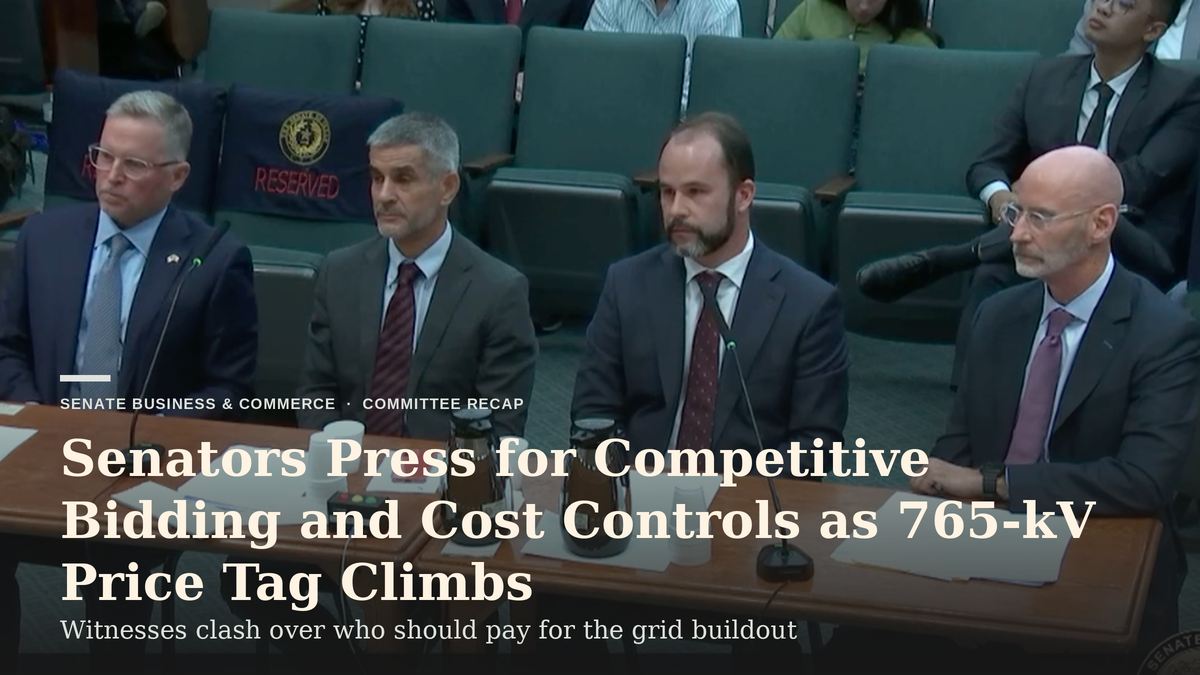
Senators spent more than six hours Sept. 30 asking who should control the cost of Texas’ transmission buildout, with witnesses urging competitive bidding, a lower guaranteed return for utilities and relief for ratepayers before the 765-kV Permian Basin lines are built.
The Senate Committee on Business and Commerce heard the first of three charges, on modernizing transmission and enhancing affordability, in a hearing that ran about nine hours. It follows the committee’s July 29 grid hearing, after which Chair Charles Schwertner, R–Georgetown, urged regulators to deny the first 765-kV applications, as The Texas Dispatch previously reported. The Dispatch outlined the charge in its preview.
Regulators and ERCOT staff opened the day. Barksdale English, the Public Utility Commission’s deputy executive director, Justin Swearingen of the Office of Public Utility Counsel and Ryan King, ERCOT’s manager of market design, took the first panel, followed by three more invited panels that included consumer, industry, utility and analyst witnesses. Little time went to the large-load interconnection overhaul known as Batch Zero, which the Dispatch’s preview had flagged; the discussion stayed on who pays for the lines.
The return utilities earn drew the first challenge. A senator pointed to a gap in what monopoly and competitive businesses earn. “6.7 versus 9.6,” the senator said. “But those are hundreds of millions, if not billions of dollars that are borne by people of Texas and, and businesses in Texas.” Another senator said the projected $30 billion for the lines to West Texas will not hold: “no way they’re going to stay in 30 billion.”
Vice Chair Phil King recalled the 2000s CREZ lines and said that project “was supposed to cost $2 billion, and it ended up costing like $8 billion.” He later called the cost question “something I really think we ought to be talking about a lot going into this next session.”
Barry Smitherman, chairman of Texans for Affordable Transmission and a former Public Utility Commission chairman, said utilities are monopolies by design. That status “was cemented even further back in 2019 with Senate Bill 1938,” he said, which required a company to already own transmission to build new lines. Estimates, he said, are “straight lines on a map.” He urged lawmakers to let ERCOT and the PUC “take competitive solicitations for large transmission projects so that the market is not just those who presently own transmission.”
Olivier Beaufils, head of the central U.S. region at Aurora Energy Research, put numbers on that idea. The 765-kV plan alone “represents a $36 billion investment,” the analyst said, and competitive bidding could mean “up to $9 billion less in capital spend,” “up to $22 billion in lifetime ratepayer savings” and “up to $660 per residential households.” Beaufils said 75 percent of competitively bid projects had no material delay, versus 37 percent for incumbent projects.
Mark Bell, president of the Association of Electric Companies of Texas, which represents utilities, took the other side of cost allocation. “Growth should pay for growth,” he said.
Other witnesses challenged the premise that transmission is the main driver. A second-panel witness said “70% of the bill is distribution, not transmission,” and “for CenterPoint it’s 60% is distribution and not transmission.” Sandra Zavala, president of the Texas Consumer Association, offered a fix lawmakers could adopt “even next session”: use the rainy day fund for securitization to pay down costs, and index the return on equity “to reflect the risk that’s being borne by the companies.”
The debate over why the lines exist also ran hot. Todd Staples of the Texas Oil and Gas Association said he wanted to “dispel a myth” that the industry supported 765 kV to move trapped electrons out of West Texas. “It is simply not true,” he said. Several senators questioned why the state was building long lines instead of using natural gas produced in the region.
Justin Swearingen of the Office of Public Utility Counsel told members the office achieved “over $2 billion in savings for consumers” in 2025 across electric and water cases, most from the return on equity that utilities earn on their investments.
In public testimony, Mark Friesenhahn said, “We believe the PUC plan is faulted and deficient.”
The committee took no votes. Schwertner gave no bill language, but the volume of testimony points to a rewrite of how Texas plans and pays for transmission in the 90th Legislature, which convenes in January 2027.
Fact box
- Issue
- Modernizing transmission and enhancing affordability (approx. 6 hours 31 minutes including public testimony, about 72 percent of the hearing)
- What happened
- Regulators, consumer advocates, utilities, analysts and public witnesses debated transmission cost recovery, return on equity, competitive bidding and who pays for the 765-kV buildout; senators questioned rising costs. No vote — interim hearing.
- When
- Wednesday, Sept. 30, 2026 · run time approx. 9:02:00 (caption timeline)
- Where
- Room E1.012, Capitol Extension, Austin
- Chair
- Sen. Charles Schwertner, R–Georgetown; Vice Chair Sen. Phil King, R–Weatherford
- Key witnesses
- Justin Swearingen, Office of Public Utility Counsel; Barry Smitherman, Texans for Affordable Transmission; Mark Bell, Association of Electric Companies of Texas; Sandra Zavala, Texas Consumer Association; Todd Staples, Texas Oil and Gas Association; an Aurora Energy Research analyst
- Archived video
- senate.texas.gov video 22668