
A Texas school district moved roughly $97 million into a private charity it helped create, and on Aug. 26 a House committee spent four and a half hours trying to establish who is allowed to look at it.
“After our review of 13 House District Education Foundations, we found that most operate in the traditional way,” Mandy Drogin of the Texas Public Policy Foundation told the panel. “However, some operate in non-traditional ways, becoming closely intertwined with their district in a way that raises legitimate questions about transparency and accountability.” Her numbers: “The district redirected approximately $97.1 million to the Barbers Hill Education Foundation between January 2012 and June 2025. By comparison, only about 6.5 million of that was given back from the foundation to the district.”
Drogin then read members a line she attributed to the district’s superintendent at a public meeting: “The state can’t touch our education Foundation money.”
The House Select Committee on Governmental Oversight, chaired by Rep. Cody Vasut, R–Angleton, sat for 11 hours and 16 minutes without a recess. Education foundations took about 281 minutes, second by the clock but first by a wide margin in member questioning. Because this was an interim hearing, no votes were taken.
Superintendent Greg Poole came to defend Barbers Hill and did not concede much. “I couldn’t agree more that bad apples need to be out,” he said. “We’re not a bad actor. We have not done anything illegal and I am not aware of any conflict. I’m not couching my words.” He put the district’s record up front: nearly $300 million returned to the state under recapture, “we haven’t raised taxes in 20 years,” raises of 4 to 5 percent, and “the highest score on the last accountability.”
He also said the scrutiny was political. “This scrutiny happened because a foundation board member ran against an incumbent rep,” Poole said. “I mean, that’s the facts. That’s why we’re being scrutinized.” And: “The only thing we’re really guilty of is eye popping success. And that success does not fit the rhetoric of those that have criticized us because they’re not fans of public ed.”
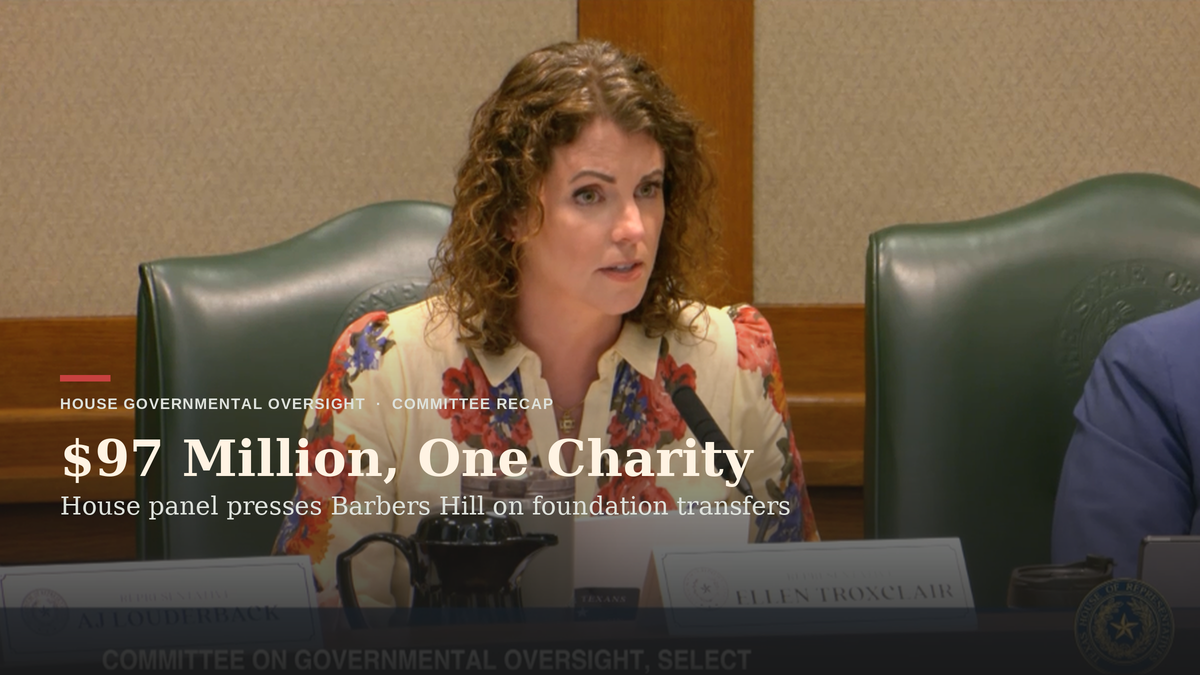
The hearing’s hardest hour belonged to Rep. Ellen Troxclair, R–Lakeway, who walked Poole through the foundation’s business relationships. She told him a foundation board member is also a vice president of the private company the foundation partnered with on a real estate venture. Then she turned to the money manager. “Hillary Poole is listed as the vice president of institutional business development at Commerce Street,” Troxclair said. “The same investment firm that you’ve directed $250 million.”
Poole said he did not know. Troxclair pressed. “To be very clear, you didn’t know if your daughter did or didn’t work for Commerce Street Holdings when you hired them to manage the education funds?” She asked whether he had certified his testimony as truthful on the witness kiosk that morning. “100%,” Poole said. “And I have.” Moments later: “Ask you three different ways, ma’am, I don’t remember.” Troxclair’s summary of his definition of a conflict was flat: “Define a conflict of interest by whether or not we like the result that’s achieved.”
Rep. Mitch Little, R–Lewisville, worked the tax side, reading from the district’s annual financial report that property “what should have been taxable value of $8.9 billion was taxed at $1.3 billion inside of Barbers Hill ISD” under Chapter 313 agreements. His question was structural: “How a nonprofit can receive payments from a property tax payer that are no longer called taxes because the Education Foundation can’t receive taxes, can it?”
Rep. Shelby Slawson, R–Stephenville, caught the district’s own witnesses telling different stories. “I’m hearing some conflicts, particularly between you, Miss Leon and Dr. Poole,” she said. “You were very clear, sir, that you were looking for a way to fix the recapture problem for your district and keep that money right there. But, Miss Leon, I thought I understood you to say that there was nothing about receiving or expending any of this money that had anything to do with recapture. So which is it?” Sara Leon, counsel to the district’s board, answered that none of the revenue “have any impact on recapture, because they’re not tax revenues.”
The state’s education agency told members it is not watching. “TEA oversees the school districts, not the foundations themselves,” said David Marks, director of financial compliance at the Texas Education Agency. “TEA does not maintain a comprehensive list of districts with education foundations.” Marks said the relevant account code shows about $95 million reported by Barbers Hill since 2018, but cautioned that “the account code alone does not confirm the ultimate recipient of every payment.”
Nobody counts the foundations either. Shawn Callaway, president of Foundation Innovation, told Slawson there are “probably 700, 750 foundations in Texas” and “no official tracking mechanism.” The typical one, he said, raises $150,000 to $300,000 a year. Slawson used that to argue for restraint: “While one foundation causes us great concern that brings us in here, we do actually need to have a broad overview so that in fashioning a remedy for one, we don’t bind up the hands unnecessarily of others.”
Drogin left members five recommendations, including mandatory conflict-of-interest disclosure and recusal for trustees and foundation directors, an annual public reconciliation of every dollar transferred, and public disclosure of all related-party transactions. Former Round Rock ISD trustee Mary Bowen went further, asking the committee to “ban vendors from donating to them.” The 90th Legislature convenes in January 2027.
The committee’s longest charge, roughly five hours, took up the Texas Public Information Act, where county officials called the law weaponized and transparency groups called it toothless. That charge is the subject of the companion recap, “Counties Call the Public Information Act Weaponized; Transparency Groups Call It Toothless.” The final 88 minutes examined whether local governments may hold Open Meetings Act meetings outside their own boundaries, after Bastrop’s council held a retreat 260 miles away in Fredericksburg. Chair Vasut closed that charge with the clearest legislative signal of the day: “The general rule I would love to see for all political subdivisions is meet where you have authority or right next door, if at all possible, and keep it close by. But we’ll look at this legislation.”
Fact box
- Issue
- Interim charge on education foundations — the role and structure of nonprofit foundations affiliated with Texas public school districts, the practice of public funds being transferred to or used by them, and whether existing law prevents conflicts of interest (approx. 4 hours 41 minutes, about 42 percent of the hearing; second-longest of three charges but by far the most member questioning)
- What happened
- A Texas Public Policy Foundation researcher told members Barbers Hill ISD routed about $97.1 million to its affiliated foundation over 13 years and got about $6.5 million back; Superintendent Greg Poole denied any illegality or conflict and called the scrutiny politically motivated; Rep. Troxclair questioned him about a foundation board member’s role at the foundation’s real-estate partner and about a relative listed at the firm managing foundation money; Poole disclosed a foundation-funded slander suit against a sitting state representative; TEA said it does not regulate or even list the foundations; a consultant estimated 700 to 750 exist statewide with no official tracking; no vote (interim hearing)
- When
- Wednesday, Aug. 26, 2026, 10:00 AM CT · run time 11:16:14, gavel to gavel with no recess (10:06 a.m. to 9:22 p.m.)
- Where
- Room E2.028, Capitol Extension, Austin
- Chair
- Rep. Cody Vasut, R–Angleton (HD-25); Vice Chair Rep. Armando Walle, D–Houston (HD-140)
- Key witnesses
- Mandy Drogin (Texas Public Policy Foundation); Brent Ringo (Kerrville ISD) and Sarah Betts (Kerrville Public School Foundation); Shawn Callaway (Foundation Innovation); Greg Poole (Barbers Hill ISD) and Sara Leon (counsel to the Barbers Hill ISD board); David Marks (Texas Education Agency); Mary Bowen (former Round Rock ISD trustee)
- Archived video
- house.texas.gov video 22756