

The insurance rules Texas writes reach only about one in five Texans who get health coverage through a job. Seven months of testimony to the House Select Committee on Health Care Affordability kept arriving at the same diagnosis, hospital prices, and kept running into the same wall: most of the money those prices drain flows through employer plans that federal law, not Texas, governs. But one set of plans sits entirely inside the state’s reach, the coverage Texas itself pays for teachers, school staff and state workers, and there the state has left its own share of the bill at $75 a month since 2001.
That is the tension the committee’s interim report, expected in late November or December, will have to resolve. The strongest affordability lever Texas holds is not a new rule for insurers. It is the coverage the state already buys, and how hard it is willing to push with it.
The diagnosis was settled by the second day
Speaker Dustin Burrows created the panel in March, and Chair James Frank of Wichita Falls used its first two days, April 30 and May 1, to establish why care costs what it does before talking about fixes. “Until and unless we have a clear understanding of where we are and how we got here, we have little or no chance of knowing where we should go from here,” he said, Community Impact reported.
The witnesses who followed, from Yale and Rice economists to the hospital and insurance trade groups, mostly agreed that price is the driver. Texas 2036, a policy group that favors market-based health reforms, told members that commercial insurers pay Texas hospitals about 254 percent of what Medicare pays, roughly double what hospitals need to break even. The National Academy for State Health Policy put the median Texas hospital’s break-even point at 110 percent of Medicare and found 96 percent of Texas hospitals in highly concentrated markets. Even the Texas Association of Health Plans, the insurers’ trade group, opened its Sept. 1 testimony by saying 65 cents of every premium dollar goes to hospitals and drugs.
For a family, the diagnosis comes down to one number. Family coverage through an employer now averages about $27,000 a year, “basically buying a new Toyota Corolla worth of health insurance” every year, Yale economist Zack Cooper told members, Community Impact reported.
Texas’ insurance rules miss four of every five workers
The same insurers’ testimony shows why the usual tool, insurance regulation, reaches so little of that spending. Of the 15.3 million Texans with employer coverage, 12.2 million are in self-funded or level-funded plans governed by the federal Employee Retirement Income Security Act, which leaves state benefit mandates and network rules out. Only 3.1 million are in the fully insured plans the Texas Department of Insurance regulates, and the small-group slice has fallen to about 600,000 people.
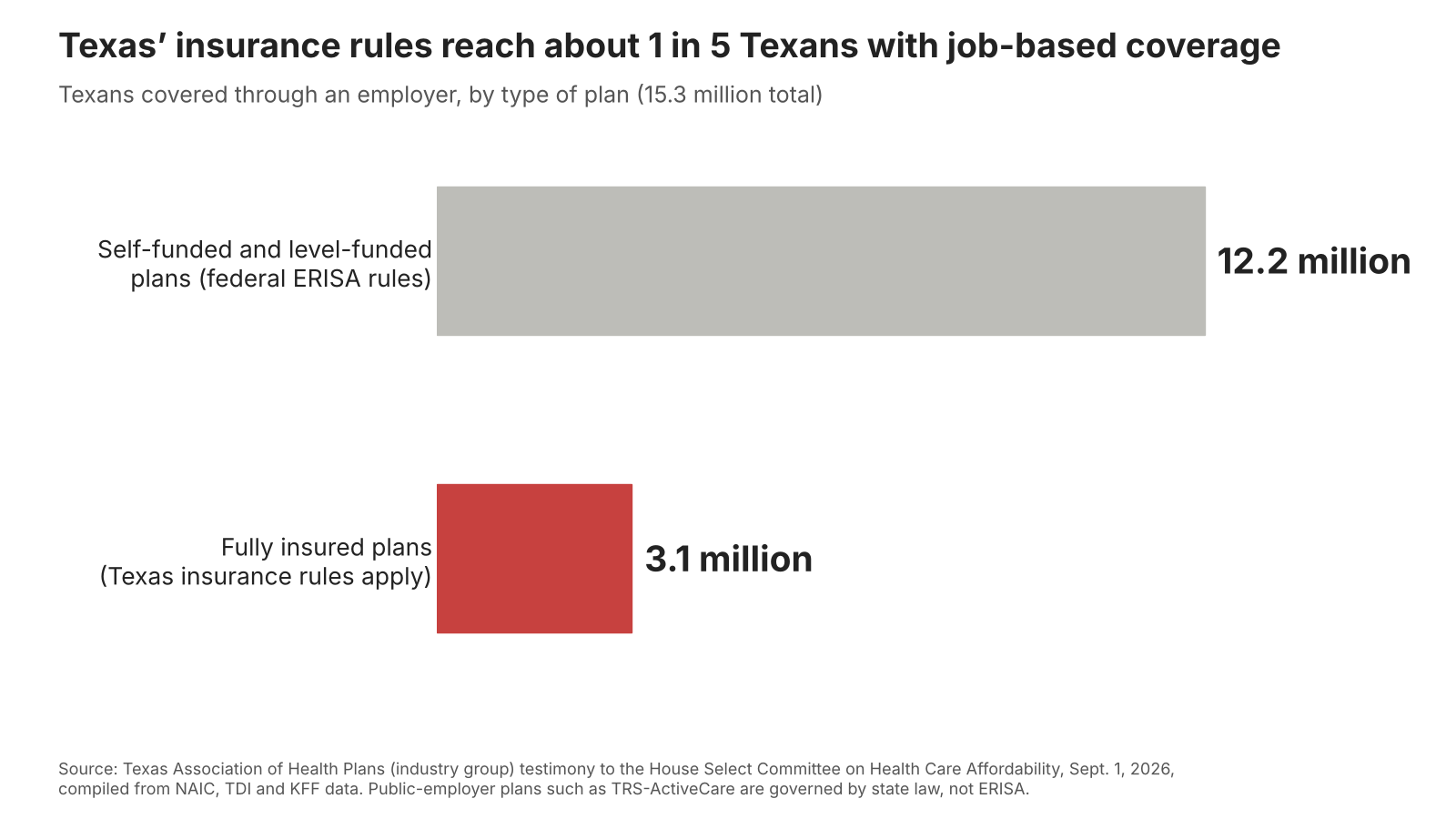
The insurers draw a deregulatory conclusion from those numbers: let small employers buy plans with fewer state mandates and looser network requirements, pointing to the 19 percent that employers save on average when they leave for level-funded plans. That debate is real, but it concerns the shrinking 20 percent. The federal law that walls off the other 80 percent has an exception that matters here. ERISA does not cover health plans run by governmental entities, which means the Legislature can shape the plans that cover school and state employees directly, without asking Washington.
School boards are already making the trade the state has not
School districts are making the price-versus-access choice on their own, one board at a time. Claudia Torres-Yanez, a Pflugerville ISD trustee, told the committee in written comments filed for the Sept. 1 hearing that her district, facing “significant budget pressures,” is dropping Blue Cross Blue Shield and moving employees to the narrower Healthcare Highways network for 2027. Teachers, she wrote, are asking whether their physicians and specialists will stay in network and “what happens when a lower-cost option for the employer creates additional cost, travel, disruption, or difficulty accessing care for employees.”
“Understanding the economic rationale is important, but it does not negate the impact a network change can have on a family,” Torres-Yanez wrote. She asked the committee for a statewide comparison of school employee health costs because trustees “lack accessible, comparable statewide data” to judge those decisions.
Katy ISD went the other way this fall. After 691 employees signed a petition calling the plan underperforming, trustees raised the district’s contribution from $385 to $427 per employee, at a cost of about $4 million, and still project a $12.1 million shortfall in the 2027 plan. Each district is using its own budget to answer a pricing question the state has the scale to ask once.
The state is a buyer, and its share has not moved since 2001
Texas buys a lot of health care. TRS-ActiveCare covers more than 411,000 school employees and dependents at nearly 1,000 employers, about 80 percent of the state’s public education employers. TRS-Care covers more than 217,000 retirees and dependents. The Employees Retirement System runs HealthSelect for state workers and retirees.
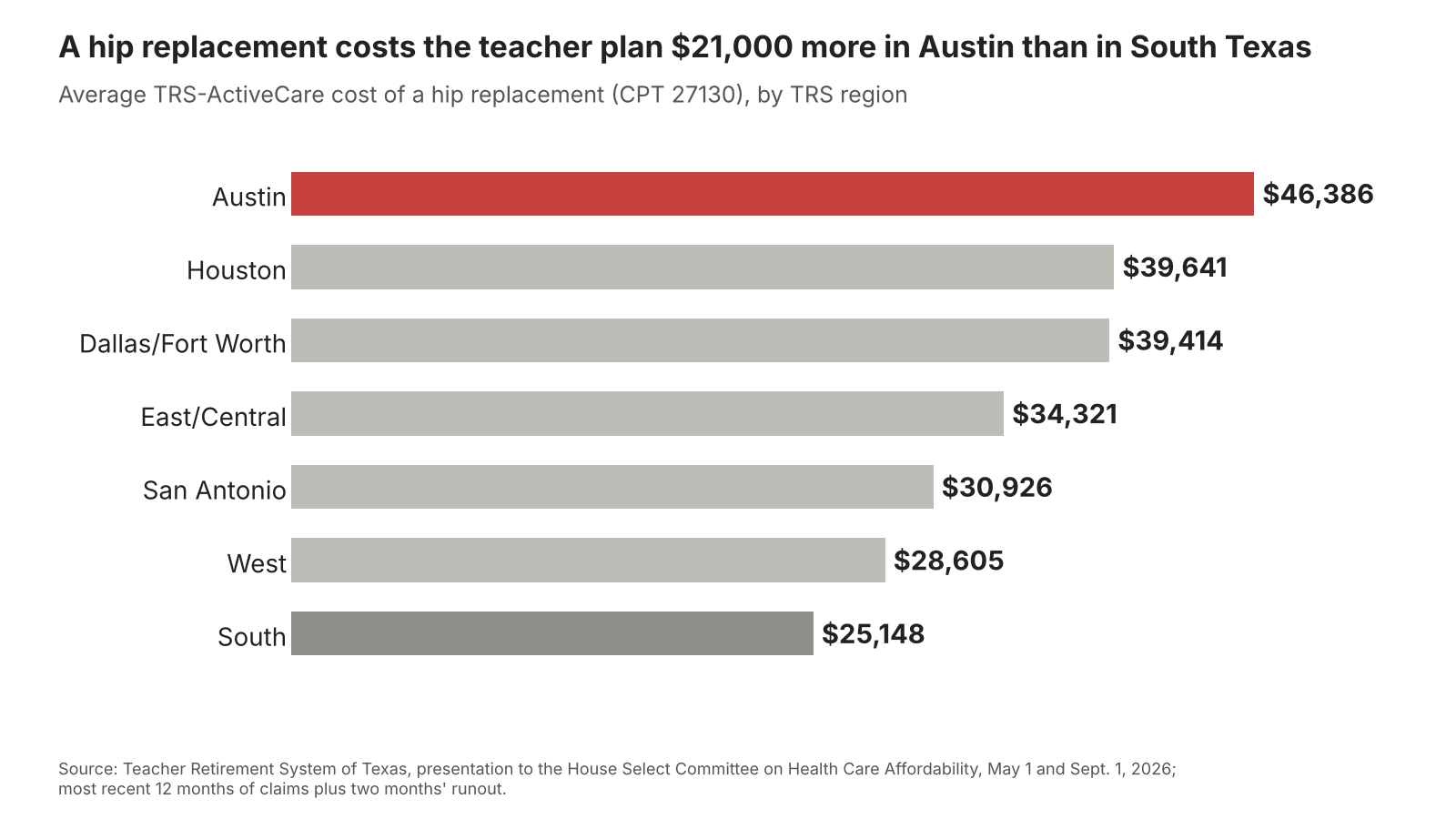
Both systems brought the committee data no private employer would share in public, and the data show prices doing the damage. TRS reported that the same hip replacement cost its plan $46,386 in the Austin region and $25,148 in South Texas, and that consolidation of anesthesia practices alone added about $11 million a year to premiums. Because the law sets TRS premiums by region, the difference lands on employees. “If you’re in an expensive region, your teachers are getting charged more for their insurance, period,” Frank said, KERA reported.
ERS told members that even with 8 percent annual rate increases, the state employee benefits fund will be exhausted in fiscal 2031, which puts the decision in front of the 2027 and 2029 Legislatures.
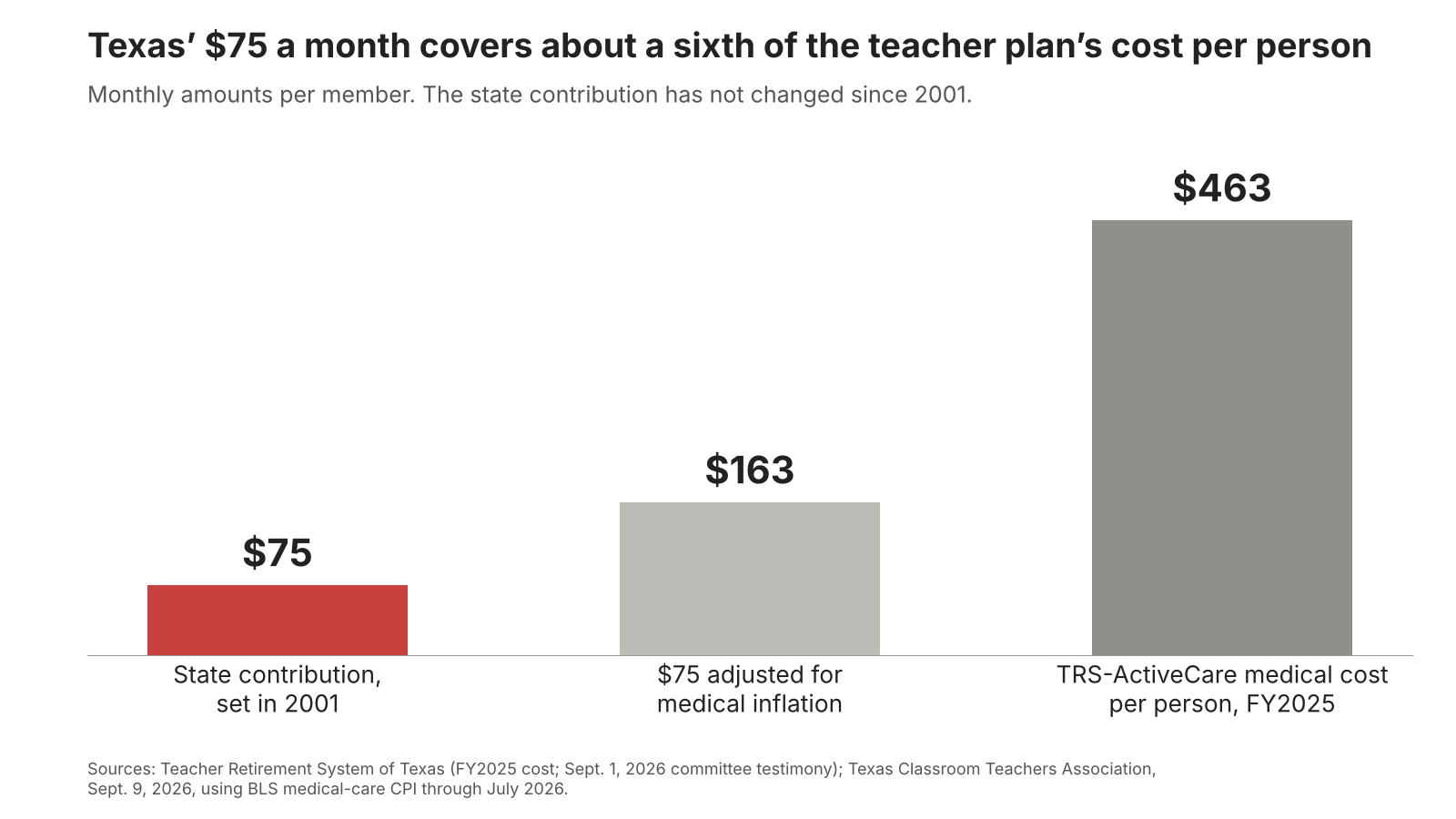
On the teacher side, the funding formula has not kept pace for a quarter-century. State law set the state’s contribution at $75 per member per month in 2001 and the district minimum at $150, and neither has changed. Adjusted for medical-care inflation, that $75 would be about $163 today, by the Texas Classroom Teachers Association’s calculation. TRS-ActiveCare’s medical costs ran $463 per person per month in fiscal 2025, so the state’s share now covers roughly a sixth of the cost. Districts average about $330 a month, and employees pay the rest.
Using the checkbook means someone gives something up
The case for using state purchasing power is that it has worked where TRS tried it. The plan’s rewards program has paid $3.9 million to members who shopped and saved the plan $16.7 million, about $4 for every $1, and it is testing tiered copays in the Houston region and Arlington ISD. Rice economist Vivian Ho cited a tiered-hospital plan that cut spending per stay 8.5 percent with no measured change in quality. Texas 2036’s session agenda calls for using TRS-ActiveCare to negotiate lower hospital prices. Frank asked why the plan doesn’t go further: “If you’ll go here, you can pay $1,000. But we don’t do that. I just don’t know why,” he said, as the Dispatch reported.
It gets hard in two places. The first is the employee, who bears the disruption that Torres-Yanez described: a narrower network or a higher copay at the expensive hospital saves money only if some teachers change doctors. The second is the hospital. The Texas Hospital Association told members that base Medicaid pays 72 percent of inpatient and 75 percent of outpatient costs, that hospitals absorbed $9 billion in unreimbursed Medicaid and uninsured costs in 2025, and that 41 percent of rural hospitals hold less than 30 days of cash. Commercially insured patients “represent more than 100 percent of all the earnings of a hospital,” incoming association chair Allen Harrison told the Dispatch. Most health economists reject the idea that public underpayment sets private prices, and Frank called hospital cost shifting a “myth” at the Sept. 1 hearing. But a hospital that loses state-plan volume will still look to recover it, and in a one-hospital rural county the state has little to bargain with.
The alternative, simply spending more, has its own price. TRS asked for $110 million in fiscal 2028 just to keep average premium increases under 10 percent, and one-time state money already holds 2026–27 premiums about $52 a month lower. Raising the $75 would cost general revenue every year without changing what hospitals charge.
The trade-off in front of lawmakers is that the state can keep paying more each session to cushion teachers and state workers from hospital prices it does not challenge, or it can use the leverage of more than 600,000 enrollees to push those prices down, accepting that employees will face narrower choices and that some hospitals, including some rural ones the state wants to keep open, will be paid less.
What to watch
- Late November–December 2026: The House Select Committee on Health Care Affordability’s interim report. Watch whether it treats TRS-ActiveCare and HealthSelect as purchasing tools or only as data sources.
- Jan. 1, 2027: Pflugerville ISD employees move to the Healthcare Highways network; Katy ISD’s new Kelsey-Seybold option takes effect.
- Jan. 12, 2027: The 90th Legislature convenes. Watch the introduced House and Senate budget bills for TRS’s $110 million ActiveCare request and any change to the $75 state contribution.
- April–May 2027: The TRS Board sets 2027–28 ActiveCare premiums and decides whether to expand facility tiering beyond the Houston region.
- Fiscal 2031: ERS’s projected exhaustion of the state employee benefits fund, which the 2027 budget will either push back or bring closer.
Sources
Primary documents
- Texas Legislature Online, House Select Committee on Health Care Affordability, meetings list (Apr. 30, May 1, Sept. 1, 2026): https://capitol.texas.gov/Committees/MeetingsByCmte.aspx?Leg=89&Chamber=H&CmteCode=C059
- Minutes, Apr. 30–May 1, 2026 hearing: https://capitol.texas.gov/tlodocs/89R/minutes/html/C0592026043009001.HTM
- Witness list, Apr. 30–May 1, 2026: https://capitol.texas.gov/tlodocs/89R/witlistmtg/html/C0592026043009001.HTM
- Hearing notice and witness list, Sept. 1, 2026: https://capitol.texas.gov/tlodocs/89R/schedules/html/C0592026090109001.HTM; https://capitol.texas.gov/tlodocs/89R/witlistmtg/html/C0592026090109001.HTM
- Minutes, Sept. 1, 2026: https://capitol.texas.gov/tlodocs/89R/minutes/pdf/C0592026090109001.PDF
- Public comments, Sept. 1, 2026, Health Care Delivery & Finance Systems (Claudia Torres-Yanez, Pflugerville ISD; Texas Health Services Authority; others): https://capitol.texas.gov/tlodocs/89R/publiccomments/Meetings/C0592026090109001/InputItems/86a44d70-62cd-42c0-985f-691ea12539bd.pdf
- Public comments, Apr. 30, 2026, Overall Health Care Spending (TexPIRG, Texas PACE Association, others): https://capitol.texas.gov/tlodocs/89R/publiccomments/Meetings/C0592026043009001/InputItems/1af6d661-3dd3-48fb-9582-3c80b16db89c.pdf
- Teacher Retirement System of Texas, presentation, May 1, 2026: https://capitol.texas.gov/tlodocs/89R/handouts/C0592026043009001/846e151d-13fb-4390-83af-56cabf7a0f2d.PDF
- Teacher Retirement System of Texas, presentation, Sept. 1, 2026: https://capitol.texas.gov/tlodocs/89R/handouts/C0592026090109001/64cf7ada-826c-4c5a-8e7c-e065010ec157.PDF
- Employees Retirement System of Texas (Blaise Duran), presentation, May 1, 2026: https://capitol.texas.gov/tlodocs/89R/handouts/C0592026043009001/d28283a2-9539-490c-873c-015c2b470079.PDF
- Teacher Retirement System of Texas, “District Financial Considerations”: https://trs.texas.gov/health-benefits/employers/district-leadership/district-financial-considerations
- U.S. Department of Labor, ERISA (health plans): https://www.dol.gov/general/topic/health-plans/ERISA
Data and research testimony
- National Academy for State Health Policy (nonpartisan association of state health officials), Maureen Hensley-Quinn, hospital prices presentation, Apr. 30, 2026: https://capitol.texas.gov/tlodocs/89R/handouts/C0592026043009001/acd8517c-8dcf-4b37-89ff-725a5dc8ff9f.PDF
- NASHP, prescription drug prices presentation, Apr. 30, 2026: https://capitol.texas.gov/tlodocs/89R/handouts/C0592026043009001/2d7ec276-3cc5-4e61-bd01-57eec5697560.PDF
- KFF (nonpartisan health policy research), Cynthia Cox, written testimony: https://capitol.texas.gov/tlodocs/89R/handouts/C0592026043009001/d2cf3226-8888-4dce-8942-c40f4acaa780.PDF
- Vivian Ho, Rice University Baker Institute, written testimony, Sept. 1, 2026: https://capitol.texas.gov/tlodocs/89R/handouts/C0592026090109001/f89aa71b-6509-48f2-8811-bea354b33cfe.PDF
- Lisa Bielamowicz (TrustWorks Collective), presentation, Sept. 1, 2026: https://capitol.texas.gov/tlodocs/89R/handouts/C0592026090109001/d22eb6ca-270f-452d-982c-4c8b58d25922.PDF
Research and interest groups (lean labeled)
- Texas 2036 (Austin policy group that favors market-based health reforms), Charles Miller, written testimony, Apr. 30, 2026: https://capitol.texas.gov/tlodocs/89R/handouts/C0592026043009001/46924c3b-4e61-47d4-bd6e-9665ec873f6a.PDF
- Texas 2036, Alec Mendoza, “The Texas Legislature is ready to address healthcare affordability,” Apr. 27, 2026: https://texas2036.org/news-analysis/the-texas-legislature-is-ready-to-address-healthcare-affordability/
- Texas Association of Health Plans (insurers’ trade group), Blake Hutson, presentation, Sept. 1, 2026: https://capitol.texas.gov/tlodocs/89R/handouts/C0592026090109001/bb9612f3-7f19-4028-bbd9-7c2f0bd63b99.PDF
- Texas Hospital Association (hospitals’ trade group), John Hawkins, written testimony, Sept. 1, 2026: https://capitol.texas.gov/tlodocs/89R/handouts/C0592026090109001/6cd122ff-8957-4ba5-bd31-e0d2f72bfecc.PDF
- Texas Hospital Association, “90 Days to the 90th Legislature,” Oct. 13, 2026: https://www.tha.org/blog/90-days-to-the-90th-legislature-healthcare-policy-impacts/
- The ERISA Industry Committee (large self-insured employers’ group), James Gelfand, handout, Sept. 1, 2026: https://capitol.texas.gov/tlodocs/89R/handouts/C0592026090109001/1b4915a0-1708-48b2-900c-765fc2525ef4.PDF
- The Kempton Group Administrators / Free Market Medical Association (direct-contracting advocates), handout, Sept. 1, 2026: https://capitol.texas.gov/tlodocs/89R/handouts/C0592026090109001/323c3398-d584-428a-902d-c67cce3025b1.PDF
- Texas Classroom Teachers Association (teachers’ professional association), comments to the LBB on TRS’s 2028–29 appropriations request, Sept. 9, 2026: https://www.tcta.org/uploads/files/general/TCTA-Testimony-to-LBB-090926_FINAL.pdf
- Texas Classroom Teachers Association, “TRS Board sets ActiveCare rates for 2026-27 with higher premiums,” May 6, 2026: https://www.tcta.org/latest-education-news/trs-board-sets-activecare-rates-for-2026-27-with-higher-premiums
News reporting
- The Texas Dispatch, “Insurers Tell House Panel Texas Regulated Its Own Health Market ‘Out of Existence’,” Sept. 3, 2026: https://thetexasdispatch.com/texas-house-health-care-affordability-plan-design-networks-recap-september-1/
- The Texas Dispatch, Analysis, “Texans Have Told the Legislature to Fix Health Care Costs …,” Sept. 3, 2026: https://thetexasdispatch.com/texas-health-care-affordability-2027-session-analysis/
- The Texas Dispatch, “Texas House Launches Select Committee to Address Rising Healthcare Costs,” May 5, 2026: https://thetexasdispatch.com/texas-house-select-committee-healthcare-affordability/
- The Texas Dispatch, “‘Quit Picking on Us’: Texas Hospitals Prepare to Defend Their Share of the Bill,” Oct. 1, 2026: https://thetexasdispatch.com/allen-harrison-texas-hospital-association-health-care-costs/
- The Texas Dispatch, “Texas 2036 Unveils 2027 Policy Playbook,” Nov. 6, 2026: https://thetexasdispatch.com/texas-2036-2027-policy-playbook-legislative-agenda/
- The Texas Dispatch, “House Bill 1153 Would End Deductibles and Copays for Breast Cancer Screening …,” Nov. 18, 2026: https://thetexasdispatch.com/hb-1153-breast-imaging-mammogram-no-cost-sharing/
- Community Impact (Hannah Norton), “‘It’s not sustainable’: Texas House lawmakers study causes of rising health care costs,” May 6, 2026: https://communityimpact.com/central-austin/texas-legislature/its-not-sustainable-texas-house-lawmakers-study-causes-of-rising-health-care-costs/
- Community Impact (Bradley Dountz), “Katy ISD approves 2027 employee health plan with $12.1M shortfall,” Oct. 6, 2026: https://communityimpact.com/katy-fulshear/education/katy-isd-approves-2027-employee-health-plan-with-12-1m-shortfall/
- KERA (Abigail Ruhman), via HPPR, “As Texas lawmakers tackle health care affordability, discussions turn to insurance costs,” May 5, 2026: https://www.hppr.org/hppr-news/2026-05-05/as-texas-lawmakers-tackle-health-care-affordability-discussions-turn-to-insurance-costs