
Three things happened in Texas health care on September 1. The House Select Committee on Health Care Affordability spent six hours taking invited testimony on plan design, networks and price transparency. Texas 2036 released polling showing supermajorities of Texas voters want the state to act. And Texas hospitals began losing roughly $27 million a day because federal regulators have not approved three Medicaid payment programs.
The first two describe a messaging opening heading into January. The third is a reminder that the largest numbers in Texas health care are not always Austin’s to move.
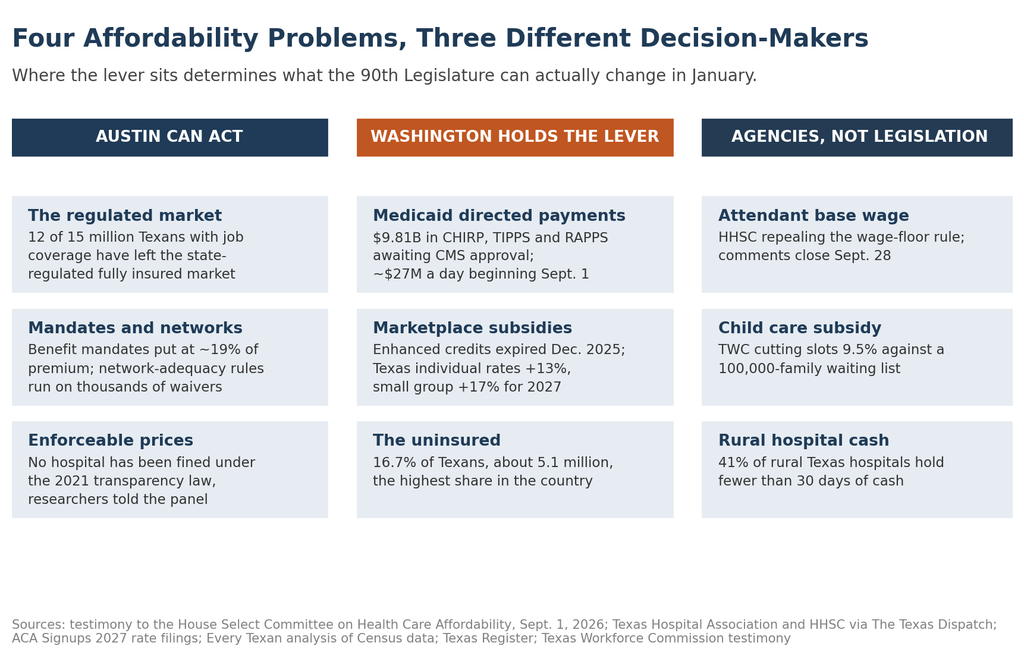
That distinction — between the affordability problems the 90th Legislature can actually reach and the ones it can only respond to — is the most useful frame for what is coming. The opportunity is real. It is also narrower and more specific than the size of the response Texans expect.
The mandate is unusually clear
Texas 2036’s tenth Texas Voter Poll, conducted by Baselice & Associates Aug. 22-26 among 1,369 registered voters with a margin of error of ±3.1 percent, found broad agreement at levels state policy debates rarely produce.
Ninety percent said Texans should have the right to know who owns their hospitals, doctors’ offices and health insurers; 5 percent disagreed. Seventy-nine percent favored requiring transparent and binding pricing before non-emergency care, against 11 percent opposed. Eighty-one percent supported more active state regulation of health care mergers to maintain competition — up from 75 percent when the question was last asked in November 2024.
The most striking number is the negative one. Asked about doing nothing, 61 percent were opposed and 18 percent in favor, making inaction the least popular option tested.
The consensus has edges though. Support narrowed sharply for government price controls, and voters split almost evenly on single-payer. Charles Miller, Texas 2036’s director of health and economic mobility policy, framed that as latitude rather than confusion: “Voters aren’t demanding one particular solution. They are giving state leaders room to work.”
What Washington is holding
The week’s biggest health care funding story was not on the committee’s agenda, because it is not the committee’s to solve.
Three Texas Medicaid programs — CHIRP for hospitals, TIPPS for physician groups and RAPPS for rural health clinics — were set to move $9.81 billion in the fiscal year that began Sept. 1, according to HHSC figures compiled by the Texas Hospital Association. The hospital program alone accounts for $9.15 billion. None of it is flowing, because the Centers for Medicare and Medicaid Services has not signed off.
The dispute is not about whether Texas hospitals qualify. It is about how local taxing districts wrote their ordinances — CMS has questioned the grouping of multi-county districts and the practice of taxing total patient revenue rather than separating inpatient from outpatient. The exchange has run since December 2025, through eleven rounds of questions and two days of in-person meetings in Baltimore in July. Governor Greg Abbott escalated it to federal health leadership in August, writing that “the tax structure previously enacted by the Texas Legislature, and being implemented daily by local governments, fully complies with federal law. What CMS is requesting does not,” and characterizing the standoff as a $12 billion “gun to the head.”
The real-time consequences are concrete for local health districts. Harris Health stands to lose at least $258 million. Forty-one percent of rural Texas hospitals hold fewer than 30 days of cash. Texas Hospital Association chief executive John Hawkins put it plainly: “No industry can withstand $27 million in losses per day.” There is precedent for resolution — Florida spent close to a year in the same standoff before federal officials approved roughly $8 billion for its hospitals on April 30 — but even a favorable ruling carries at least a 90-day claims backlog.
The second federal lever is the individual market. Enhanced Affordable Care Act subsidies expired in December 2025 when Congress declined to extend them. Texas insurers have proposed average 2027 increases of about 13 percent in the individual market and 16.9 percent in small group, consistent with the roughly 14 percent median KFF found nationally. Texas enrollment has already fallen about 4 percent, from roughly 3.42 million to 3.28 million.
Underneath both sits the structural fact the committee’s own hearing notice acknowledged: 16.7 percent of Texans — about 5.1 million people — were uninsured in 2024, the highest share in the country.
What Austin is holding
Set the federal column aside and a narrower agenda comes into focus. It matches the committee’s interim charges — and the Sept. 1 testimony gave it unusual specificity.
The market Texas regulates is the one employers are leaving. Blake Hudson, vice president of public affairs at the Texas Association of Health Plans, told members that of the roughly 15 million Texans with employer coverage, about 80 percent are no longer in the state-regulated fully insured market. “The other 12 million have left it, and they’re fleeing it as fast as possible,” he said. Asked why plans cannot steer patients toward lower-cost providers, Hudson said: “You can’t do any of that. It’s just been regulated out of existence.”
His specifics are verifiable claims lawmakers can test. Texas network-adequacy standards, he said, are “roughly double the size of what the federal ACA requirements are,” and compliance now runs on waivers — the state’s largest PPO going from about 2,500 statewide to nearly 9,000 under newer rules. “Not a single insurer can be compliant with the new law. They all had to get waivers.” He put benefit mandates at “about a 19% difference in the cost of their monthly premiums.” Price-based steering, he noted, is barred in the fully insured market and permitted in the self-funded one — which is a plausible account of why employers keep moving.
The mandate figure is an industry estimate and should be treated as one; providers and patient groups argue mandates cover care that would otherwise be denied or shifted onto families. But the underlying question is squarely Texas’s, unlike almost everything in the federal column. Hudson put the tradeoff to members directly: “Members, you kind of want to have it both ways here. Like, do you want us to get tough on prices? Do you want us to move away from networks? We can do that. But you have to let us do it.”
Two private innovators in the insurance business argued the network model itself is optional. Patrick Quigley, chief executive of Sidecar Health, described a plan that pays a benchmark amount per service and lets members keep half of any savings when they choose a cheaper provider. “If they choose a provider that charges more, they pay the difference,” Quigley said. He reported emergency room admissions 45 percent lower among members and primary care use 11 percent higher, and made the sharpest version of the argument on offer: “The reason we have regulations around network adequacy is because networks by definition are inadequate.”
Fred Turner, chief executive of Curative, described what it costs to try: roughly 14 months to obtain a license and a “$27 million commitment just to pass go.” He said some insurer-owned hospitals “have refused to contract with us at even double the going market rate,” and pointed to an asymmetry in Texas law — the state has any-willing-provider requirements with no counterpart for payers. “There is no equivalent for payers. There is no any willing payer.”
Members were receptive in ways that preview what might be filed in the 90th legislative session. Rep. Daniel Alders, R-Tyler, said of provider networks: “I’m not hearing any good argument for keeping them around.” Rep. Tom Oliverson, R-Cypress, committed publicly to working with Turner on counting cash-card payments toward coverage requirements.
The panel was not uncritical of insurers though. Chair James Frank, R-Wichita Falls, questioned whether deductibles give patients any reason to compare prices — “You could have a place that’s $40,000 and another that’s $20 for the exact same thing” — and observed that insurers “by and large, make more money when the spend is higher. It’s like the house in Vegas no matter what.”
Transparency, and the enforcement gap. This is where voter consensus is strongest and where Texas has the most instructive record. The state passed two laws in 2021: House Bill 2090 created an all-payor claims database at UTHealth Houston and required machine-readable price files starting July 1, 2022, and Senate Bill 1137 set hospital price-transparency requirements carrying significant fines.
Vivian Ho of Rice University’s Baker Institute told the committee she is not aware of a single hospital being penalized. “As far as I can tell, no hospitals have been fined,” she said. She offered a sample of Houston prices for gallbladder surgery: $3,774 at one hospital, $5,872 at another, $11,200 at a third. Oliverson said the law has “extremely stiff penalties” but that “it’s probably not being enforced. I’m going to take that up with the agency.” Rep. Shelley Luther, R-Tom Bean, noted that physicians “say we love transparency but they’re not doing it.”
The database has its own problem. Oliverson said the cost of accessing the HB 2090 data “is actually not nominal. It’s actually substantial. If that data is not accessible to researchers, what are we even doing?” Rep. Jay Dean, R-Longview, said the committee is “already looking into that now.” Hudson separately noted that the Texas Department of Insurance has not finalized rules implementing shared-savings provisions passed last session.
That is a more useful finding than five years of debate about whether to require disclosure. Texas already requires it. What it has not done is enforce it, price access to it, or make published prices binding — and the poll suggests voters are already there, with 79 percent wanting prices that hold before care is delivered rather than files posted after.
One state plan is testing whether incentives work at all. The Teacher Retirement System told members its TRS-ActiveCare rewards program, capped at $600 per household, has paid out $4 million and saved the plan $17 million. Chief Health Officer Megan Bludau said TRS hopes to expand facility tiering “even in the next plan year.” Frank’s response pointed at the obvious next step: “If you’ll go here, you can pay $1,000. But we don’t do that. I just don’t know why.”
What is being decided without a vote
A third category does not appear in the committee’s charges at all, because it is moving through rulemaking and budget execution rather than legislation. Both items land on the workforce that delivers care.
On Aug. 28, HHSC published five linked rule changes in the Texas Register repealing the base wage rule for personal attendants and striking every cross-reference to it, including the home-care requirement that an attendant’s hourly rate “must be at least the base wage.” The agency’s position is that the rules are obsolete: Budget Rider 23 replaced the per-worker floor with a funded average attendant base wage effective Sept. 1, 2025, so the repeal conforms the rulebook to a policy the Legislature already changed. The agency’s fiscal note asserts no economic cost to anyone and no change in the number of people affected.
That assertion is the part worth testing, and the comment period closing Sept. 28 is where to test it. A per-worker floor and a funded average are not the same instrument, and the difference matters most at the bottom of the wage distribution — in a workforce serving Texans whose alternative to home care is institutional care the state pays more for.
The second item surfaced by accident. At an Aug. 26 hearing of the House Committee on Trade, Workforce & Economic Development, the Texas Workforce Commission described a subsidy program serving 117,000 families. Two hours later — after the agency panel had been excused — Texas Licensed Child Care Association president Tim Kaminsky told members TWC had just announced a 9.5 percent reduction in children served, covering the rest of 2026 and all of 2027. “At a time when the waiting list already exceeds 100,000,” he said.
Chair Angie Chen Button told the commission Texas is asking Dallas County alone to serve 1,604 fewer children a day and requested an official analysis. The committee had not received it when the hearing closed. Early Matters Texas executive director Wendy Uptain noted that families already pay an average of $14,000 a year for one child — “more than tuition at UT” — and that eight state agencies touch child care with no single owner.
Child care is not conventionally filed under health care affordability. It belongs there for the same reason attendant wages do: both are household costs of care, and both are being set right now by agencies rather than by the body voters are telling to act.
The opening, stated precisely
The rural hospital numbers make the stakes legible. Twenty-one rural Texas hospitals have closed in the past decade, more than any other state. The 89th Legislature responded with House Bill 18 and $44 million over two years — real money that is small against a sector where 41 percent of facilities hold under a month of cash and $9.81 billion in supplemental payments is frozen in Baltimore.
That is the shape of the thing. Texas has a public mandate that most policy areas never get, a select committee built to use it, and a January session in which to file. It also has an affordability problem whose largest single line item is a federal approval, whose second largest is an expired federal subsidy, and whose most immediate decisions are being made in the Texas Register while the committee takes testimony.
The opportunity is not diminished by that. It is defined by it. The bills that matter in January will be the ones aimed at what Austin actually controls — mandates and network rules, plan design and market structure, enforcement of transparency laws already on the books, and the appropriations that decide what the state pays the people who deliver care.
Hudson’s challenge to the committee is the honest version of the choice: lawmakers can have tighter network rules or aggressive price steering, and they have been asking for both. Quigley’s is the harder one, because it questions the premise underneath twenty years of Texas insurance regulation — that a network is what makes coverage adequate.
What to watch
Sept. 9 and after: Whether CMS moves on the current-year directed-payment application. Every day without approval is roughly $27 million, and a favorable ruling still leaves a 90-day claims backlog.
Sept. 28: Comments close on the HHSC attendant base wage repeal and on the eleven Early Childhood Intervention rulemakings published the same day. Watch whether anyone contests the “no economic cost” fiscal note.
Nov. 19 and Dec. 1: The Quad-Agency Child Care Initiative commission meets; the governor’s early childhood task force report is due. Also watch whether TWC produces the analysis Button requested.
Fall: The select committee’s interim report. The four charges are a reasonable preview of what gets filed, but the report’s treatment of mandates will signal whether the small-employer fight is about plan design or about benefit requirements.
January 2027: The 90th Legislature convenes. The test of whether the poll mattered is not how many health care bills are filed. It is whether the ones that pass are aimed at levers Texas actually holds.
Sources
- Insurers Tell House Panel Texas Regulated Its Own Health Market ‘Out of Existence’ (Sept. 3, 2026)
- Texas 2036 Poll Finds Supermajorities of Voters Back Healthcare Price Transparency and Competition Reforms (Sept. 2, 2026)
- Texas Hospitals Begin Losing $27 Million a Day as Washington Withholds Medicaid Approval (Sept. 1, 2026)
- House Health Care Affordability Panel to Weigh Plan Design, Small-Employer Coverage and Cost Transparency (Aug. 25, 2026)
- Providers Say Texas Cut Child Care Slots While 100,000 Families Wait (Aug. 29, 2026)
- Texas Moves to Strike the Attendant Pay Floor From Its Home-Care Rules and Says It Will Cost No One Anything (Aug. 28, 2026)
- Texas Legislature Online — Senate Bill 1137 (87R, 2021) and House Bill 2090 (87R, 2021)
- Texas Department of Insurance — Information on Implementation of HB 2090
- House Select Committee on Health Care Affordability, Sept. 1 hearing notice
- Teacher Retirement System of Texas — TRS-ActiveCare rewards program
- UTHealth Houston School of Public Health — Texas All-Payor Claims Database
- Texas House — Select Committee on Health Care Affordability
- Legislative Reference Library — Interim Hearings, Week of August 31, 2026
- Every Texan — New Census Data Reflect Rising Challenges in Texas on Health Insurance, Poverty, and Income Inequality
- ACA Signups — 2027 Rate Changes, Texas
- Peterson-KFF Health System Tracker — How much and why ACA Marketplace premiums are going up in 2027
- Baker Institute — What’s at Stake for Texans Who Rely on Insurance Through the Affordable Care Act?
- Texas Association of Health Plans — Small Employers Are Paying for Texas’s Mandate Problem
- Texas 2036 — Health price transparency: A timeline and explainer
- Texas Standard — Extra Affordable Care Act subsidies are set to expire. Here’s who will be most affected
- Texas Monthly — New Money for Texas Rural Hospitals Isn’t Nearly Enough
- Houston Public Media — Health care is getting more expensive. Texas lawmakers want to understand why (May 1, 2026)
- Houston Public Media — As Texas lawmakers tackle health care affordability, discussions turn to insurance costs (May 4, 2026)
- Texas Health Institute — What the Affordability Hearing Revealed and What Comes Next