
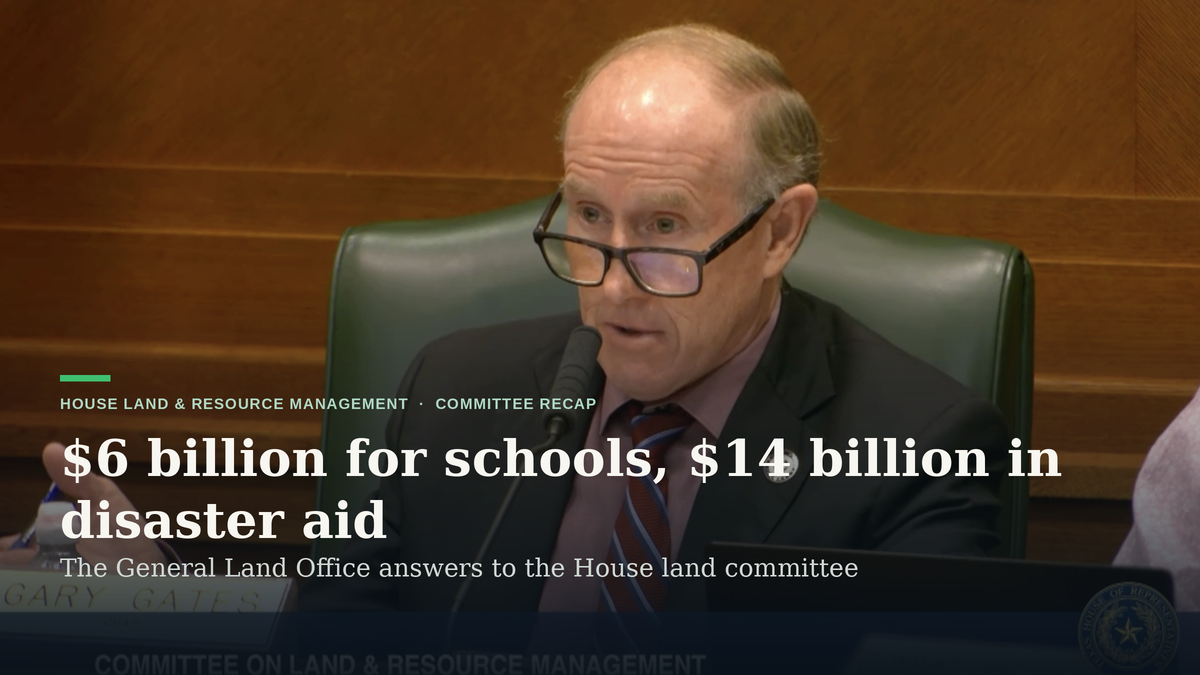
Before it spent the afternoon fighting over municipal utility districts, the Texas House land committee opened Tuesday by auditing the state’s biggest landlord. Officials from the General Land Office walked members through an agency that manages 13 million acres, sends more than a billion dollars a year to public schools, and is still spending down a $14 billion federal disaster-recovery portfolio five years and several storms deep.
The House Committee on Land & Resource Management devoted its first roughly 50 minutes to oversight of the three agencies in its jurisdiction — the General Land Office, the School Land Board and the Board for Lease of University Lands — under the monitoring authority the Legislature assigns standing committees in Section 301.014 of the Government Code, which includes watching for fraud, waste and abuse.
Commissioner Dawn Buckingham did not attend. In her place, Jennifer Jones, the GLO’s chief clerk and deputy land commissioner, led the delegation. “I’m here on behalf of our Commissioner Buckingham, who regrets that she cannot be here today,” Jones told the panel, introducing chief financial officer David Repp and senior deputy director Brian Carter alongside her.
Repp made the education pitch the office lead with. Generating “revenue to the permanent school fund to educate the children in Texas is one of” the agency’s core missions, he said, before laying out the numbers. Since Buckingham took office, the CFO said, the GLO has contributed roughly $6 billion to the Permanent School Fund. The office generated $1.1 billion for the fund in fiscal 2023, has produced about $1.3 billion so far this year, and expects to “generate about $1.6 billion this fiscal year.”
The agency runs on about 800 staff and an annual budget near $1 billion — “mostly federal grant funding,” Repp noted — and its Veterans Land Board “has assisted more than 6,000 veterans and has distributed nearly $2 billion in loans.”
The heaviest single number belonged to disaster recovery. Heather Lagrone, the GLO’s senior deputy director for disaster-recovery programs, told members the office administers the state’s federally funded rebuilding after hurricanes and floods. “The GLO is currently operating [an] approximately $14 billion portfolio that is serving nine separate events and one mitigation program,” she said. “To date, the GLO has expended 70% of our existing portfolio, or just over $10 billion.”
Lagrone used her time to flag a recurring problem with the federal money — that unspent HUD dollars can lapse back to Washington — and to credit two programs with catching it. A “Second Chance” program “has repurposed over $137 million to 37 communities and 15 affordable-housing projects,” she said, and a mitigation reallocation program “will ensure at least another $92 million remains in the state.” Without them, she told members, “more than $229 million would have expired and been returned to the fed[eral government].”
Jones was recalled to brief the committee on the School Land Board, which approves land sales, leases and investments for the Permanent School Fund, before the panel moved to the university lands. Billy Murphy — William Murphy Jr. — introduced himself as “the CEO of University Lands, which is a department of the University of Texas system,” and offered “a brief overview of the board for lease of university lands,” the body that manages oil-and-gas leasing on the West Texas acreage held for the Permanent University Fund.
Chairman Gary Gates, R–Richmond, used the university-lands panel to draw the map for members, teasing apart which lands feed which endowment. He pressed Murphy on how the fund squeezes value out of the ground and beyond it. “Oil and gas generates the most revenue,” Murphy said, but the fund also has “the ability to purchase real estate for investment purposes” to augment it. Gates walked the witnesses through the distinction between the university lands and the GLO’s separate 13-million-acre portfolio — “what you give to the school fund, that’s a totally separate set of leases and land, correct?” — and asked what actually sits on that GLO acreage. Told it is “oil and gas mostly,” a witness reminded him the 13 million acres also “includes mineral acreage and submerged land,” not just surface tracts.
The oversight block drew none of the heat that would fill the room once MUDs came up, and because the committee is meeting in the interim, it took no vote. Its review of the three agencies feeds the same set of interim recommendations headed to the 90th Legislature in January 2027 — a baseline of what the state’s land agencies are earning and spending before lawmakers decide whether any of it needs changing.
Also heard: After closing testimony on the land agencies, the committee turned to its marquee charge — municipal utility districts and their effect on housing affordability — which consumed the bulk of the hearing and is the subject of the companion story. Developers defended MUDs as an affordability tool while homeowners and city officials asked lawmakers for more local control. Tuesday was the second of the committee’s back-to-back sessions, following a Monday hearing on the 2025 housing laws.
The hearing at a glance
Issue
Oversight of the committee’s three land agencies — the General Land Office, School Land Board and Board for Lease of University Lands — under the fraud-waste-abuse monitoring charge. About 50 minutes, or roughly one-fifth of the hearing.
What happened
Invited testimony. GLO officials detailed Permanent School Fund revenue, the Veterans Land Board loan program and a $14 billion federal disaster-recovery portfolio; University Lands’ CEO briefed members on oil-and-gas leasing for the Permanent University Fund. Chair Gates questioned witnesses on how the two endowments’ lands and leases differ. Interim hearing — no vote taken.
When
9:00 AM CT, Tuesday, July 21, 2026 · agency block ran roughly the first 50 minutes of a 3-hour, 46-minute hearing
Where
Room E2.026, Capitol Extension, AustinChairRep. Gary Gates, R–Richmond (HD-28)
Archived video
house.texas.gov/videos/22719