
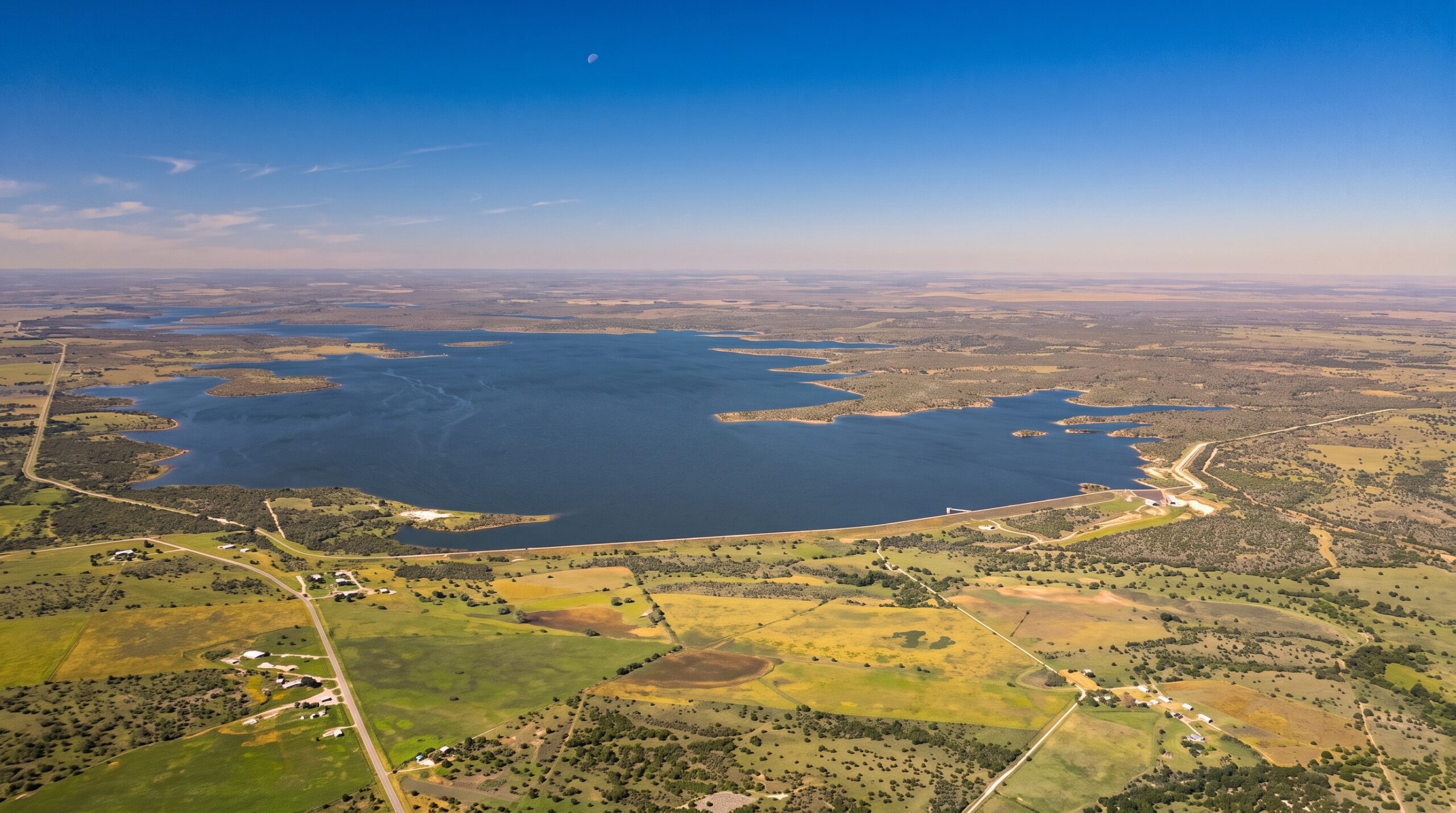
Corpus Christi has asked state environmental regulators for emergency permission to stop sending water down the Nueces River to the bays, days after the rains that rescued its water supply also triggered the legal obligation to release it.
City staff hand-delivered the application to the Texas Commission on Environmental Quality — the state agency that regulates water rights, air quality and waste — in Austin on Aug. 11. City Manager Peter Zanoni’s letter says the request “is necessary to address an emergency affecting the City’s public water supply and to protect public health, safety, and welfare.” The City of Three Rivers and the Nueces River Authority signed on as well. All three hold rights under the order the city is now asking the state to set aside.
At issue is a 1995 agreement, amended in 2001, that governs the two reservoirs Corpus Christi depends on. Under it, once Choke Canyon Reservoir and Lake Corpus Christi together rise above 30 percent of capacity, the city must send a set monthly volume of fresh water through the Wesley Seale Dam into the Nueces Estuary — releases known in the order as “environmental pass-thru.” The point is to imitate the natural river flow that keeps the bays from turning too salty for the fish, shrimp and oysters that grow there. Below 30 percent, the releases stop.
For roughly a year and a half the reservoirs sat under that line and nothing was released. Then the water came back. Lake Corpus Christi stood at 91.4 percent full on Aug. 19, according to Water Data for Texas, the reservoir monitoring service run by the Texas Water Development Board, the agency that plans and finances state water supply. Choke Canyon, the larger and emptier of the two, was at 24.0 percent. Together they held 393,199 acre-feet against a capacity of 918,882 — about 42.8 percent, past both the 30 percent trigger and the 40 percent mark.
Counting Lake Texana, the third reservoir serving the region, the Corpus Christi area was 50.1 percent full on Aug. 19. A month earlier, on July 19, it was 27.5 percent. A year earlier it was 25.3 percent. Regional supply nearly doubled in a month. That runs against the direction of the state as a whole, where drought expanded for a second straight week in mid-August and statewide reservoir storage kept sliding.
The city does not want to spend it though. In its public notice on the application, Corpus Christi said it “is proposing to temporarily suspend pass-thru requirements until the combined capacity of the Western Reservoirs reach 50%.” The request runs about six months, or until that 50 percent mark is hit, whichever comes first. Zanoni’s letter puts the volume the order would otherwise require at 48 million gallons a day.
“30%, 40% combined water levels is not a lot,” Zanoni told KRIS 6 News on Aug. 12. “We should be 50, 60, 70 all the time. So let’s try to hold onto this water as long as we can.”
The city is applying the same logic to its own residents. Crossing 40 percent would ordinarily move Corpus Christi from Stage 2 to Stage 1 restrictions, easing limits on outdoor watering. Zanoni said it will not. “Let’s stay in stage 2,” he said, “because our models show we’re going to be at 40 percent in a couple weeks anyway” — a reference to evaporation and pumping drawing the number back down.
Not everyone agrees the bays can wait. Representatives of the Coastal Bend Bays and Estuaries Program, a nonprofit conservation group that works on Nueces estuary health, have raised concerns about suspending the inflows. Supporters of the city’s position note that the bays showed no fish kills or die-offs attributable to the year and a half without releases.
In April, state Rep. Denise Villalobos, R-Corpus Christi, wrote to the three rights-holders urging them to ask the state to terminate the 2001 order outright. Zanoni replied that the city had hired an outside consultant to study whether it could be rewritten.
The decision now sits with TCEQ. Zanoni said the agency’s executive director can approve the request administratively, but that the commissioners would then need to ratify it — “and that could be in September.” Until they do, the order stands, and the meter on 48 million gallons a day keeps running.